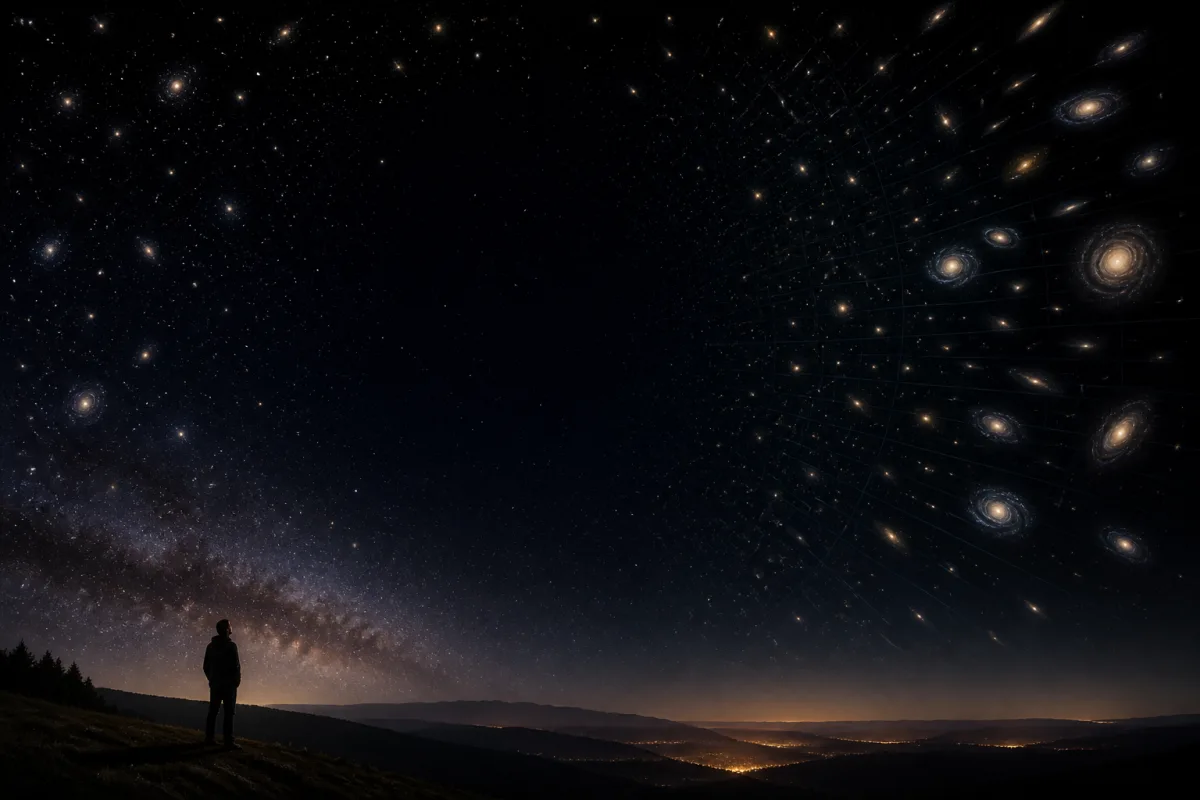
Look up on a clear night and the sky between the stars is mostly black. That seems obvious until you ask a deceptively simple question: if the universe contains an enormous number of stars, why is every direction not filled with light?
The question is known as Olbers’ paradox. It is not solved by saying that stars are spread too far apart. In an infinite, eternal and unchanging universe, every line of sight would eventually end on a star. The sky would be bright from horizon to horizon.
The old universe imagined by the paradox
Imagine the stars arranged through an endless forest. A path in any direction will eventually meet a tree. In the same way, if stars filled an infinite universe that had always existed, a line from Earth would eventually reach a stellar surface.
Individual distant stars would look faint, but there would be vastly more of them in the larger shells of space. The increase in the number of stars would balance the fall in brightness with distance. In that simplified universe, the night sky could not remain dark.
Dust is not a complete answer either. Dust can block visible light, but it absorbs energy and warms up. Over enough time it would glow in other wavelengths. A permanent darkness would still be difficult to maintain in a static, endlessly old cosmos.
The universe has an age
The real universe is not infinitely old. It has a measurable history, and light travels at a finite speed. We can see only the regions whose light has had time to reach us since the hot, dense early universe.
That limit is one reason the sky is dark. Some stars and galaxies exist beyond the part of the universe we can observe, while light from other distant objects has not had enough time to arrive. The observable universe is a horizon set by time as well as distance.
Expansion stretches ancient light
The universe is also expanding. As light crosses expanding space, its wavelength is stretched toward the red and infrared parts of the spectrum. A distant galaxy can have emitted visible light, but by the time that light reaches us its energy may be spread over longer wavelengths.
This does not make the light vanish. It changes where the energy appears and reduces the amount arriving in any one band. Much of the universe’s ancient radiation is too faint or too red for human eyes, even though telescopes can detect it.
That is why the 93-billion-light-year size of the observable universe does not mean every part of it should look bright. The figure describes the region from which light can reach us today, not an infinite wall of stars packed at equal brightness.
Space is not empty between the stars
The black areas contain light. Space telescopes routinely detect faint galaxies, microwave radiation and infrared glow in places that look empty to the eye. Human vision is sensitive to only a narrow slice of the electromagnetic spectrum and needs a certain brightness before it registers a signal.
Long exposures reveal a sky that is crowded with galaxies. The Hubble Deep Field showed thousands of distant galaxies in a patch of sky that appeared nearly blank. Darkness is therefore not the absence of structure. It is often the limit of our eyes and the faintness of the light.
Why the answer is not simply “the universe is expanding”
Expansion is important, but it is one part of the answer. A finite cosmic age limits the volume we can see. Expansion changes the energy and arrival rate of ancient light. The evolution of stars and galaxies also matters: the universe has not been shining at the same rate throughout its history.
The dark sky is a record of all three facts. The cosmos began in a hot state, has been changing for billions of years and is not visible beyond its observational horizon. A static universe would produce the paradox; the universe we inhabit does not meet the paradox’s assumptions.
A practical test from your own backyard
Compare a bright star near the horizon with one high overhead. The lower star often flickers because its light crosses more moving air. That atmospheric effect is separate from Olbers’ paradox, but it is a useful reminder that the sky we see is shaped by both the source and the journey of the light.
The next time the night looks empty, remember that the darkness is not a blank wall. It is the visible edge of a universe with a finite age, changing distances and more light than our eyes can collect.