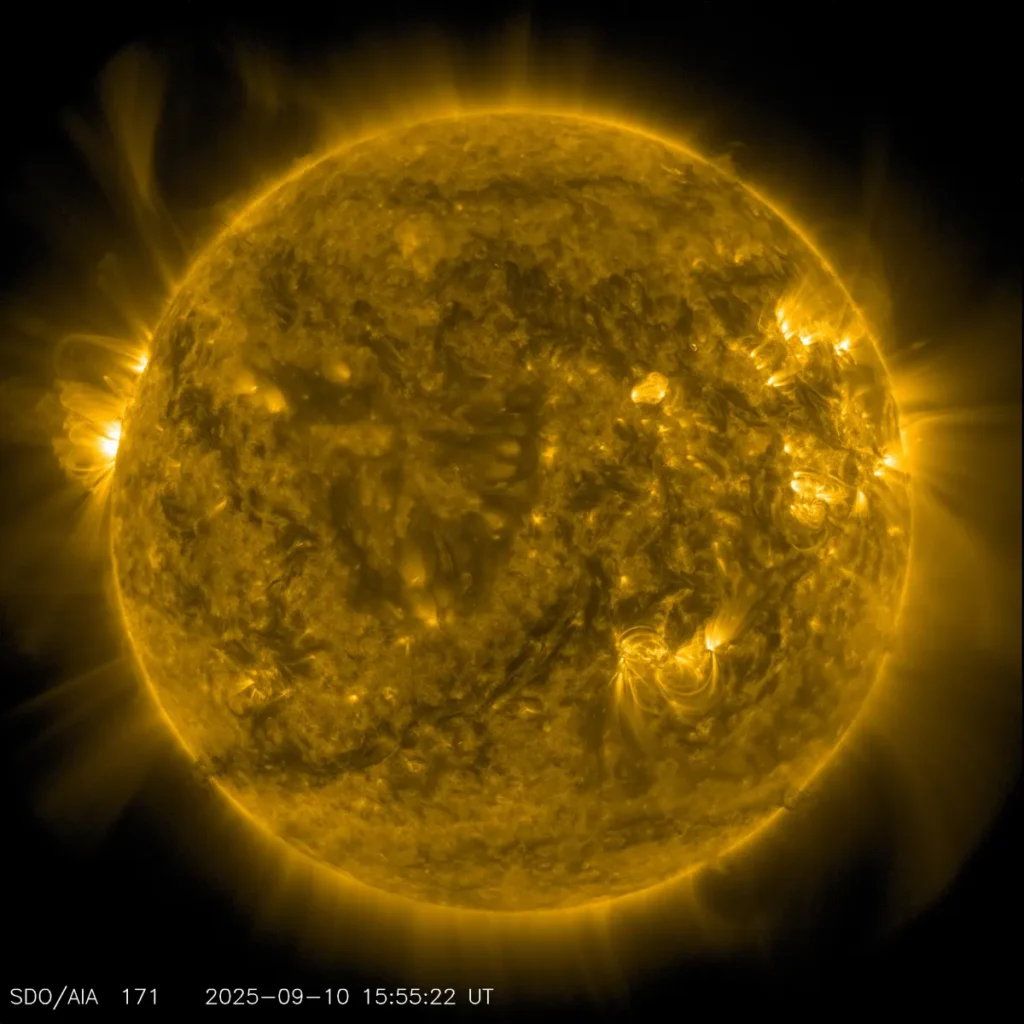
The Sun shines because nuclear fusion is taking place in its core. Under immense pressure and a temperature of about 15 million degrees Celsius, hydrogen nuclei join to form helium. A small amount of mass is converted into energy, which eventually reaches the surface as sunlight and heat.
The Sun is not burning like a fire on Earth. A chemical fire needs oxygen and releases energy by rearranging atoms. The Sun’s power comes from changes inside atomic nuclei, a far more energetic process.
Gravity creates the conditions for fusion
The Sun contains mostly hydrogen and helium and holds more than 99 percent of the Solar System’s mass. Its gravity pulls the gas inward, compressing the core until the density and temperature are high enough for hydrogen nuclei to collide and fuse.
Hydrogen nuclei are positively charged, so they repel one another. In the Sun’s core, a small number get close enough for the strong nuclear force to bind them. Quantum mechanics also matters: the reaction can occur even when a classical calculation would say the particles do not have quite enough energy to overcome the repulsion.
Four hydrogen nuclei become one helium nucleus
The main reaction chain in the Sun begins with protons, the nuclei of hydrogen. Through several steps, four protons become a helium nucleus, while energy and other particles are released. The helium nucleus has slightly less mass than the four starting protons. The difference appears as energy, following Einstein’s relation between mass and energy.
Only a tiny fraction of the Sun’s mass is converted at any moment, but the core contains an enormous amount of hydrogen and has been carrying out the reaction for about 4.6 billion years. NASA estimates that the Sun has roughly another five billion years of main-sequence life ahead of it.
How energy moves outward
Fusion energy begins as high-energy photons and particles in the core. It does not travel in a straight line to Earth. Photons are absorbed and re-emitted countless times in the radiative zone, losing energy through the process. Farther out, hot plasma moves energy through convection.
At the photosphere—the layer we see as the Sun’s surface—the energy escapes as visible light, infrared radiation and other wavelengths. The journey from the Sun’s core to the surface is slow, while the final trip from the surface to Earth takes about eight minutes and 20 seconds.
Neutrinos provide another check
Fusion also produces neutrinos, nearly massless particles that pass through the Sun and reach Earth within minutes. Unlike light, they rarely interact with matter, so detectors can observe them as a direct trace of reactions in the core. The measured neutrino signal matches the picture of hydrogen fusion and helped resolve an early disagreement between theory and observation.
The Sun’s light and its neutrinos therefore carry different messages. Photons spend a long time moving through the star before they escape, while neutrinos cross the interior almost immediately. Together they let scientists test both the energy source and the conditions deep below the visible surface.
Curiosmos has examined the Carrington Event and the Sun’s effect on Earth. Space weather concerns the outer atmosphere, but it begins with the same star whose core powers every layer above it.
The Sun’s energy also drives the eruptions tracked by NASA’s PUNCH mission. Fusion supplies the steady light; magnetic fields in the outer atmosphere shape the storms that can travel through the Solar System.
Fusion holds the Sun up
The energy produced by fusion creates pressure that pushes outward. Gravity pulls inward. The balance between those forces keeps the Sun stable for most of its life. If fusion slows, the core contracts; if energy production rises, the star expands. The Sun constantly adjusts around that balance.
This is why a star can shine for billions of years without using up its fuel in a few minutes. The reaction is controlled by the core’s pressure and temperature, not by a flame spreading through the whole star.
What happens when the hydrogen runs low?
Eventually, the core will contain too little hydrogen for the current reaction to continue. Gravity will compress the core, and hydrogen fusion will move into a shell around it. The Sun will expand into a red giant, shed its outer layers and end as a white dwarf.
The Sun’s final stages are described in NASA’s solar facts. Its light will change long before the fuel is exhausted, but nothing about that timetable affects life on Earth today. The Sun is still in the long, steady middle of its stellar life.
The light that makes Earth possible
Sunlight drives Earth’s climate, powers photosynthesis and supplies the energy behind most surface ecosystems. It also shapes the atmospheres and surfaces of the other planets, moons, asteroids and comets.
The next time the Sun looks like a simple bright disk, remember that the light began as a nuclear reaction deep below the visible surface. The warmth on your face is the final, quiet arrival of energy made in a star’s core.