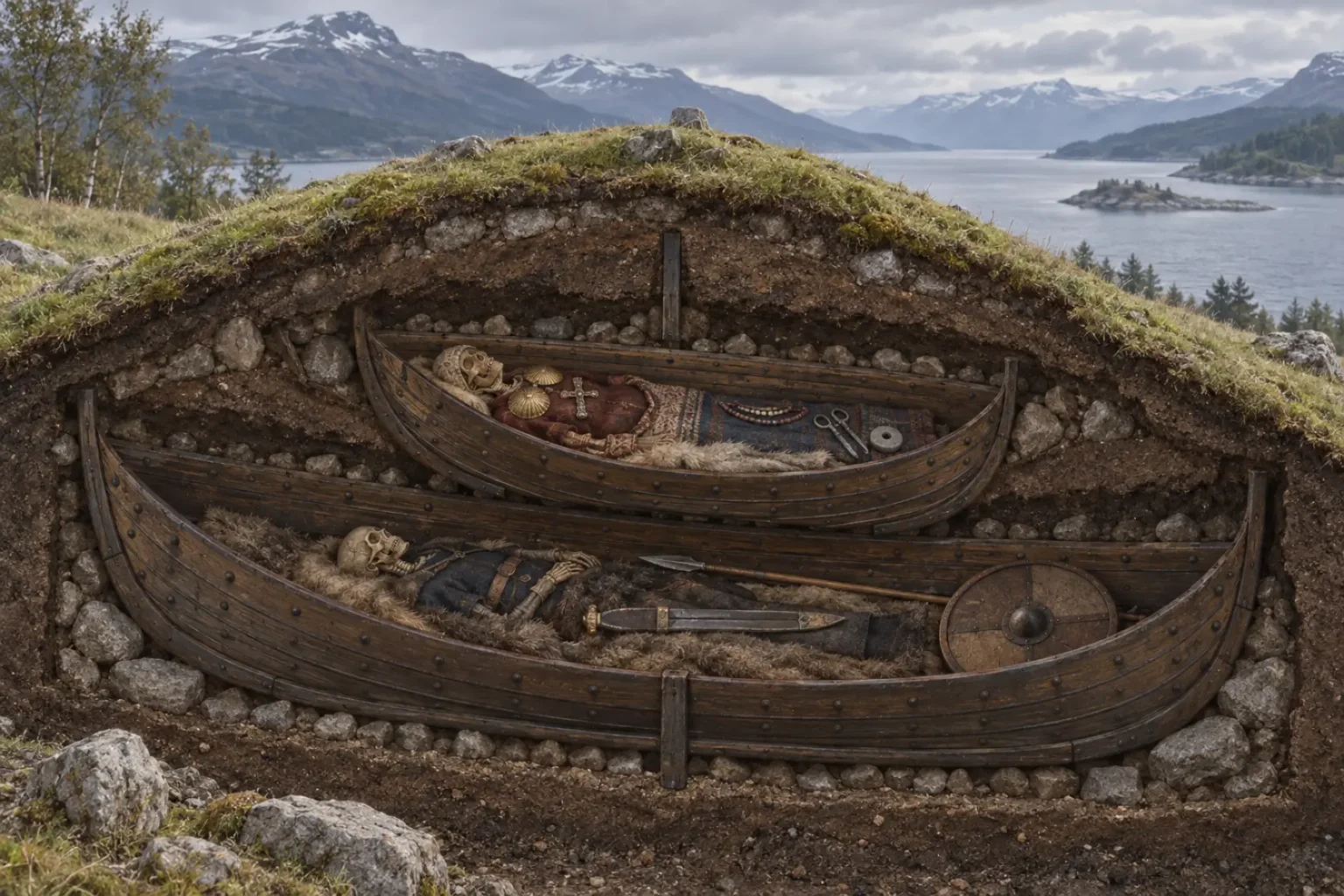
Viking boat graves at Skeiet, near Vinjeøra in central Norway, preserve something stranger than a single burial. A smaller boat burial had been placed inside an older, larger one, even though the two people died roughly a century apart.
The boats had rotted away. What remained were iron rivets, a keel, fragments of bone and the objects that had travelled with the dead. Together, they preserve a question more interesting than a simple mystery: why did a later community return to an earlier grave and build a new burial inside it?
What was found at Vinjeøra?
The later burial belonged to a woman who died in the second half of the ninth century. Her boat was around 7 to 8 metres long. Near her were two large gilded bronze brooches shaped like shells, a cruciform brooch, a pearl necklace, scissors, a spindle whorl and the head of a cow.
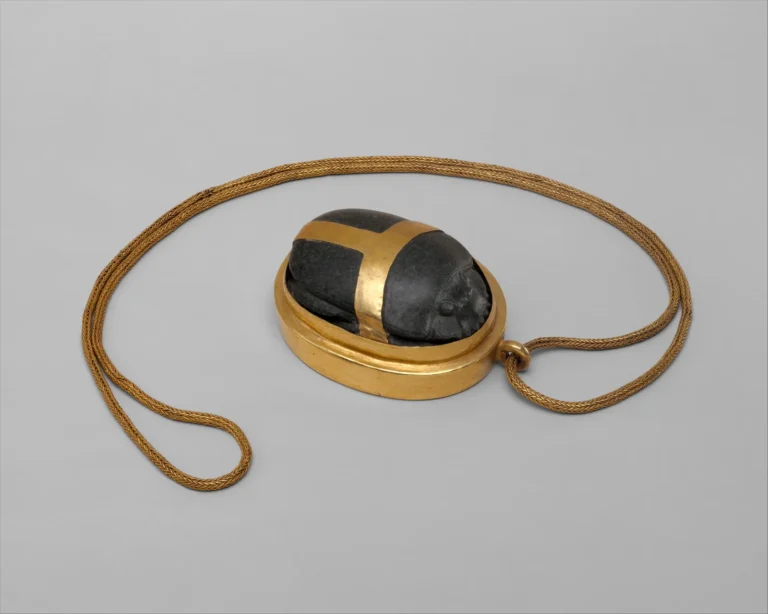
The cruciform brooch had originally been part of an Irish harness fitting. It had been brought back to Scandinavia and reused as jewellery. That small change of purpose is a vivid clue to the movement of people and objects across the Viking world. An object made for a horse or harness in Ireland became part of a woman’s burial in Norway.
Underneath was an older boat grave, probably from the eighth century. It held a man with a spear, shield and single-edged sword. His boat was larger, around 9 to 10 metres long, and had already become part of the landscape before the later burial was made.
How do archaeologists know there were two boats?
There is no intact wooden hull to lift from the soil. The timber disappeared long ago, leaving the metal fasteners and the shape of the construction behind. The surviving rivets and keel lines show that two separate boats occupied the mound, with the later, smaller boat set inside the earlier one.
That distinction matters. A boat grave is not simply a wooden container for a body. Its position, size and relationship to an older grave were choices made by the people who prepared the cemetery. The arrangement tells us that the second burial was connected to the first in some way, even if the exact relationship has been lost.
Why does the century gap matter?
The man and woman were not buried together after a single event. Their graves belong to different generations. The older burial was made in the eighth century, while the woman was laid to rest around a hundred years later.
That gap turns the site into a record of memory. Whoever prepared the later grave had to recognise the earlier one, expose or work around it and decide that it was the right place for another burial. The decision may have connected the woman to the man, to his family or to the rights associated with the land.
Those are possibilities, not a family tree. The surviving remains are too fragmentary to establish kinship, and there is no inscription explaining the choice. Archaeology can show the action clearly while leaving the motive open.
What do the grave goods say about the people?
The woman’s grave combines domestic tools, jewellery and objects that point to long-distance contact. The spindle whorl and scissors belong to the practical work of making and maintaining textiles. The brooches and pearls tell us how clothing was fastened and displayed. The reused Irish fitting adds a story of travel and exchange.
The man’s weapons give a different impression, but they should not be treated as a complete biography. A spear and shield are statements made in a burial context. They tell us how the community chose to present him, not everything he did while alive.
The same caution applies to the woman. A spindle whorl does not reduce her life to textile work, and a sword does not prove that the man spent his life fighting. Grave goods are selected memories: evidence of identity, status and relationships filtered through the ritual of burial.
Could the two people have been related?
Raymond Sauvage, who studied the Vinjeøra burials, has suggested that the later grave may have been connected to family memory and claims to property. A burial placed inside an older monument could have anchored a household’s history to a particular piece of land.
It is an attractive explanation because the site occupies a visible position at the edge of a large mound, overlooking the fjord. The mound itself may have been older still, with origins in the early Merovingian period. A grave in that position was part of a landscape that could be seen, revisited and used to mark belonging.
But the property interpretation remains a hypothesis. The excavation has not produced a document naming the dead or a DNA result proving that they were family. The strength of the evidence lies in the repeated act of burial: a community returned to an old monument and made it meaningful again.
What does the wider cemetery add?
The nested boats were part of a much larger cemetery at Skeiet. Excavations connected with the E39 road project found at least 11 ploughed burial mounds, four cremations, three boat graves and several inhumations. The cemetery was used from roughly 550 to 950 CE.
That long sequence puts the two boats into perspective. The cemetery was not created in a single moment. Its rituals changed over centuries, from cremations to boat burials and later inhumations, while settlement and farming altered the ground around them.
Seen this way, the nested graves are not an isolated curiosity. They are one visible moment in a place where people repeatedly negotiated how to remember the dead.
What remains unknown?
Only small pieces of skull survived well enough to be identified. Researchers hoped that DNA and isotope analysis might reveal more about the two people, including where they grew up and whether they were related. Poor preservation makes those answers difficult.
We also do not know whether the later builders intended to honour the man, claim his status, protect a family connection or make a new statement about the land. Several motives may have overlapped. A burial can preserve a relationship without telling us whether it was affection, ancestry, politics or all three.
That is what makes the Viking boat graves at Vinjeøra so compelling. The visible evidence is precise: two boats, two people, different centuries and a deliberate nesting of one burial inside another. The story around that decision is still open, but it is grounded in a real act of remembrance rather than a legend added later.
Sources and further reading
- NTNU/Science Norway: Unusual Viking boat graves unearthed in central Norway
- NTNU University Museum: 2023 excavation reports, including E39 Betna–Stormyra and Vinjeøra
- NTNU Open: Raymond Sauvage, Ritual Practice at Late Iron-Age and Viking-Age Cemeteries in Norway
- Smithsonian Magazine: Context on the nested boat graves
For a different view of Viking movement and status, read our report on Denmark’s largest Viking silver hoard.