Tiwanaku’s ceremonial landscape
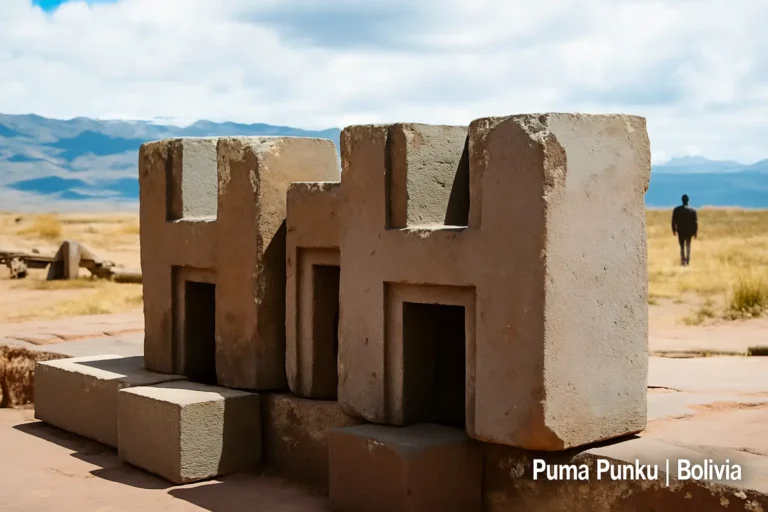
Puma Punku belongs to the monumental centre of Tiwanaku, near Lake Titicaca in Bolivia. UNESCO’s site record describes a settlement that developed into a planned city between 400 and 900 AD, with precisely carved stone buildings and underground drainage.
Its protected remains include the Akapana and Kalasasaya as well as Puma Punku. The buildings express the political and religious importance of a culture that influenced a wide area of the southern Andes.


Recording the scattered blocks
Alexei Vranich’s 2018 reconstruction study describes Puma Punku as plazas and ramps arranged around a raised platform. Many architectural pieces are missing, and later alterations complicate their interpretation.
The project modelled 140 andesite pieces and 17 sandstone slabs, using field measurements and archival records. Scaled prints let researchers handle the pieces and test possible joins.


Reconstructing a building
Matching mouldings, insets and stone beds helped the team propose part of an andesite building. Vranich identified architectural parallels at earlier regional sites, including Chiripa and Pucara.
The study also notes that Puma Punku was never completed. Missing blocks, looting and subsequent rearrangements leave limits on reconstruction. The models offer a way to examine possible fits while reducing the need to disturb the surviving stones.


Related reading: pyramid archive coverage, aerial photographs archive.
Join the Curiosmos discussion on Telegram.