Baba Vanga predictions still appear whenever the world feels uncertain. A phrase about a war, a disaster or a powerful country is pulled from an old story and presented as if the future has finally caught up with it. But what if the deeper mystery is not whether one sentence foretold an event? What if it is how a private encounter became a global catalogue of prophecies?
What is actually documented about Baba Vanga?
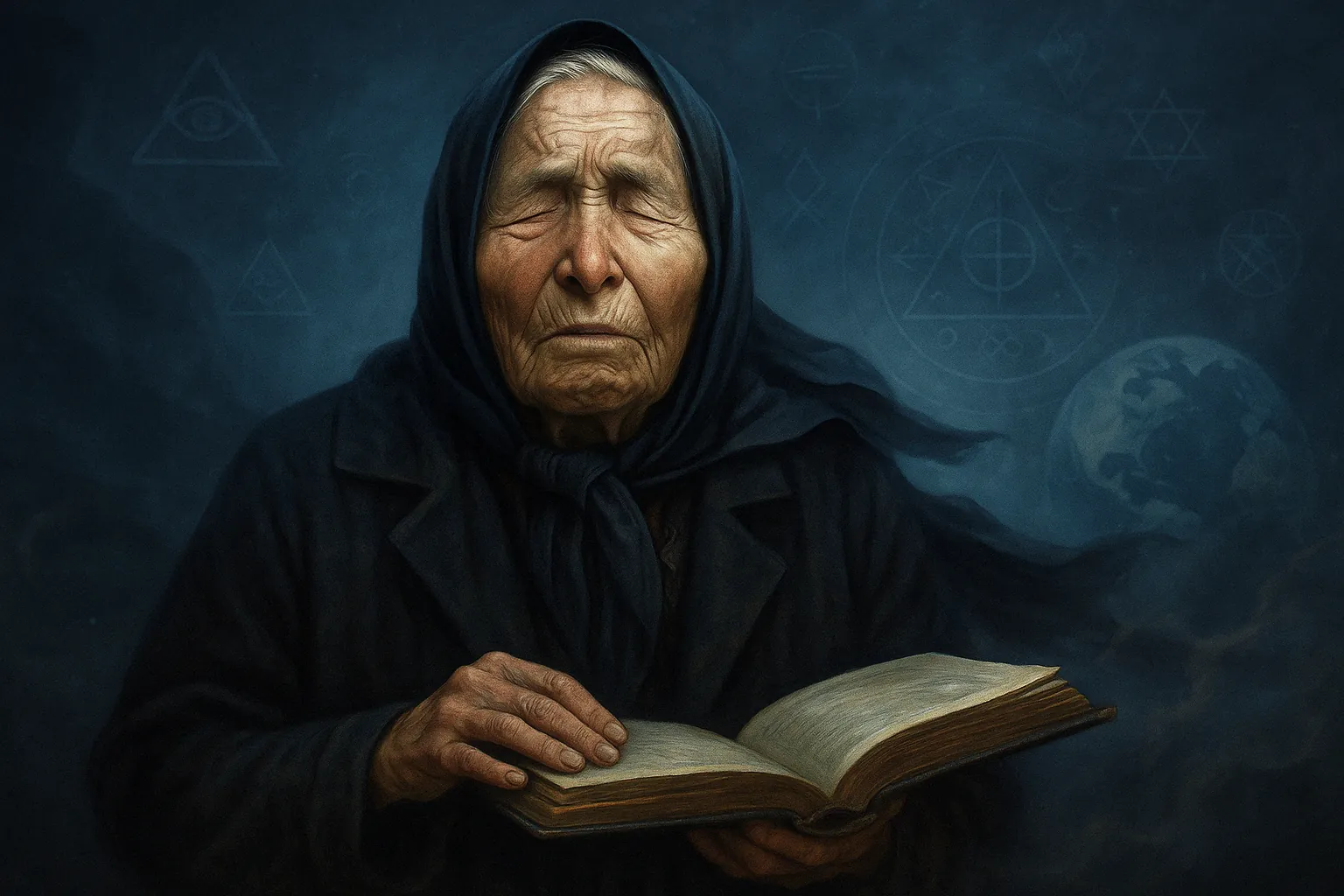
Vangelia Pandeva Gushterova, known as Baba Vanga, became famous in Bulgaria as a healer and clairvoyant. People visited her, remembered conversations and repeated what they believed she had told them. That is a real part of her history. The difficult question begins when a remembered conversation is turned into a precise prediction decades later.
A study in Comparative Studies in Society and History follows that transformation through witnesses, newspapers, books, television and the internet. Its subject is not a simple verdict on Vanga’s abilities. It is the way messages acquire new meanings as they move from one medium and one generation to another.
Keep exploring
Continue with Curiosmos
Why do the same predictions keep returning?
The most famous stories are usually short. One version links “steel birds” and falling towers to the attacks of September 11, 2001. Another connects a line about a vessel being covered by water with the sinking of the Russian submarine Kursk in 2000. Other lists attach her name to wars, economic crises, medical breakthroughs and the future of Russia.
These stories are compelling because they invite the mind to complete a pattern. A phrase that sounds ordinary before an event can seem astonishing after it. Yet a reader needs to ask a simple question each time: where is the dated record of the words, and who first connected them to the event?
That question does not make the story less interesting. It changes the story from a collection of guaranteed forecasts into an investigation of memory, interpretation and belief. A vague image can travel farther than a precise statement because it can be fitted to more than one future.
A recording is not the same as a prophecy list
There is an important distinction between evidence that Vanga met people and evidence that a particular prediction was made before a particular event. In 2023, Radio Bulgaria reported that recordings of séances with Vanga were being digitized through a project involving Bulgaria’s State Agency “Archives.” The recordings matter because they preserve part of the historical setting around her work.
They do not automatically turn every later list into a verified transcript. A recording can document a voice, a visitor and a conversation. To establish a prediction, researchers would still need the original date, the complete wording and a clear chain showing how the claim was preserved before the event it supposedly describes.
What if the legend grew after Vanga’s death?
That possibility helps explain why new “Baba Vanga predictions” appear every year. Online lists often gather old phrases, translations and unattributed quotations, then place them beside the current year. The result looks like a calendar written in advance, even when the trail leads back to a much later article, book or television programme.
The Cambridge researchers describe this process as a history of mediation: witnesses, publishers and viewers do not simply pass along a fixed message. They select, translate, shorten and reinterpret it. In that sense, the modern Baba Vanga legend is also a record of what different audiences hoped, feared or needed to hear.
The unanswered question
Was Baba Vanga a gifted observer, a spiritual guide, a clairvoyant—or a figure whose reputation grew through retelling? The surviving material cannot settle every part of that question. It can, however, show us which claims have a traceable source and which ones arrive as a finished story with no first document attached.
That is where the mystery becomes more revealing. A prophecy is supposed to point from the past toward the future. Baba Vanga’s legend also points in the other direction: from the present back into the past, where each generation searches for a sentence that seems to explain its own moment.