Chandra X-ray Observatory: 20 Images That Reveal an Invisible Universe

Montage of six composite images made with data from Chandra as well as other observatories. Credit: X-ray: NASA/CXC; Optical: NASA/STScI

Most of the universe is invisible to human eyes. The Chandra X-ray Observatory changes that by recording high-energy light from places where gravity, magnetic fields and stellar explosions push matter to extreme temperatures. Since its launch on July 23, 1999, Chandra has helped astronomers study everything from planets in our own solar system to black holes and the hot gas between galaxies.

The pictures below are not ordinary photographs. X-rays are assigned colors and combined, where useful, with visible, infrared or radio observations. The result is a map of physical processes that an optical image alone cannot show.

Artist's impression of the Chandra X-ray Observatory. Credit: NASA / CXC / NGST
Artist’s impression of the Chandra X-ray Observatory. Credit: NASA / CXC / NGST

What makes Chandra different?

Earth’s atmosphere blocks cosmic X-rays, so an X-ray observatory has to work above it. Chandra’s mirrors are shaped so that X-rays skim their surfaces rather than strike them head-on. That unusual design gives the telescope roughly eight times the resolution of earlier X-ray observatories and lets it detect sources more than 20 times fainter, according to NASA.

Keep exploring

Continue with Curiosmos

That sensitivity turns invisible heat and violent motion into something we can inspect. A bright patch may mark shock waves from a supernova; a thin thread may trace magnetized gas; a dark centre can reveal material falling toward a black hole. The color in a composite is a key to the data, not a claim that the object would look that way to the unaided eye.

Planets, stars and the centre of the Milky Way

Chandra’s reach begins close to home. The first image in this group shows Uranus, where astronomers detected X-rays reflected or produced in the planet’s atmosphere. The observation is a reminder that even a cold-looking ice giant can interact with the solar radiation around it.

Earlier this year, astronomers using the Chandra X-Ray Observatory showed this image of Uranus after they detected X-Rays for the first time. The image above includes an X-Ray image by Chandra (in pink) over an optical image from the Keck-I Telescope. Credit: X-ray: NASA/CXO/University College London/W. Dunn et al; Optical: W.M. Keck Observatory

The next composite shifts to the heart of our galaxy. Radio observations outline enormous magnetized structures around the Milky Way’s centre while Chandra reveals the hot, energetic component. Taken together, the data show that the galactic centre is not quiet: it is threaded by fields and outflows that cannot be understood from one wavelength alone.

The magnificent composite image of the Center of the Milky Way, where scientists discovered the new phenomenon. Credit: X-ray: NASA/CXC/UMass/Q.D. Wang; Radio: NRF/SARAO/MeerKAT

Eta Carinae is a massive, unstable star system surrounded by material thrown off in earlier eruptions. Chandra’s X-rays help locate the hottest shocks in that nebula, while optical and ultraviolet light show its shape and dust.

Star system Eta Carinae in the Milky Way, possibly containing the next star in our galaxy to explode into a supernova. This is a composite image with optical and ultraviolet data from Hubble, and X-Rays from Chandra. Credit: X-ray: NASA/CXC; Ultraviolet/Optical: NASA/STScI; Combined Image: NASA/ESA/N. Smith (University of Arizona), J. Morse (BoldlyGo Institute) and A. Pagan

Cassiopeia A, the remains of a stellar explosion in our galaxy, is one of Chandra’s best-studied targets. The expanding shell contains freshly forged elements and fast-moving shock fronts—part of the raw material from which later stars and planets can form.

Advertisement
Supernova remnant Cassiopeia A has been studied by Chandra for decades and has provided incredibe data about this object. Credit: X-ray: NASA/CXC/RIKEN/T. Sato et al.; Optical: NASA/STScI

Supernova remnants: the debris of exploded stars

Supernova remnants are laboratories. Their expanding gas accelerates particles, heats surrounding material and distributes heavy elements through space. Chandra’s images let researchers separate those ingredients and follow how the blast changes with time.

The Cartwheel Galaxy shown here has been observed by several space telescopes including the Chandra observatory. This image is composed of optical data from Hubble and Chandra’s X-ray data (in purple). Credit: X-ray: NASA/CXC; Optical: NASA/STScI

The Cartwheel Galaxy is best known for its ring, created by a collision with another galaxy. In the composite below, X-rays highlight hot gas and energetic sources inside the system while Hubble data supply the familiar visible structure.

Composite image of Cygnus OB2 with X-Ray data from Chandra (red and blue). Credit: X-ray: NASA/CXC/SAO/J. Drake et al; H-alpha: Univ. of Hertfordshire/INT/IPHAS; Infrared: NASA/JPL-Caltech/Spitzer

Cygnus OB2 is a crowded nursery of massive young stars. These stars flood their surroundings with radiation and stellar winds; the X-ray component helps reveal the violence inside a region that would otherwise look like a diffuse cloud of light.

X-ray image of supernova remnant G292.0+1.8 showing the expanding field area after the explosion. Credit: NASA/CXC/SAO

G292.0+1.8 is another supernova remnant, shown here as an expanding field of hot plasma. The chemical fingerprints in such remnants help astronomers reconstruct the star that exploded and the way its debris is mixing with the galaxy.
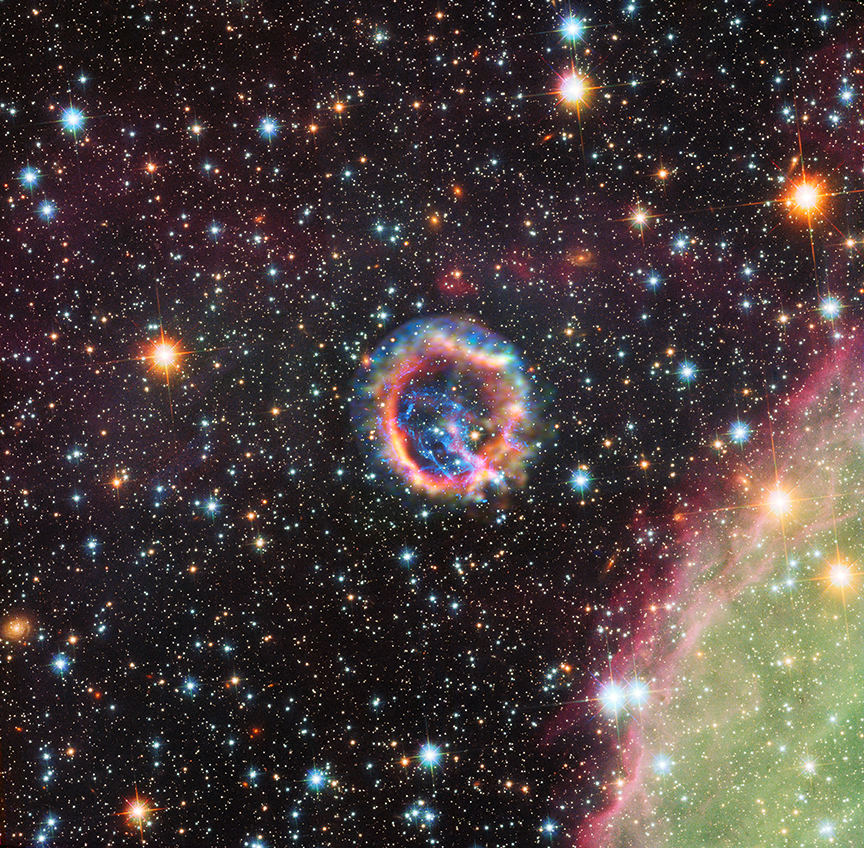
Supernova remnant of a star within the Small Magellanic Cloud. Credit: X-ray (NASA/CXC/ESO/F.Vogt et al); Optical (ESO/VLT/MUSE), Optical (NASA/STScI)

The Small Magellanic Cloud offers a nearby external laboratory. E0102 is the remnant of a stellar explosion, and the combined X-ray and optical view shows both the shocked gas and the larger structure around it.
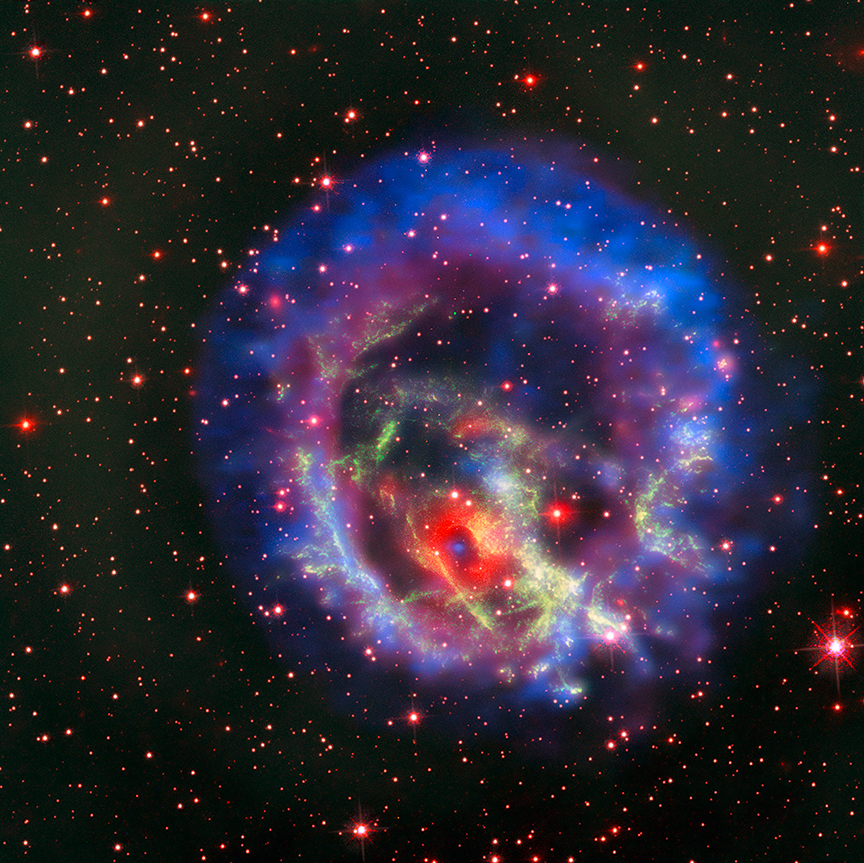
Composite image of neutron star E0102 made with data from the Chandra Observatory and the Very Large Telescope in Chile. Credit: X-ray (NASA/CXC/ESO/F.Vogt et al); Optical (ESO/VLT/MUSE & NASA/STScI)

SN 1006 appeared in the sky more than a millennium ago. Its remnant is still expanding, and the X-ray emission marks the shock where the blast wave accelerates particles.

Supernova remnant SN 1006 shown in this Chandra image. The object appeared more than 1,000 years and has been studied by ancient and Medieval astronomers. Credit: NASA/CXC/Middlebury College/F.Winkler

Kepler’s supernova was observed in 1604. Four centuries later, its remnant still carries the record of that explosion in expanding shells of gas and high-energy radiation.

Remnant of Kepler's supernova, which the famous astronomer discovered in 1604. This is a composite image from optical and X-ray data. Credit: X-ray: NASA/CXC/NCSU/M.Burkey et al; Optical: DSS
Remnant of Kepler’s supernova, which the famous astronomer discovered in 1604. This is a composite image from optical and X-ray data. Credit: X-ray: NASA/CXC/NCSU/M.Burkey et al; Optical: DSS

The Crab Nebula is powered by a pulsar—the rapidly spinning remains of a massive star. The X-ray view traces the energetic wind flowing away from that neutron star and shows why the Crab remains a benchmark object in high-energy astronomy.

Composite image of the Crab Nebula combining X-Ray data from Chandra and optical and infrared data from other observatories. Credit: X-ray: NASA/CXC/SAO/F.Seward; Optical: NASA/ESA/ASU/J.Hester & A.Loll; Infrared: NASA/JPL-Caltech/Univ. Minn./R.Gehrz

Star formation and galaxy clusters

Not every Chandra target is an exploded star. Some images show where stars are being born, or how enormous reservoirs of hot gas behave on the scale of galaxies.

Composite image of the Tarantula Nebula, an active star-forming region close to the Milky Way. Credit: X-ray: NASA/CXC/PSU/L.Townsley et al.; Infrared: NASA/JPL/PSU/L.Townsley et al.

The Tarantula Nebula is a vigorous star-forming region in the Large Magellanic Cloud. X-rays pick out the combined effect of young, massive stars and their winds, while infrared observations see through dust that hides much of the nursery in visible light.

Advertisement
Composite image of a region of the Small Magellanic Cloud called NGC 602 made with X-Ray data from Chandra. Credit: X-ray: NASA/CXC/Univ.Potsdam/L.Oskinova et al; Optical: NASA/STScI; Infrared: NASA/JPL-Caltech

NGC 602, in the Small Magellanic Cloud, contains a young cluster surrounded by clouds of gas and dust. Its X-ray sources help astronomers identify the young stars and understand how a cluster develops in a metal-poor environment.
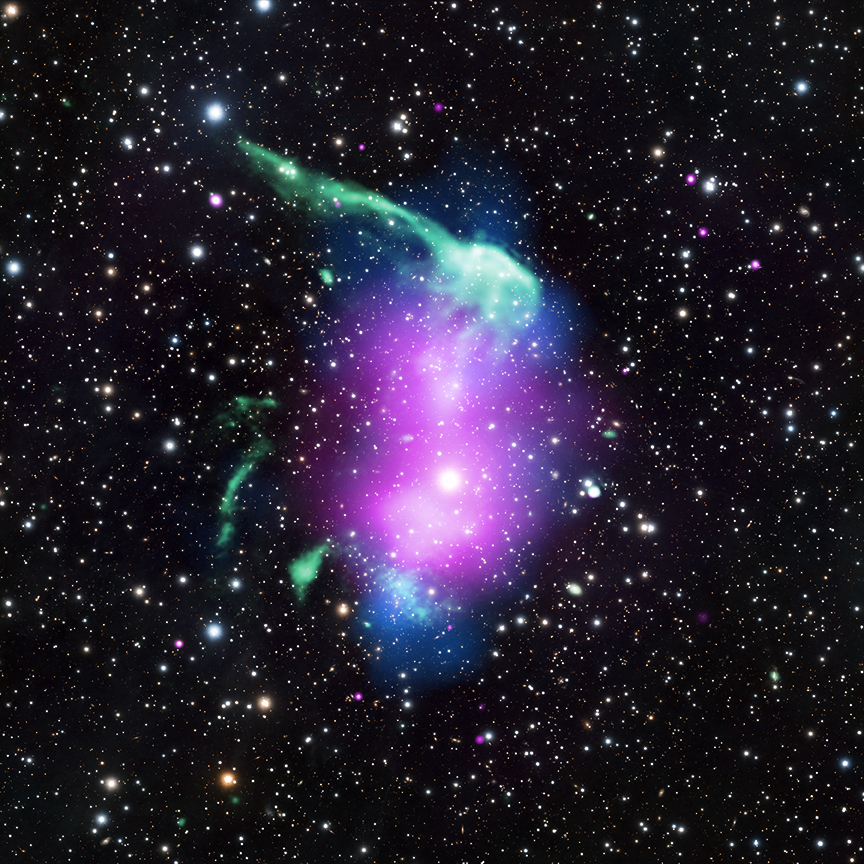
The "Toothbrush Cluster" in a composite image with X-Ray Data from Chandra and visible light data from the Subaru Telescope. Credit: X-ray: NASA/CXC/SAO/R. van Weeren et al; Radio: LOFAR/ASTRON; Optical: NAOJ/Subaru
The “Toothbrush Cluster” in a composite image with X-Ray Data from Chandra and visible light data from the Subaru Telescope. Credit: X-ray: NASA/CXC/SAO/R. van Weeren et al; Radio: LOFAR/ASTRON; Optical: NAOJ/Subaru

The “Toothbrush Cluster” is a collision between large galaxy clusters. The shock front is visible in radio and X-ray data, providing a direct look at particles being accelerated on a scale far larger than a single galaxy.
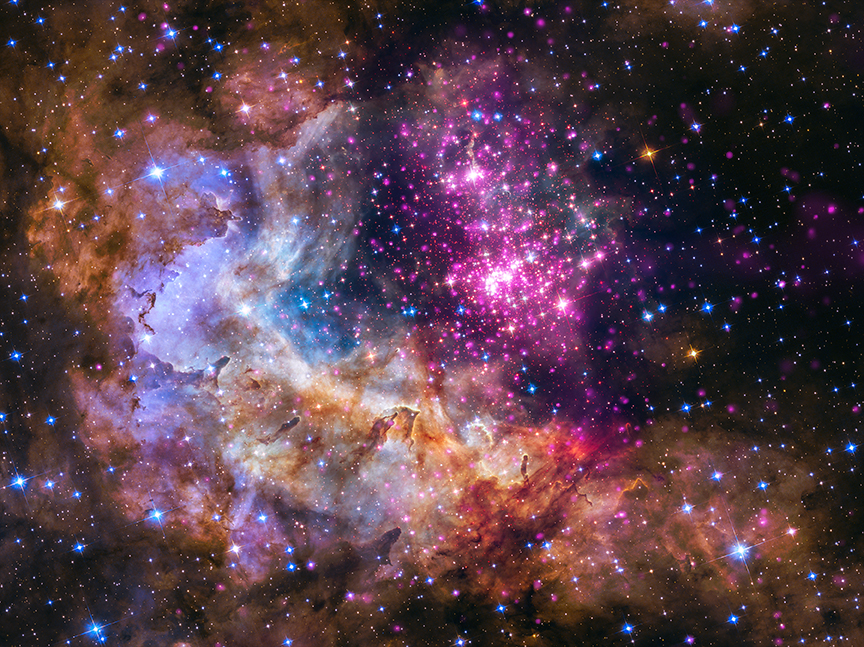
A cluster of young stars about 20,000 light-years from our planet. Credit: X-ray: NASA/CXC/SAO/Sejong Univ./Hur et al; Optical: NASA/STScI

Galaxies, black-hole environments and distant light

Chandra also works at the largest scales. Hot gas and X-ray binaries can expose activity that is hidden in a galaxy’s optical glow, while combined datasets reveal how galaxies grow and interact.

An older composite image of the galactic center. Credit: X-ray: NASA/CXC/UMass/D. Wang et al.; Optical: NASA/ESA/STScI/D.Wang et al.; IR: NASA/JPL-Caltech/SSC/S.Stolovy

The centre of the Milky Way appears again in a wider, older composite. The different layers—X-ray, optical and infrared—are useful precisely because they answer different questions: where the hot plasma lies, where stars are concentrated and where dust blocks the view.

Composite image of galaxies NGC 2207 and IC 2163 which are in the process of merging. The image was made with X-Ray data from Chandra and infrared and optical data from Hubble and Spitzer. Credit: X-ray: NASA/CXC/SAO/S.Mineo et al, Optical: NASA/STScI, Infrared: NASA/JPL-Caltech

NGC 2207 and IC 2163 are two spiral galaxies in the process of merging. Their interaction compresses gas and triggers new sources of X-rays, while infrared and optical data show the tidal shapes carved by gravity.

Image of the famous "Pillars of Creation" made with the help of Chandra. Credit: X-ray: NASA/CXC/U.Colorado/Linsky et al.; Optical: NASA/ESA/STScI/ASU/J.Hester & P.Scowen.
Image of the famous “Pillars of Creation” made with the help of Chandra. Credit: X-ray: NASA/CXC/U.Colorado/Linsky et al.; Optical: NASA/ESA/STScI/ASU/J.Hester & P.Scowen.

The Pillars of Creation are famous from Hubble, but Chandra adds another layer. X-rays identify young, energetic stars inside and around the dusty columns, turning a beautiful silhouette into a record of stellar birth.

The Coronet Cluster which is one of the closest active regions of star formation. Credit: X-ray: NASA/CXC/CfA/J.Forbrich et al.; Infrared: NASA/SSC/CfA/IRAC GTO Team

Why the images matter

Chandra’s most important contribution is not a particular color palette or a single spectacular object. It is the ability to compare the universe in different kinds of light. A supernova remnant, a star-forming cloud and a cluster collision all leave different signatures in X-rays. Read alongside optical, infrared and radio observations, those signatures give astronomers a more complete account of how matter moves, heats, collapses and escapes.

For the mission and its latest results, see NASA’s Chandra mission page and the Chandra X-ray Observatory archive.

Sources

Author profile

Vladislav Tchakarov

Hello, my name is Vladislav and I am glad to have you here on Curiosmos. As a history student, I have a strong passion for history and science, and the opportunity to research and write in this field on a daily basis is a dream come true.