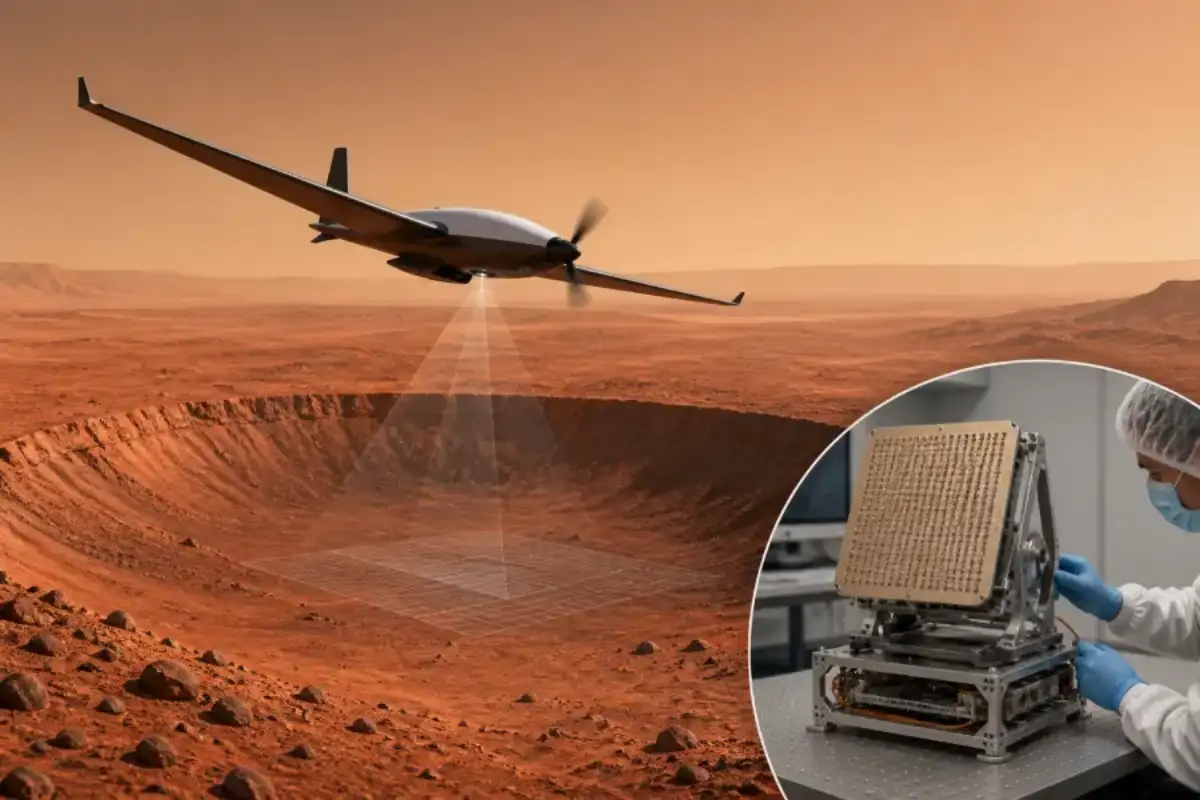
NASA is testing the communications and radar hardware for a proposed Mars aircraft mission called SkyFall. The project is still on Earth, but its engineers are working through the details that would allow three small aircraft to fly in the thin Martian atmosphere and send useful data back to a rover or an orbiter.
A recent test at NASA’s Jet Propulsion Laboratory involved connecting a coaxial cable to a SkyFall antenna inside an electromagnetic-interference chamber. The antenna was pointed upward to reduce reflections while engineers measured how it behaved. That sort of work is not as dramatic as a launch, but it decides whether a spacecraft can communicate reliably once it is millions of kilometres away.
What SkyFall is meant to do
The concept calls for three aircraft, each carrying four instruments. Their job would be to look across terrain from above, helping scientists and rover planners see slopes, channels and obstacles before sending a vehicle into them. Aerial observations could also connect separate outcrops that are difficult to study from the ground.
NASA’s Ingenuity helicopter showed that powered, controlled flight is possible in Mars’ rarefied atmosphere. Ingenuity’s flights also demonstrated a practical benefit: images from the air helped the Perseverance rover team choose routes and science targets. SkyFall builds on that idea with a mission designed around several aircraft and a larger scientific payload.
Why antennas are a serious Mars problem
Every message from Mars has to cross a large distance and arrive at a receiving system that may be moving, rotating or working under strict power limits. A small mismatch in the antenna pattern can reduce the link margin. Electrical interference from other instruments can make the problem worse.
Engineers use test chambers to separate the antenna’s own signal from reflections and background noise. They can then compare the measured pattern with computer models and make changes before the hardware is installed on an aircraft. The work also helps show whether a radar system can produce useful data without interfering with navigation or communications.
A mission still years from launch
NASA says SkyFall is expected to launch aboard the Space Reactor-1 Freedom in late 2028. That is a target, not a guarantee that the aircraft have been approved for flight. Hardware concepts often change as engineers test mass, power, communications and the realities of a launch vehicle.
The important step now is proving that the instruments can work together. Mars aircraft have to survive launch, cruise, entry and deployment before they can make a single image. Testing the antenna on Earth is part of that chain, and it gives the mission team a chance to find weak points while repairs are still possible.
If SkyFall reaches Mars, its biggest contribution may be simple: a view of the planet from just above the ground. That perspective would give rover teams more information before they commit to a route, while giving scientists a wider map of the places they are trying to understand.
Flight on Mars is unforgiving because the atmosphere at the surface is less than one percent as dense as Earth’s. An aircraft has to keep moving fast enough to make lift while carrying batteries, computers, instruments and a radio. A concept that works in a laboratory still has to survive dust, cold nights and the delay between a command sent from Earth and a response from the vehicle.
That is why an antenna test belongs in the story even though it does not produce a photograph of Mars. The mission would depend on a chain of links: the aircraft would send data to a relay, the relay would pass it to a spacecraft or rover, and the information would then travel home. A weak link can turn a successful flight into a silent one. Measuring the antenna early gives engineers a chance to change the design before the rest of the aircraft is built around it.
SkyFall is part of a broader story about how we explore places that are difficult to reach directly. Curiosmos has looked at how distance changes what a space mission can measure.