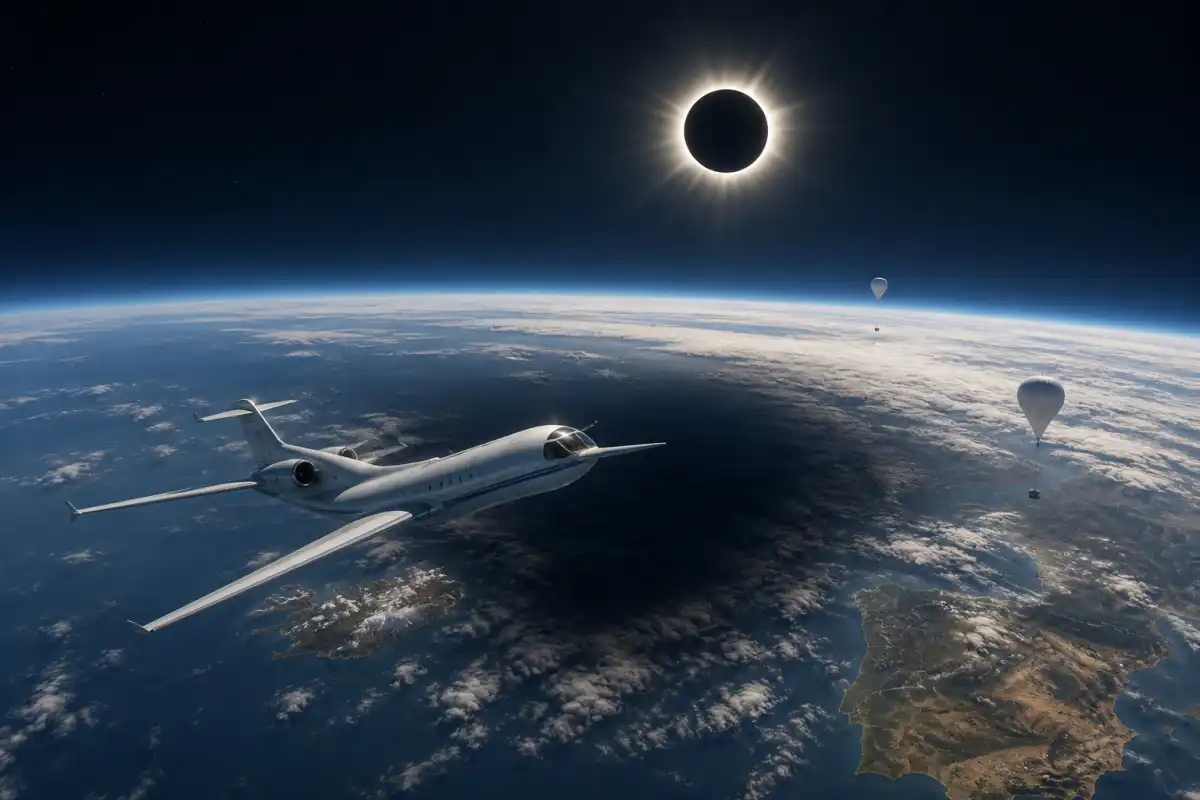
When the Moon’s shadow crosses the Earth on August 12, the darkness will last only a few minutes in any one place. NASA is planning to use those minutes as efficiently as possible. A WB-57 research jet will climb above much of the atmosphere, while student teams launch balloons before, during and after totality in Iceland and Spain.
The eclipse will be total along a narrow path crossing Greenland, Iceland, the North Atlantic, northern Russia, Spain and a small part of Portugal. A partial eclipse will be visible across much of Europe, North America and northwestern Africa. For observers in Zagreb, the event will be partial rather than total, but the science campaign will be looking at the same shadow from several angles.
A jet that can stay inside the shadow longer
NASA’s WB-57 will fly at roughly 50,000 feet, where the air is thinner and the view is less disturbed by clouds and turbulence. The aircraft can also move quickly enough to follow the eclipse. From the ground, totality at the most favorable locations will last less than two and a half minutes. The jet can stretch its observing time to nearly three minutes.
That extra time matters because the corona is changing even while it looks still to the human eye. The corona is the Sun’s outer atmosphere, made of extremely hot, thin plasma threaded by magnetic fields. During totality, the bright photosphere is hidden and the corona becomes visible without the usual glare. NASA’s cameras will record the scene in visible and infrared wavelengths, taking as many as 20 frames per second.
The aircraft is not simply taking a prettier eclipse photograph. The measurements are intended to help researchers follow structures in the corona and study how the Sun’s atmosphere moves energy outward. Infrared observations can also reveal details that are difficult to separate in ordinary visible-light images. Because the jet is moving with the shadow, the team can compare a longer sequence of frames before the aircraft leaves the best geometry.
What the balloons will measure
The eclipse changes the lower atmosphere as daylight disappears and returns. Temperatures, winds and waves in the air near the ground can shift on a short timescale. NASA’s Nationwide Eclipse Ballooning Project is designed to record that response across the hours around totality.
In Iceland, two teams plan to release about 80 balloons from 18 hours before the eclipse until eight hours afterward. The balloons will sample conditions in the boundary layer, the part of the atmosphere that interacts most directly with the surface. In Spain, six balloons will carry 360-degree cameras and instruments for ozone and other atmospheric measurements.
Launching so many balloons creates a time series. Researchers can ask how quickly the atmosphere responds, how far the disturbance travels and how long it takes to settle. Student teams are part of the experiment, which gives the campaign an educational purpose as well as a scientific one.
When to watch
NASA’s live coverage is scheduled to begin at 1:15 p.m. Eastern Daylight Time on August 12. Totality begins in Iceland at about 1:45 p.m. EDT and reaches Spain at about 2:28 p.m. EDT. Local times vary along the path, so viewers should use NASA’s eclipse maps for their exact location and use certified eye protection whenever any part of the Sun is visible.
A total eclipse is a brief visual event. The measurements gathered around it will last much longer. The jet will follow the shadow, the balloons will continue after the sky brightens, and the resulting data will help scientists compare the Sun’s outer atmosphere with the atmosphere below our feet.
If you want a clearer guide to the sky itself, read Curiosmos’ explanation of why stars twinkle while planets usually do not—the atmosphere that complicates ordinary stargazing becomes part of the eclipse experiment.