Vacuum birefringence sounds like a contradiction. A vacuum is supposed to be empty, while birefringence is a property associated with materials such as crystals. In quantum physics, however, empty space can respond to an extremely strong magnetic field and change the way light is observed.
The effect is tiny in ordinary surroundings. Magnetars provide a natural test because their magnetic fields are vastly stronger than any field humans can create on Earth.
Light has an orientation
Light is an electromagnetic wave. As it travels, its electric field points in particular directions. Polarization is the name for that orientation.
When light passes through a crystal, different polarization states can travel at different speeds or follow slightly different paths. The crystal acts as a kind of filter. Astronomers measure polarization in the light from stars, nebulae, and black holes to learn about magnetic fields and the geometry of the source.
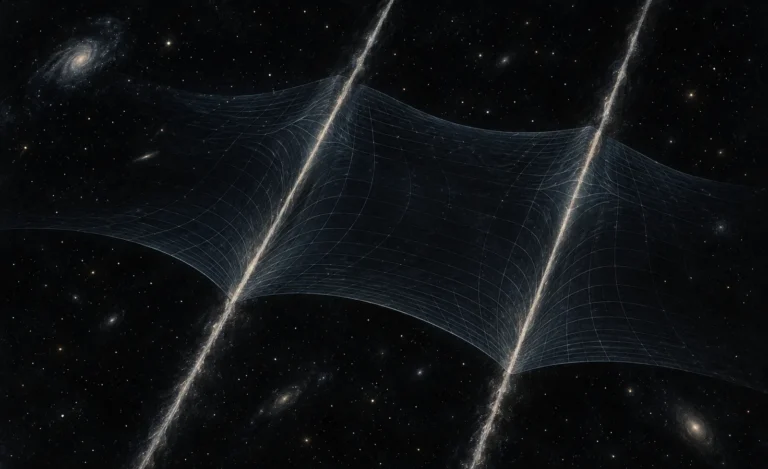
Vacuum birefringence predicts that a powerful magnetic field can produce a similar separation in empty space. The cause is not dust or glass. It comes from the quantum fields that exist even in regions with no ordinary matter.
Why magnetars are the best places to look
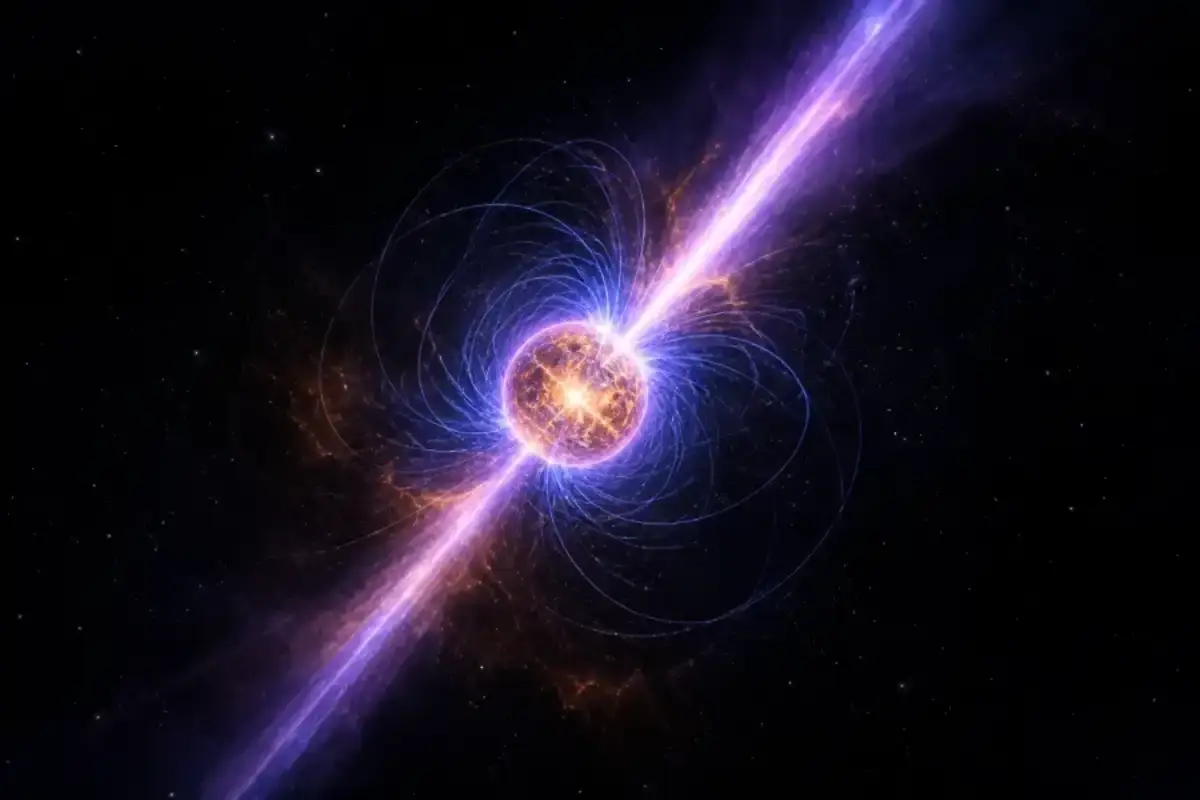
Magnetars are neutron stars formed when massive stars collapse. Their magnetic fields can reach trillions of times the strength of Earth’s field. The stars rotate rapidly and emit X-rays, giving telescopes a changing signal as the magnetic poles move in and out of view.
The combination is useful. If the magnetic field changes the polarization of the X-rays, the pattern should vary with the star’s rotation. Astronomers can compare the observations with models that include the star’s surface and models that include the quantum effect.
NASA’s IXPE measured the magnetar 1E 1547.0-5408 and found unusually high X-ray polarization. The result is consistent with vacuum birefringence and with the idea that the field around the star is acting like a quantum optical medium.
Empty space is not a hidden liquid
It is easy to picture the effect as light moving through an invisible fluid. That picture is useful only as a starting analogy. There is no material filling the space around the magnetar, and photons are not slowed by a conventional substance.
Quantum electrodynamics describes the interaction through fields and virtual particles. Under extreme conditions, the vacuum’s response changes the propagation and polarization of light. The effect becomes measurable because the magnetic field is so intense, not because space has acquired a new material state.
How scientists can test it
One magnetar is not enough. A stronger case would come from observing several objects with different magnetic-field orientations, rotation rates, and surface temperatures. The same effect should appear in a pattern predicted by the geometry of each source.
Future X-ray polarization measurements can also test competing explanations. If the signal changes in ways the vacuum-birefringence model cannot reproduce, another part of the magnetar physics may be responsible.
That is what makes the effect interesting. It links quantum theory to objects that are visible only as faint points of X-ray light. The telescope is not looking into empty space directly. It is reading the small changes empty space leaves in the light that crosses it.
The language can sound abstract, but the measurement is concrete. A detector records the angle and strength of polarization across the magnetar’s rotation. Researchers then ask whether the pattern follows the magnetic geometry expected from ordinary emission or whether it contains the signature predicted by quantum electrodynamics.
If future magnetars show the same effect, vacuum birefringence could become a practical tool for mapping fields that cannot be sampled in any other way. If they do not, the disagreement will still tell physicists something about how neutron-star surfaces and magnetic atmospheres behave.
The prediction also sits at an interesting meeting point between astronomy and particle physics. A neutron star is an astronomical object, but the effect being tested belongs to a theory usually examined with laboratory particles and fields. The magnetar turns the sky into a place where the two areas can be tested together.
For readers, the important distinction is between seeing the effect and understanding every detail of the source. The IXPE result is promising because the polarization follows a pattern that the theory can explain. Further observations are needed before the pattern can be treated as a settled measurement of the vacuum itself.