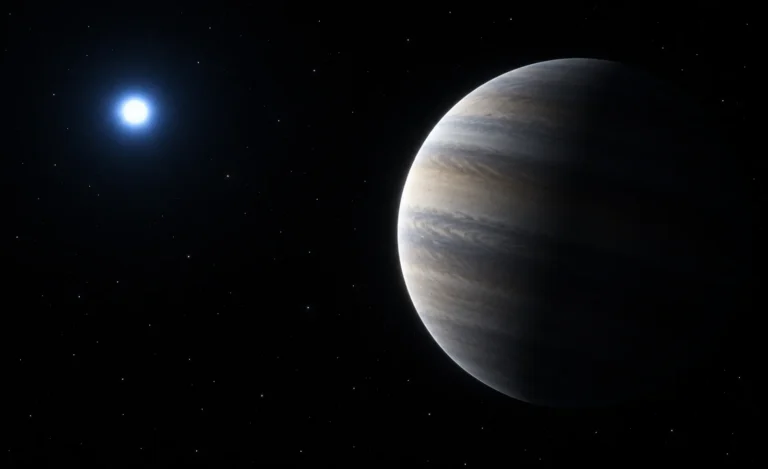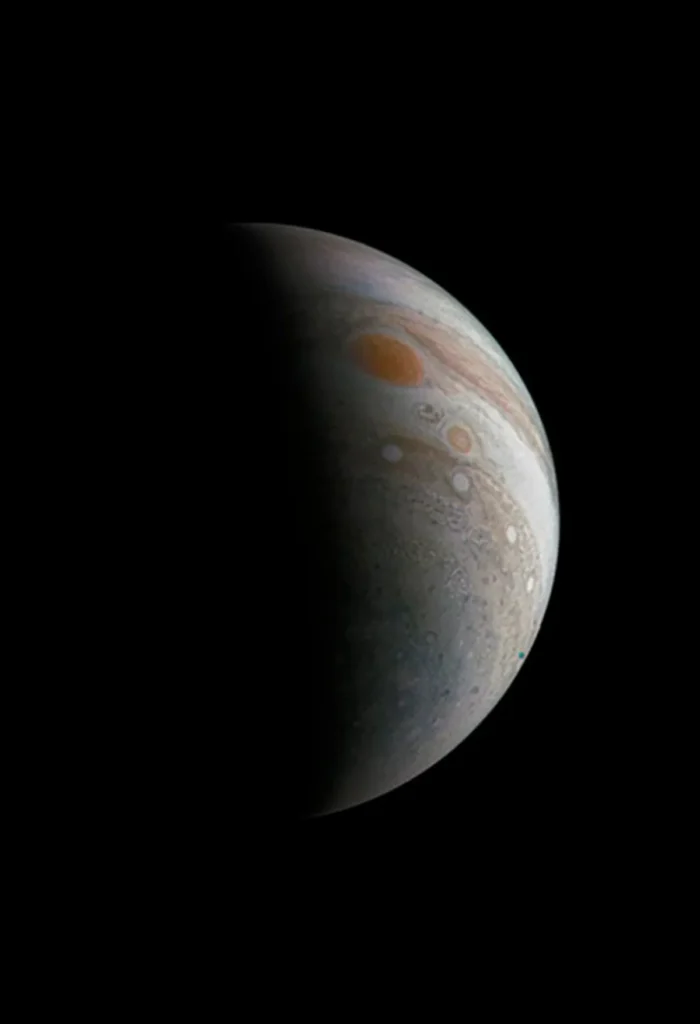
Jupiter’s Great Red Spot is a storm system wider than Earth, turning inside the planet’s cloud tops for centuries of recorded observation. It is not a solid mark on the surface. Jupiter has no solid surface beneath the visible clouds; the spot is a huge, persistent vortex in a deep atmosphere of hydrogen and helium.
Its exact colour has changed over time, and its size has changed too. That is why the Great Red Spot is not a solved picture with one fixed explanation. Scientists know what kind of object it is—a long-lived storm—but continue to study the chemistry and dynamics that keep it visible.
How a storm can last so long
Jupiter rotates once in roughly ten hours, faster than any other planet in the Solar System. The rapid rotation organises the atmosphere into alternating east–west jet streams. These bands limit how far storms can move north or south and help preserve long-lived vortices.
The Great Red Spot sits between powerful jet streams. Its winds circulate around a region of relatively high pressure, and the surrounding bands keep feeding motion into the system. On Earth, storms lose energy when they meet land or friction near the surface. Jupiter’s deep gas layers provide no continent to break the vortex apart.
Why is it red?
There is no single confirmed answer. One leading explanation involves chemicals lifted from deeper levels and altered by sunlight high in the cloud tops. Ultraviolet radiation can break apart molecules, creating compounds that absorb blue light and leave a reddish appearance.
Other models focus on material rising from below the visible clouds. NASA research using Cassini data found evidence that sunlight may help produce the colour, although the chemistry remains an active subject. The red shade can vary from salmon to deep brick, and the spot sometimes appears pale.
It used to be larger
Historical observations show that the Great Red Spot has shrunk in its east–west width over recent decades. The storm is still enormous, but its outline and speed change as it interacts with the jet streams around it.
A shrinking storm is not necessarily a dying storm. The height of the vortex, the strength of its winds and the way energy moves through the surrounding atmosphere matter as much as its visible width. Long-term observations help scientists separate a temporary change from a lasting trend.
Curiosmos has previously looked at Juno’s close views of Jupiter and Ganymede. Images from Juno show that the planet’s clouds are crowded with smaller storms, filaments and waves. The Great Red Spot is the largest and most famous member of that turbulent system.
Older Jupiter photographs make the same point from a longer historical distance. Each spacecraft sees a slightly different atmosphere, and the differences help researchers follow the spot as it changes.
How Juno studies the storm
NASA’s Juno spacecraft uses cameras, microwave instruments and other sensors to look below the visible cloud tops. Microwave measurements can reveal temperature and structure at depths that ordinary photographs cannot reach.
Juno’s close passes also measure the storm’s gravity and magnetic environment. The goal is to understand how deep the vortex extends, how it changes with time and what its circulation says about Jupiter’s interior.
What keeps the vortex alive
The spot sits in a band of atmosphere where winds travel in opposite directions on either side. That shear can feed energy into the vortex, while the planet’s rapid rotation prevents it from spreading like a small storm on a slowly turning world. Smaller eddies may merge with the spot or break away from it, changing its outline without ending the circulation.
Its longevity also depends on depth. A storm that reaches far below the visible clouds has a larger reservoir of moving gas than a shallow feature. Juno’s microwave measurements are valuable because they can test whether the colour and shape seen at the top continue into those hidden layers.
Why Jupiter matters to planetary science
Jupiter is a natural laboratory for atmospheric physics. Its storms operate at scales impossible on Earth, but the same ideas—rotation, pressure, convection and jet streams—appear in weather systems across the Solar System.
The Great Red Spot is therefore more than an attractive feature in a telescope image. It is a long-running experiment in fluid motion, photographed from the outside while a spacecraft measures the layers beneath it.
Continued observations matter because the storm is changing while researchers watch. A new image can reveal a shift in colour or shape; a new Juno pass can show whether the change reaches deeper layers. The value lies in the record built over years, not in one dramatic view.