The Sun’s surface is not a smooth, glowing shell. It is a restless layer of boiling plasma, threaded by magnetic fields and covered in motions that are far too small for most telescopes to resolve. A new study has now captured one of those motions in detail: tiny vortices forming where magnetized plasma meets the surrounding solar surface.
The structures are known as Kelvin–Helmholtz instabilities. They appear when neighbouring layers of fluid or gas slide past one another at different speeds. On Earth, the same physics can produce curled cloud bands and wave-like patterns on the surface of water. On the Sun, the fluid is electrically charged plasma, and the moving boundary is shaped by magnetic fields.
A prediction finally seen in the real Sun
Solar physicists have expected this instability to occur around magnetic features for decades. The problem was not the theory. It was the scale. The smallest vortices are so compact and short-lived that ordinary observations blurred them into a broad edge.
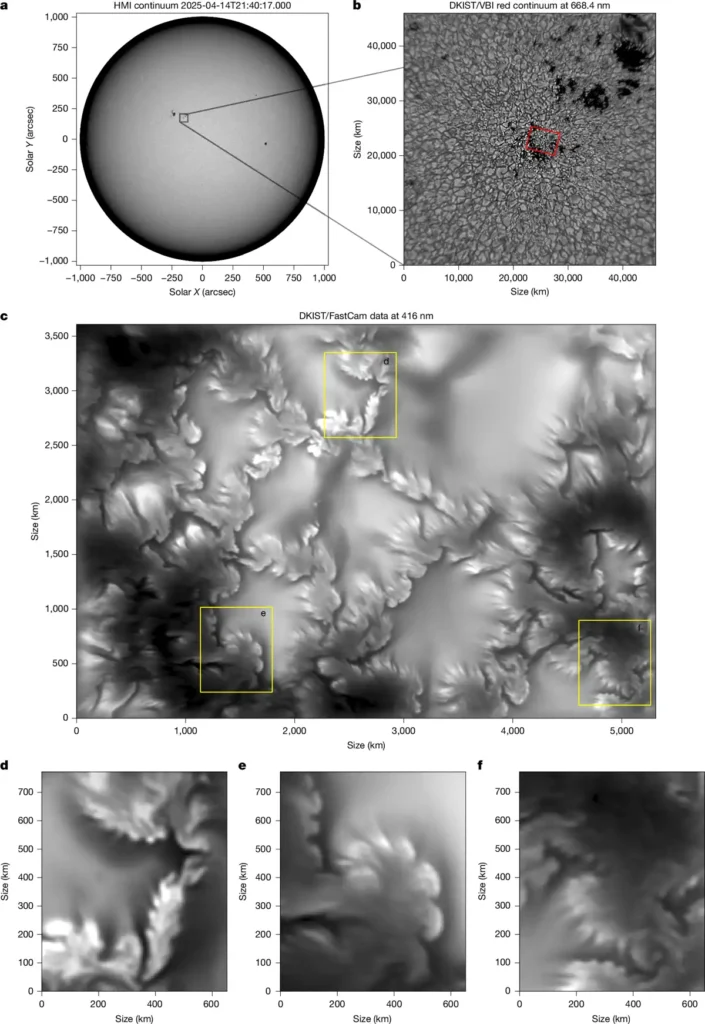
The new observations came from the National Science Foundation’s Daniel K. Inouye Solar Telescope in Hawaiʻi, the world’s largest ground-based solar telescope. Its Visible Broadband Imager recorded the photosphere at a resolution of about 19 kilometres. At that scale, the boundary around magnetic concentrations no longer looks smooth. It breaks into a chain of curls, streaks and small rotating structures.
The team identified 47 vortices in the observed region. Their sizes ranged from roughly 25 to 170 kilometres, with a typical spacing of about 65 kilometres. The researchers then compared the images with high-resolution magnetohydrodynamic simulations. The shapes and growth patterns matched what Kelvin–Helmholtz instability should produce.
Why the vortices matter
This is not just a sharper picture of a familiar surface. Kelvin–Helmholtz instabilities can move mass, energy, momentum and magnetic flux between neighbouring layers. In the Sun’s photosphere, that makes them part of the machinery that builds and rearranges magnetic fields.
Magnetic fields control much of the Sun’s visible activity. They help shape sunspots, active regions and the loops that rise into the corona. When magnetic fields become tangled or braided, they can store energy that is later released through flares and other eruptions. The new observations do not show a flare being born, but they reveal a small-scale process that may help explain how solar magnetic fields evolve before larger events occur.
That connection matters to space weather. Solar eruptions can disturb satellites, radio links and power systems on Earth. Researchers still cannot predict every eruption, but understanding how magnetic structure is created and dissipated is one of the steps toward better models.
The Sun looks different at this scale
At lower resolution, a magnetized patch on the Sun can look like a simple dark pore surrounded by bright granulation. The Inouye observations show a much more complicated border. The magnetic concentration is not separated from its surroundings by a clean line. Instead, the interface is filled with moving curls and striations.
There is a useful lesson in that change of scale. A telescope does not merely make a familiar object larger. It can reveal that the description we were using was incomplete. The Sun’s surface was never truly smooth; it only appeared that way when the smallest motions were hidden.
Curiosmos has followed the way solar observations connect to the space-weather problem, including NASA’s PUNCH mission and its effort to narrow solar-storm arrival times. The Inouye result addresses an earlier part of the chain: the fine magnetic motion taking place before solar activity travels into space.
A new window on magnetic plasma
The researchers describe the discovery as experimental confirmation of a long-standing prediction. That does not close the subject. The observations cover one active region, and the smallest features are close to the telescope’s diffraction limit. More observations will be needed to learn how common these vortices are across different parts of the Sun and how strongly they influence the atmosphere above.
For now, the result gives solar physicists something they have been missing: a direct view of the instability itself. The Sun’s magnetic boundaries are not quiet borders. They are places where plasma twists, trades energy and reshapes the fields that govern the star’s most dramatic behaviour.