The Tarantula Nebula is one of the busiest stellar nurseries in our galactic neighbourhood. Thousands of young stars are packed into a web of gas and dust in the Large Magellanic Cloud, about 160,000 light-years away. Now three NASA space telescopes have combined their views to show not only where stars are forming, but where much of the region’s energy disappears.
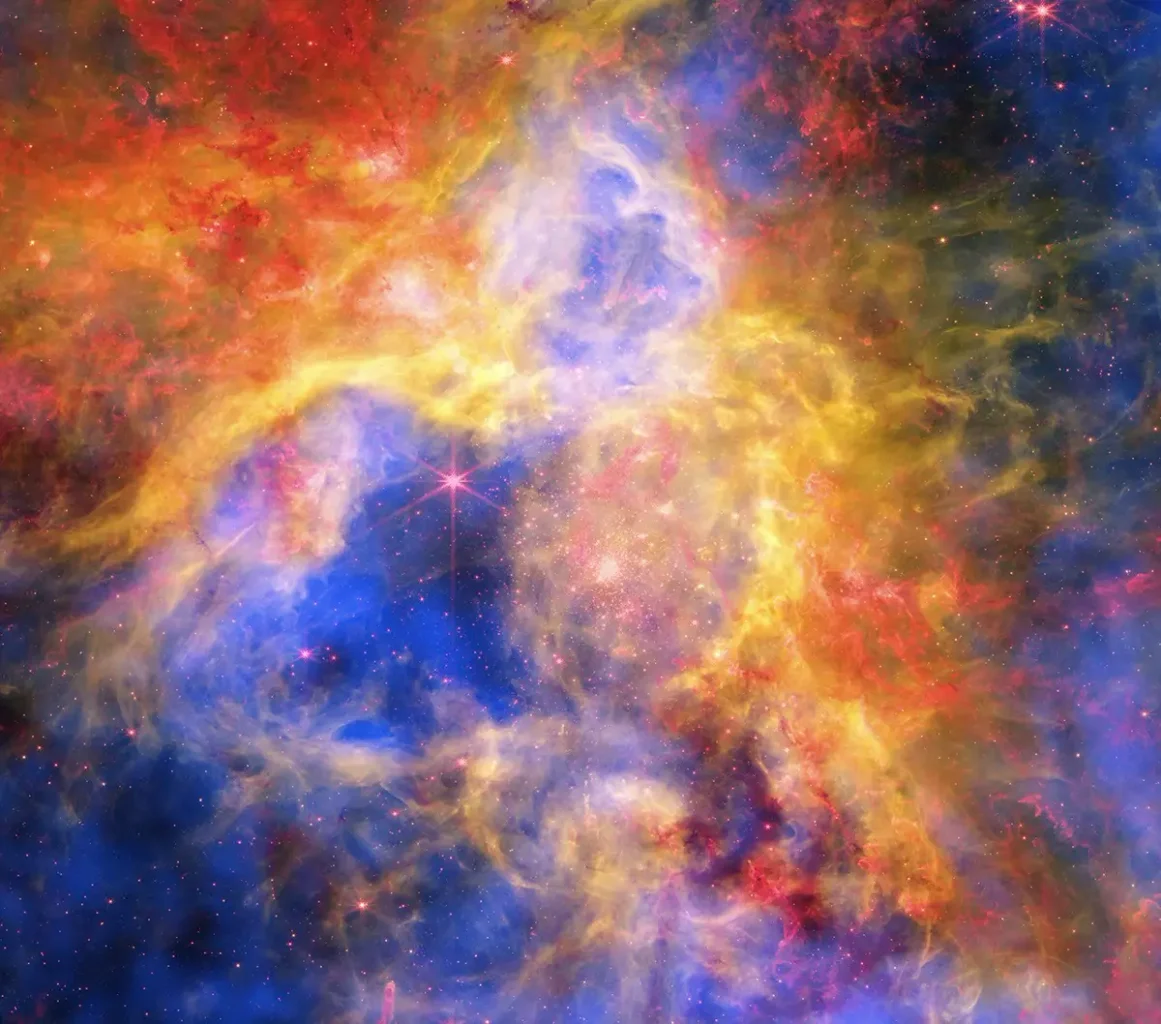
The new image brings together X-rays from the Chandra X-ray Observatory, infrared light from the James Webb Space Telescope and optical observations from Hubble. Each layer sees a different part of the nebula. Webb picks out young stars and cool dust. Hubble traces hydrogen gas. Chandra reveals hot gas heated to millions of degrees by the winds of massive stars.
A star factory with a missing energy budget
Massive young stars pour energy into their surroundings through powerful winds. Astronomers expected those winds to heat large amounts of gas until it shone in X-rays. But the new study finds less X-ray-emitting gas in the Tarantula Nebula than the energy budget suggested should be there.
That mismatch is the scientific heart of the image. The colours are beautiful, but the important result is the question they expose: if the winds are putting so much energy into the nebula, where is it going?
By comparing the Chandra data with Webb, Hubble, Spitzer and computer simulations, the researchers identified several ways for the energy to leave. Up to half of the hot gas may be leaking through the walls of the nebula’s shell-like structures. Hot and cool gas can also mix near those boundaries, lowering the temperature of the combined material. A third process, thermal conduction, allows heat to pass directly between hot gas and cooler material in dense parts of the shells.
Why the three colours are not just decoration
The Tarantula Nebula is often photographed as a bright cloud, but no single wavelength can tell its full story. Infrared light sees through some of the dust and reveals stars that would be hidden in visible light. Optical observations show the warmer hydrogen gas. X-rays expose the violent side of the region, where stellar winds and shock waves raise the temperature to millions of degrees.
When the three views overlap, the image becomes a map of different physical conditions. Blue regions can stand alone where Chandra sees hot gas. Red Webb data mark young stars and cooler dust. Green Hubble data trace hydrogen. The orange and yellow areas are places where the observations overlap, not extra colours painted onto the nebula.
That distinction is worth keeping in mind when looking at any space-telescope image. The finished colour scheme is a translation of measurements into something human eyes can compare. The science lies in what each instrument detected and how the teams modelled the result.
What this says about star formation
The Tarantula Nebula is a nearby laboratory for conditions that may resemble the star-forming regions of young galaxies. Its massive stars reshape the clouds that made them. Their winds can compress gas in one place, blow holes through another and change the supply of raw material for the next generation of stars.
Understanding the energy balance helps astronomers model that feedback. If hot gas escapes more readily than expected, then a stellar nursery may affect its host galaxy differently from the simple picture in which all of the wind energy stays trapped. Gas leakage and mixing can influence how quickly clouds cool, how efficiently new stars form and how material is returned to the wider galaxy.
The result also shows why long-running observatories continue to matter. Webb sees details that were invisible in infrared surveys from earlier decades. Chandra adds the high-energy view, while Hubble supplies the optical map needed to place the hot and cool components in context. None of the three replaces the others.
A nebula caught changing its surroundings
The Tarantula Nebula is not a static cloud lit from behind. It is a region in which young stars are actively changing the material around them, and the material is carrying that energy away through several channels. The new composite makes that exchange visible: bright stars, cool dust, warm hydrogen and escaping hot gas occupying the same enormous structure.
Curiosmos has also followed how different observatories reveal different stages of stellar life, including the way changing light helps astronomers distinguish stars from planets. The Tarantula story begins earlier, in a nursery where massive stars are still shaping the clouds that surround them.
When astronomers ask where the Tarantula’s energy goes, they are really asking how a star-forming region lives with the stars it creates. The answer is not one dramatic escape route. It is a combination of leakage, mixing and heat transfer—small processes adding up across a cloud large enough to contain thousands of young suns.