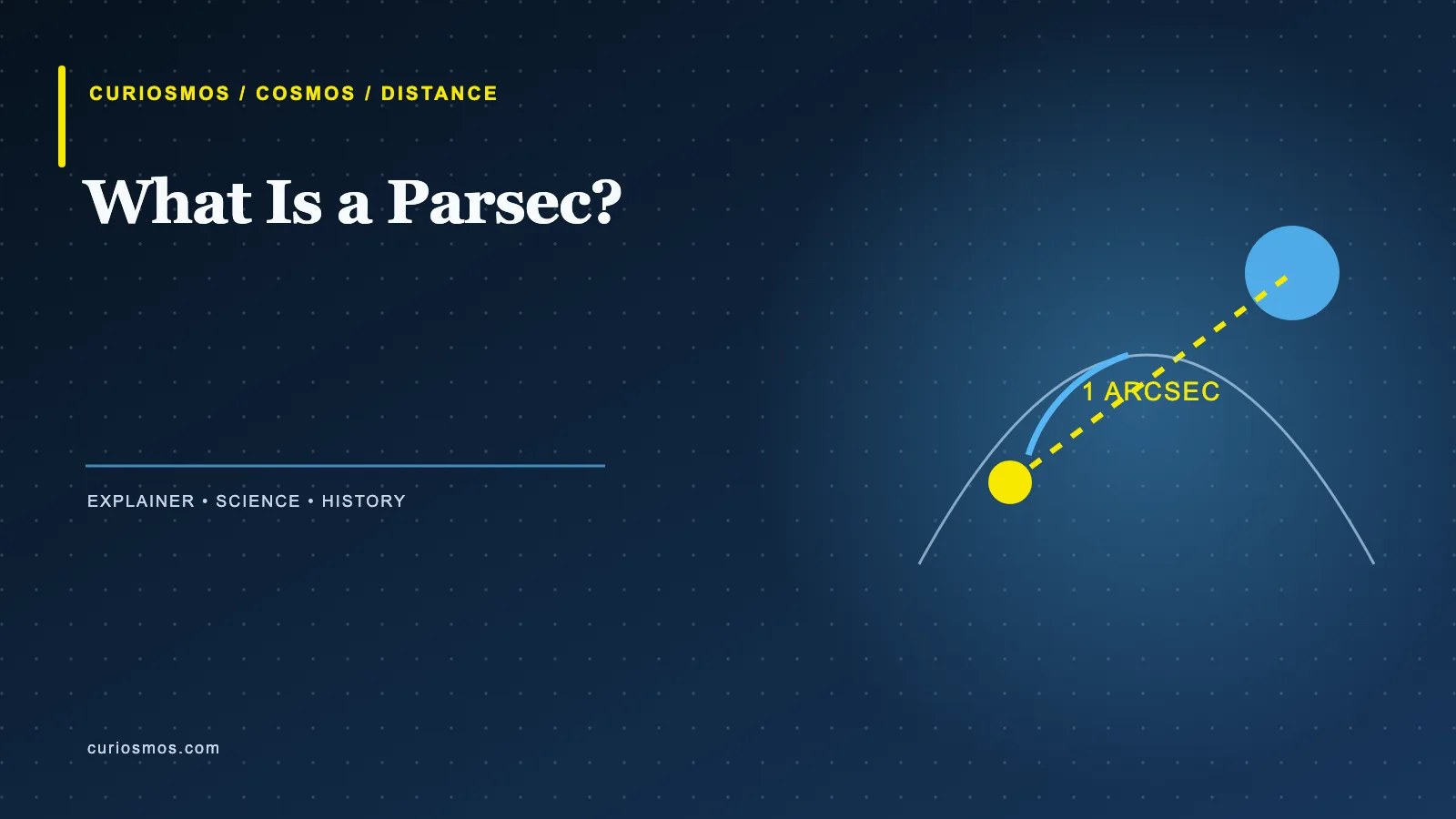
What is a parsec? It is a unit of distance used by astronomers to describe the space between stars and galaxies. One parsec equals about 3.26 light-years, or roughly 31 trillion kilometres. The number is large, but the idea behind it is wonderfully simple: a parsec is the distance at which Earth’s orbit around the Sun would appear to span an angle of one arcsecond.
That definition connects the unit to a real observation. Astronomers do not need to stretch a tape between the stars. They measure how a nearby star appears to shift against the distant background as Earth changes position during its orbit. This apparent shift is called parallax, and it is the foundation of the parsec.
How parallax creates a distance
Hold a finger in front of your face and look at it first with one eye, then the other. The finger seems to move against the background because your eyes are viewing it from two different positions. Earth gives astronomers the same kind of baseline on a much larger scale.
In January, Earth is on one side of the Sun. Six months later, it is on the other side. A nearby star therefore appears to move slightly when compared with stars that are much farther away. The angle is tiny, which is why measuring it requires precise instruments and careful calibration.
If the full change in position is one arcsecond, the star is one parsec away. If the measured parallax is half an arcsecond, the star is two parsecs away. A smaller shift means a greater distance. The relationship is an inverse one: distance in parsecs is approximately one divided by the parallax angle in arcseconds.
Why not just use light-years?
Light-years are perfectly valid, and they are often easier to picture because they describe how far light travels in a year. A parsec is useful for a different reason. It keeps the measurement tied to the method used to obtain it. The unit tells us that the distance came from geometry and a measured angle, rather than from a vague comparison with the speed of light.
Both units are used in public science writing. Astronomers often prefer parsecs in research papers because the numbers scale neatly. A thousand parsecs is a kiloparsec, written kpc. A million parsecs is a megaparsec, written Mpc. The distance from the Sun to the centre of the Milky Way is about 8 kiloparsecs. The separation between galaxies is commonly described in megaparsecs.
Where the unit stops working
Parallax is most reliable for relatively nearby stars. As the distance grows, the apparent shift becomes too small to measure directly, even with space telescopes. Astronomers then use a sequence of other methods, each calibrated against the one before it. Variable stars, exploding stars and the redshift of galaxies extend the distance scale far beyond the reach of direct parallax.
That sequence is known as the cosmic distance ladder. Our guide to how scientists measure distance in space follows the ladder from radar and parallax to the methods used for distant galaxies. A parsec is one of the first important steps because it gives those later methods a trustworthy local foundation.
What does a parsec look like in the real universe?
At 3.26 light-years, one parsec is slightly farther than the distance to the nearest star system, Alpha Centauri, which lies a little over four light-years away. The local stellar neighbourhood is therefore measured in parsecs, while the structure of the Milky Way is measured in kiloparsecs.
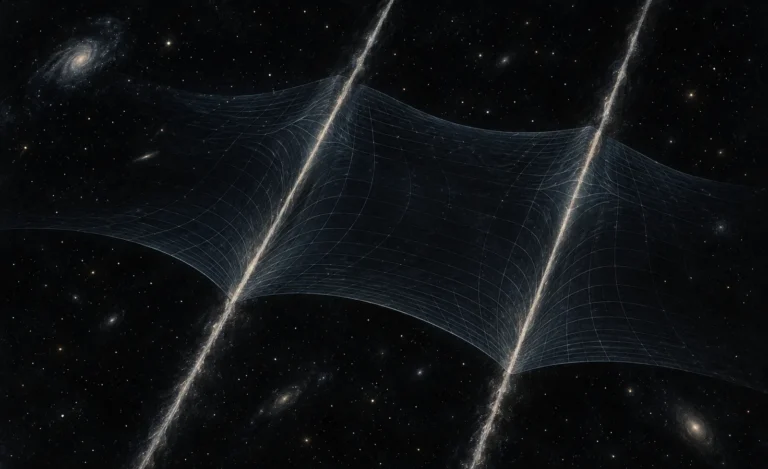
When astronomers map our galaxy’s place in the wider cosmic web, they move to megaparsecs. The Laniakea Supercluster, the broad region that contains the Milky Way and many neighbouring galaxy groups, is described on a scale of hundreds of millions of light-years. At that size, megaparsecs make the distances easier to compare.
The unit also helps explain why looking farther away means looking further back in time. Light from a galaxy one million parsecs away has travelled for more than three million years before reaching Earth. At still greater distances, cosmic expansion stretches the light toward redder wavelengths and changes how distance is described.
That is why there is no single ruler for the universe. Parsec measurements begin with the small, precise movement of a star. From there, astronomers build outward, checking each new method against the geometry that came first.