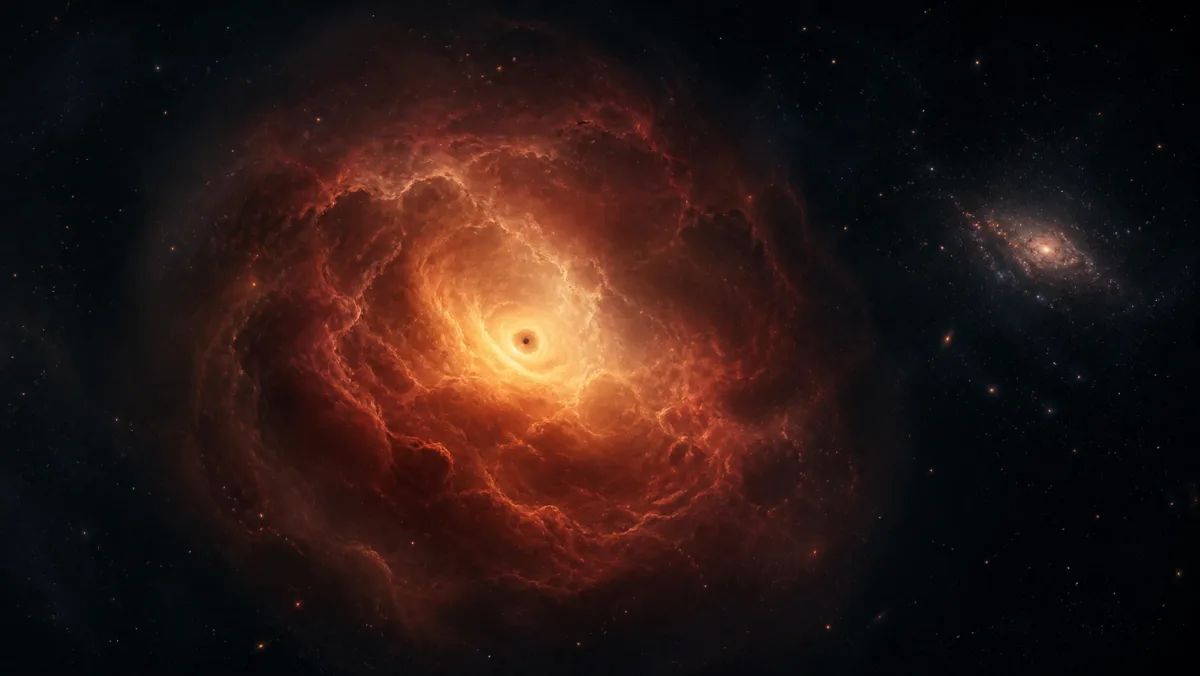
Webb’s spectrum of MoM-BH*-1 points to a growing black hole surrounded by dense gas. The object appears as it was about 660 million years after the Big Bang. Its light may offer a way to understand the compact sources astronomers call little red dots.
Reading the gas around the black hole
In their original research preprint, Rohan Naidu and colleagues model the source with a dust-free, turbulent gas envelope. Their evidence includes a sharp change in the hydrogen spectrum called a Balmer break, broad emission and absorption features.
The model leaves little room for light from a host galaxy. It could also explain little red dots embedded in brighter galaxies. The authors caution that ordinary mass estimates may be too large because the gas changes the observed light and the assumptions behind those estimates.
What “black hole star” means
BH* names the proposed gas-enshrouded configuration. The spectrum supports an interpretation; it does not directly reveal the object’s interior.
A separate test with another little red dot
NASA’s June 2026 report concerns GLIMPSE-17775, a different source seen about 1.8 billion years after the Big Bang. Its detailed spectrum also supports a black hole inside dense gas. NASA describes more than 40 spectral lines, including signatures that help distinguish the energy source and surrounding material. These observations test the wider BH* picture; they are not measurements of MoM-BH*-1.
Related Curiosmos reading
For the wider observing methods, see a star orbiting Sagittarius A*, black-hole imaging and light travel time. Our earlier coverage also follows the little red dots.