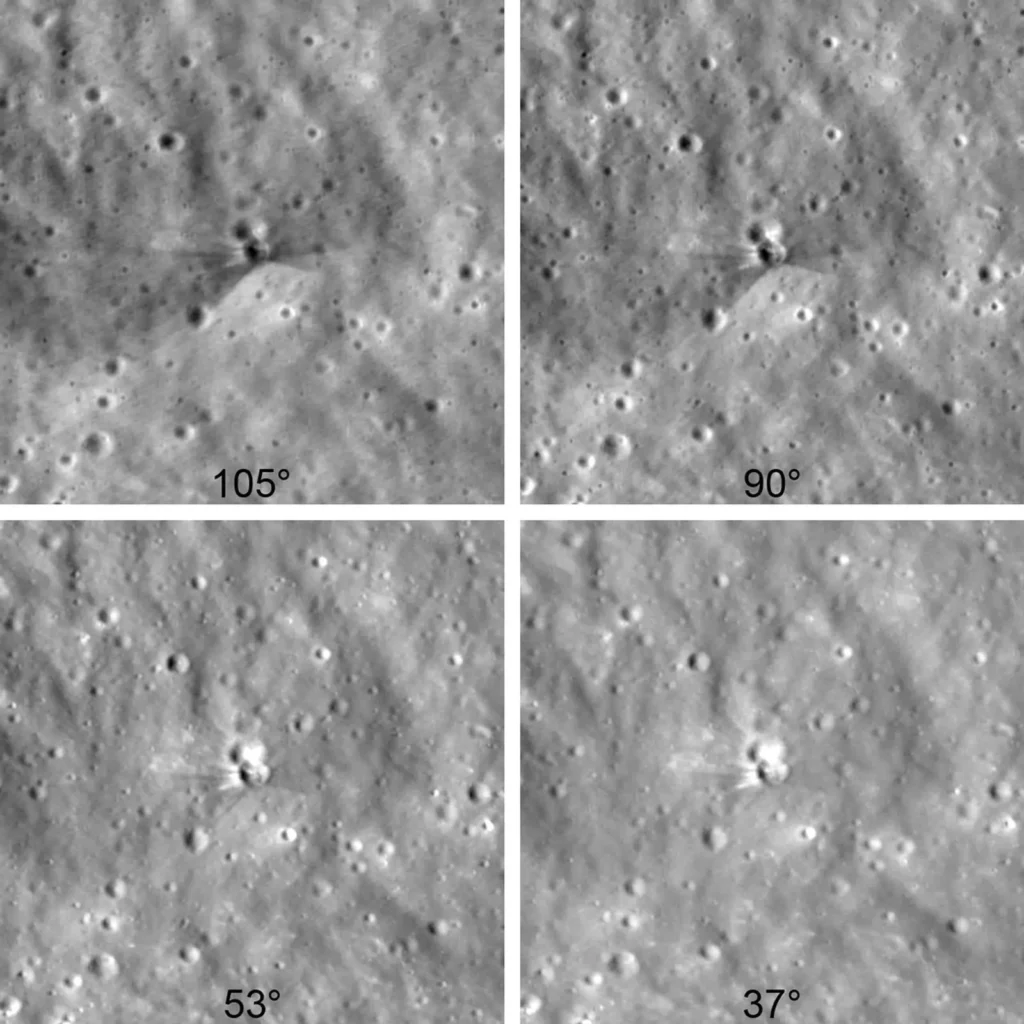
A discarded Falcon 9 upper stage struck the Moon on August 5, 2026. Six days later, NASA’s Lunar Reconnaissance Orbiter found the scar it left behind: a crater about 60 feet, or 18 metres, wide and less than 10 feet, or 3 metres, deep.
The impact was not an accident in the usual sense. The rocket stage had completed its job after launching Firefly Aerospace’s Blue Ghost 1 lunar mission in January 2025. Once the stage was no longer useful, its path eventually carried it into the Moon. Astronomers tracked that path, NASA calculated where it was likely to end, and South Korea’s Danuri orbiter helped locate the fresh crater before LRO was sent in for a closer look.
What followed became an unusually tidy experiment in lunar geology. Scientists knew when the object hit. They had a good estimate of its mass and trajectory. They also had photographs of the same ground taken before the collision. That combination allowed them to study a new crater almost from the moment it formed.
LRO had only seconds to get the picture
Photographing one small target from lunar orbit is harder than it sounds. LRO circles the Moon from pole to pole roughly every two hours, travelling about a mile per second at an altitude near 60 miles. The Moon turns slowly beneath it, so the spacecraft must wait for the desired location to pass below its orbit.
NASA engineers tilted LRO during several passes on August 11 and 12 so that its Narrow-Angle Camera could point toward the impact site. Timing mattered as much as direction. A picture taken 10 seconds too early or too late would put the target roughly 10 miles away from the centre of the frame.
The camera can resolve features close to 3 feet across. It photographed the crater from several angles and under changing sunlight, which made different parts of the impact site stand out. Where the rim cast a clear shadow, researchers could estimate the crater’s depth. Other views showed rays of debris spreading across the surrounding ground.
Those rays are not all the same colour. Dark streaks contain lunar surface material that has spent a long time exposed to solar wind, cosmic rays, and countless micrometeorite strikes. NASA estimates that the collision threw some of this weathered material from roughly 18 inches, or 46 centimetres, below the surface. Brighter patches near the rim came from greater depth, where the soil had been shielded from space weathering.
The contrast gives scientists a shallow cross-section of the Moon without drilling into it. A piece of spent rocket hardware briefly became an impact probe.
The forecast missed by only about a kilometre
Independent astronomers first reconstructed the stage’s orbit from public tracking data. NASA’s Center for Near Earth Object Studies then used the event to test calculations normally associated with planetary defence: if an object is going to hit another world, how precisely can its final position be predicted?
The problem is not solved by tracing a smooth line to a smooth Moon. Lunar mountains, crater walls, and slopes change the point at which an incoming object first meets the ground. NASA therefore produced estimates that included the local terrain. The final prediction was accurate to about 0.6 miles, or 1 kilometre.
South Korea’s Danuri spacecraft photographed the region only hours after impact and sent coordinates to the LRO team. NASA then compared the new images with older coverage and placed the crater’s centre at 19.4759 degrees north, 266.7138 degrees east, at an elevation of 511 metres.
That level of accuracy matters beyond this single rocket stage. Space around the Moon is becoming busier. More spacecraft, upper stages, and commercial missions will travel through cislunar space, and not every object will remain controllable forever. Predicting where hardware will end up is part of operating responsibly in that environment.
The same methods also help scientists prepare for natural impacts. CNEOS is best known for tracking asteroids and comets that may approach Earth. A known piece of rocket hardware offered a rare chance to test the final steps of an impact prediction against a real crater.
Human-made craters are useful, but they are not harmless
The Moon is covered in impact scars, from basins hundreds of kilometres across to pinpricks formed by dust grains. One more 18-metre crater will not alter the Moon as a world. Yet deliberate or unavoidable spacecraft impacts still need careful planning.
The reason is partly scientific. The Moon preserves ancient surfaces and geological records that have survived for billions of years. Some regions may contain water ice or other resources. Others may eventually hold instruments, landing zones, navigation beacons, or heritage sites connected with earlier missions. A predictable impact should not be allowed to threaten a place that has scientific or historical value.
The Falcon 9 stage also struck hard enough to excavate fresh lunar soil. That is useful to researchers, but the same dust would be a serious problem near working equipment. Lunar dust is sharp, electrostatically active, and difficult to keep away from seals, radiators, cameras, and suits. NASA is already testing how Artemis hardware can survive that abrasive environment.
There is another reason to pay attention. The Moon has almost no atmosphere to slow incoming objects or erase their tracks. As our guide to why the Moon has almost no atmosphere explains, a rocket stage reaches the surface at orbital speed rather than burning up as it might at Earth. Its crater can remain visible long after the mission that launched it has been forgotten.
A precisely documented new scar on an ancient surface
LRO has spent years mapping the Moon in extraordinary detail. It has photographed landing sites, landslides, boulder tracks, impact flashes, and geological structures hidden in terrain that once appeared featureless. The Falcon 9 crater joins that record with an unusually complete history.
Researchers know the launch that placed the stage in space. They tracked its later path. They calculated where it would hit, received an early confirmation from Danuri, and photographed the result under several lighting conditions. They can compare the new crater directly with the ground before August 5.
That makes this small crater more valuable than its size suggests. Natural lunar craters rarely arrive with a flight record and a timestamp. This one did.