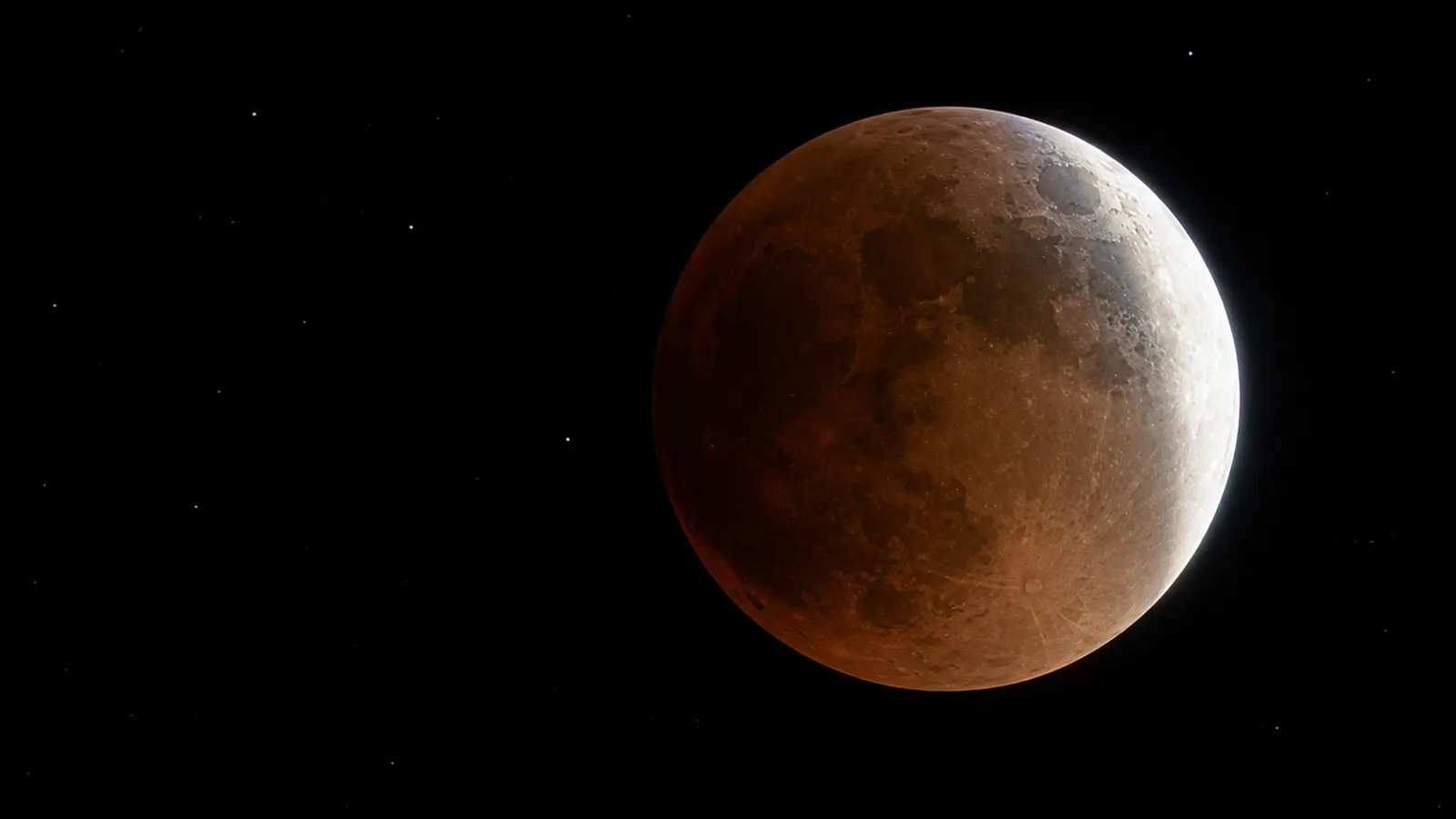
The full Moon will pass through Earth’s shadow on the night of 27–28 August, producing one of the deepest partial lunar eclipses of 2026. At maximum eclipse, about 93 percent of the Moon’s diameter will lie inside the darkest part of the shadow, while a narrow bright crescent remains outside it.
The event is visible without a telescope. The Moon may take on the copper and brick-red colours associated with a total eclipse, but the effect will be uneven because a small portion of the lunar disc stays in direct sunlight. Visibility is best across the Americas, Europe, Africa, and western Asia; local weather and moonrise determine what each observer can see.
What Earth’s shadow does
The shadow has two parts. The penumbra is the outer region, where Earth blocks only some of the Sun’s light. The umbra is the central region, where the planet covers the Sun completely from the Moon’s point of view. A partial lunar eclipse occurs when the Moon passes through the umbra without the entire disc being immersed in it.
The Moon does not vanish when it enters the umbra because Earth’s atmosphere bends a small amount of sunlight into the shadow. Air scatters blue light more strongly and allows more red and orange light to reach the Moon. Dust, clouds, and volcanic aerosols can change the final colour, so no two eclipses look exactly alike.
When to watch
NASA’s eclipse calculations give a partial phase lasting a little over three hours. The Moon begins entering the umbra at about 01:23 UTC on 28 August, reaches maximum around 04:12 UTC, and leaves the umbra at about 05:51 UTC. In Zagreb and central European summer time, that corresponds roughly to 03:23–07:51, with the maximum near 06:12; observers should check local moon altitude and a local eclipse timetable before setting an alarm.
The Americas receive the most convenient evening viewing because the eclipse begins before or around moonset in many locations. Europe and Africa see the event in the early morning, while western Asia sees part of the sequence after midnight. The further east an observer is, the more important the Moon’s position above the horizon becomes.
Unlike a solar eclipse, a lunar eclipse is safe to watch with the unaided eye. Binoculars can bring out the boundary between the dark umbra and the brighter lunar surface, but no special filter is required. A clear view of the eastern sky and a stable surface for binoculars are more useful than expensive equipment.
Why the Moon is not always fully eclipsed
The Moon’s orbit is tilted by about five degrees relative to Earth’s path around the Sun. Most full Moons therefore pass above or below Earth’s shadow. An eclipse occurs only when the full Moon is close to one of the points where the two orbital planes cross, called a node.
The August event is deep because the alignment is close but not perfect. The Moon’s track carries nearly the whole disc through the umbra, yet a sliver remains outside the central shadow. That geometry also explains why the Moon may look dramatically darker on one side while a bright edge survives.
The eclipse is a useful reminder that the Moon’s changing appearance is a matter of geometry. The lunar surface is always lit by the Sun; what changes is how Earth, Moon, and Sun line up. Curiosmos has explained why the Moon has phases and why stars twinkle while planets usually do not. This week’s shadow is the same orbital dance seen on a larger scale.