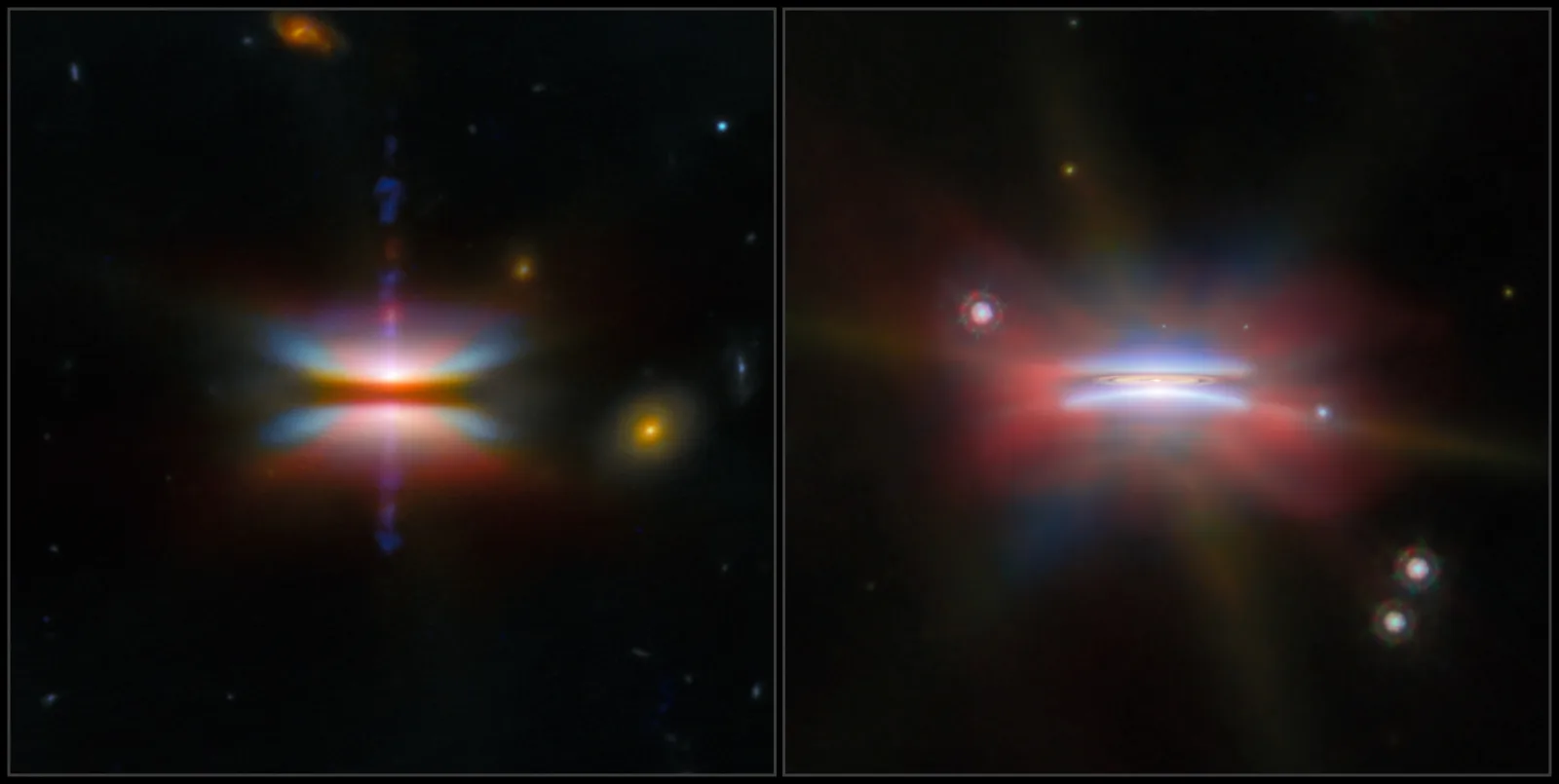
Planets are assembled inside broad disks of gas and dust around young stars, but those disks do not last forever. A new James Webb Space Telescope survey shows that winds from young, Sun-like stars can remove the gas while planets are still trying to grow, creating a race between planet building and disk dispersal.
The study, led by Naman Bajaj of the University of Arizona with Uma Gorti of the SETI Institute, examined 72 young stars. Webb detected molecular hydrogen from 66 of those systems, a sign that gas is still present, and found evidence of outflows in many of them. The observations give astronomers a much clearer view of the material that controls the early lives of planetary systems.
The raw material for planets is temporary
A protoplanetary disk is not a quiet cloud waiting for planets to appear. Dust grains collide and stick, rocky bodies grow, and the largest cores can pull in hydrogen and helium. That last step is what makes a gas giant. If the disk loses its gas first, a developing planet may remain a smaller rocky or icy world instead.
Young stars erode their disks in several ways. Ultraviolet and X-ray radiation heat the upper layers until gas can escape. Magnetic fields can launch narrow jets, while radiation-driven winds lift material away over a wider area. Each mechanism leaves a different chemical and geometric signature, so the team looked for more than a single bright feature.
Hydrogen and neon reveal the wind
Webb’s instruments are sensitive to infrared light from molecules that are difficult to see through the dust surrounding a newborn star. The survey found conical hydrogen winds in 46 systems and neon jets in 40. These shapes indicate that material is being carried away rather than simply glowing in place.
The neon signal is especially useful because its strength changes as gas is exposed to energetic radiation. By comparing hydrogen and neon, the researchers can distinguish a narrow magnetic jet from a broader flow powered by the star’s radiation. The balance appears to change as the systems age: magnetic launching is more prominent early on, while photoevaporation becomes increasingly important later.
That transition matters for planets. A strong magnetic jet can remove material from the inner disk, but a spreading photoevaporative wind can clear the outer reservoir that feeds growing planets. The timing determines whether a planet has access to enough gas to become a Jupiter-like world.
A look at the future Solar System’s starting point
The stars in the survey are not copies of the Sun, and the observations do not trace one system from birth to maturity. Instead, the sample provides a sequence of snapshots at different ages. Together they let astronomers compare the strength and shape of disk winds as systems move through their first few million years.
Those comparisons can test why some stars keep their disks longer than others. Stellar mass, magnetic activity, the amount of dust and the presence of early planets may all change how quickly gas is lost. The data also help refine models that connect a disk’s lifetime with the kinds of planets that ultimately appear.
Curiosmos has previously explained how stars change as they use their fuel and how Webb revealed a hidden planet in the Beta Pictoris system. Those mature worlds are the end of a process that begins in the disks Webb is now measuring. The new survey supplies the missing early chapter: the environment in which planets must grow before the raw material disappears.
The race is measurable
The study does not say that every young system is about to lose its planets or that giant planets cannot form after winds begin. It shows that gas removal is an active, observable process and that its timing is likely one of the main controls on planetary architecture.
Future Webb observations of individual disks can track the winds in more detail and compare them with gaps, rings and other structures made by growing planets. The broad survey establishes the scale of the process; the next step is to connect each kind of wind with the planets that are forming inside it.
That comparison will also help explain why planetary systems can look so different even when they begin around similar stars. A disk that keeps its gas for several million years has time to build large cores and feed them with hydrogen. A disk cleared earlier may leave behind a system dominated by smaller rocky planets, icy bodies and debris.
The survey gives astronomers a way to test those alternatives with observations rather than assumptions. Webb can measure the chemistry of the escaping gas, while other telescopes can map the dust and search for the gaps made by young planets. Together, those measurements can tie a disk’s disappearing gas to the worlds that remain.