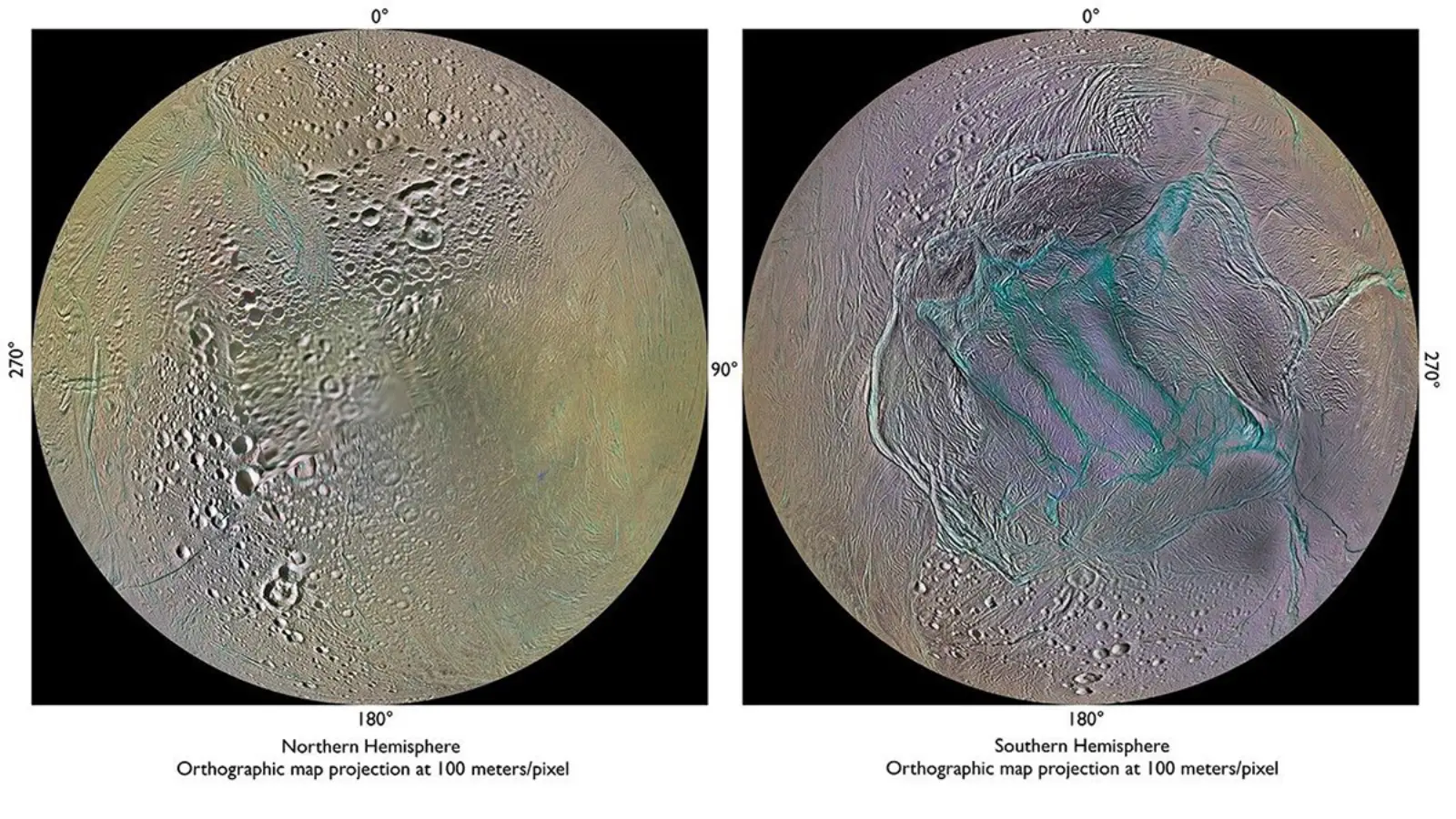
Enceladus’ south pole is cut by four long fractures that spray water vapour and ice into space. Scientists call them the “tiger stripes,” and a new model suggests that waves moving through the moon’s hidden ocean may help keep those fissures open.
The idea begins with Enceladus’ motion. The small Saturnian moon does not turn in a perfectly steady way. Its ice shell can wobble slightly as the moon moves through Saturn’s gravity field. According to the new study, that motion transfers energy into the ocean beneath the ice, creating waves that push back against the shell.
Those waves would not be like ocean surf on Earth. Enceladus’ ocean is enclosed between rock and ice, and the water is under enormous pressure. The model treats it as a global layer that responds to the changing shape and motion of the shell. Where the stresses concentrate, friction can turn movement into heat.
That heat matters because the tiger stripes are active. Cassini flew through their plumes and detected water vapour, salts and organic molecules. The fractures reach through the ice shell to the ocean below, giving material a route to the surface and into orbit around Saturn. Without a source of heat, the cracks should gradually freeze shut.
The new calculation proposes a feedback loop. Enceladus wobbles, the ocean develops waves, and the waves load the ice shell with repeated stresses. Some of the motion is converted into heat along the fractures. Melting then helps the cracks remain mobile, allowing more water to escape through the plumes.
The model also addresses a long-standing geometric puzzle. The tiger stripes run roughly parallel and are separated by similar distances. A random set of cracks would not be expected to show such regular spacing. If the ocean and shell respond to a repeating pattern of tidal stresses, the spacing could reflect the way energy moves through the moon rather than the chance path of a single break.
The stripes are not identical, either. They differ in brightness, width and the amount of material escaping from them. That variation gives the model something else to explain. A fracture that spends more time under tension could carry a larger plume, while a neighbouring crack might remain partly closed. Comparing those differences with the predicted stress pattern may show whether the ocean-wave mechanism can reproduce the real south-polar landscape.
This is still a proposal, not a direct observation of waves beneath Enceladus. No spacecraft has watched the ocean move in real time. The model has to reproduce several facts at once: the position of the fractures, their activity, the heat released from the south pole and the composition of the plume.
Future missions could test the idea more closely. A spacecraft that measured the gravity field, the shell’s thickness and the timing of plume activity could reveal whether the ocean is moving in the way the model predicts. Repeated imaging might also show whether the fractures open and close in step with Enceladus’ orbit.
There is a second reason to care about the timing. The plume is the easiest part of Enceladus to sample, but it is also the end point of a long journey through the shell. If the fractures are repeatedly heated and refilled, the particles released today may represent a mixture of ocean water and material altered inside the ice. Understanding that route is essential when scientists use plume chemistry to assess the moon’s habitability.
Enceladus is one of the clearest examples of why an icy moon can be more than a frozen surface. Its interior may be doing the work that volcanism does on larger worlds, moving heat and chemicals through a deep ocean and feeding a plume that telescopes can sample from afar. Curiosmos has previously examined the mysterious moons of the Solar System; this new work focuses on the mechanical process that makes one of them visibly active.
The significance is practical as well as theoretical. If the ocean is exchanging material with the surface, its chemistry may be accessible without drilling through kilometres of ice. Understanding how the cracks are maintained will help scientists judge where a future mission should fly, what it should measure and whether the plume is a reliable sample of the water below.