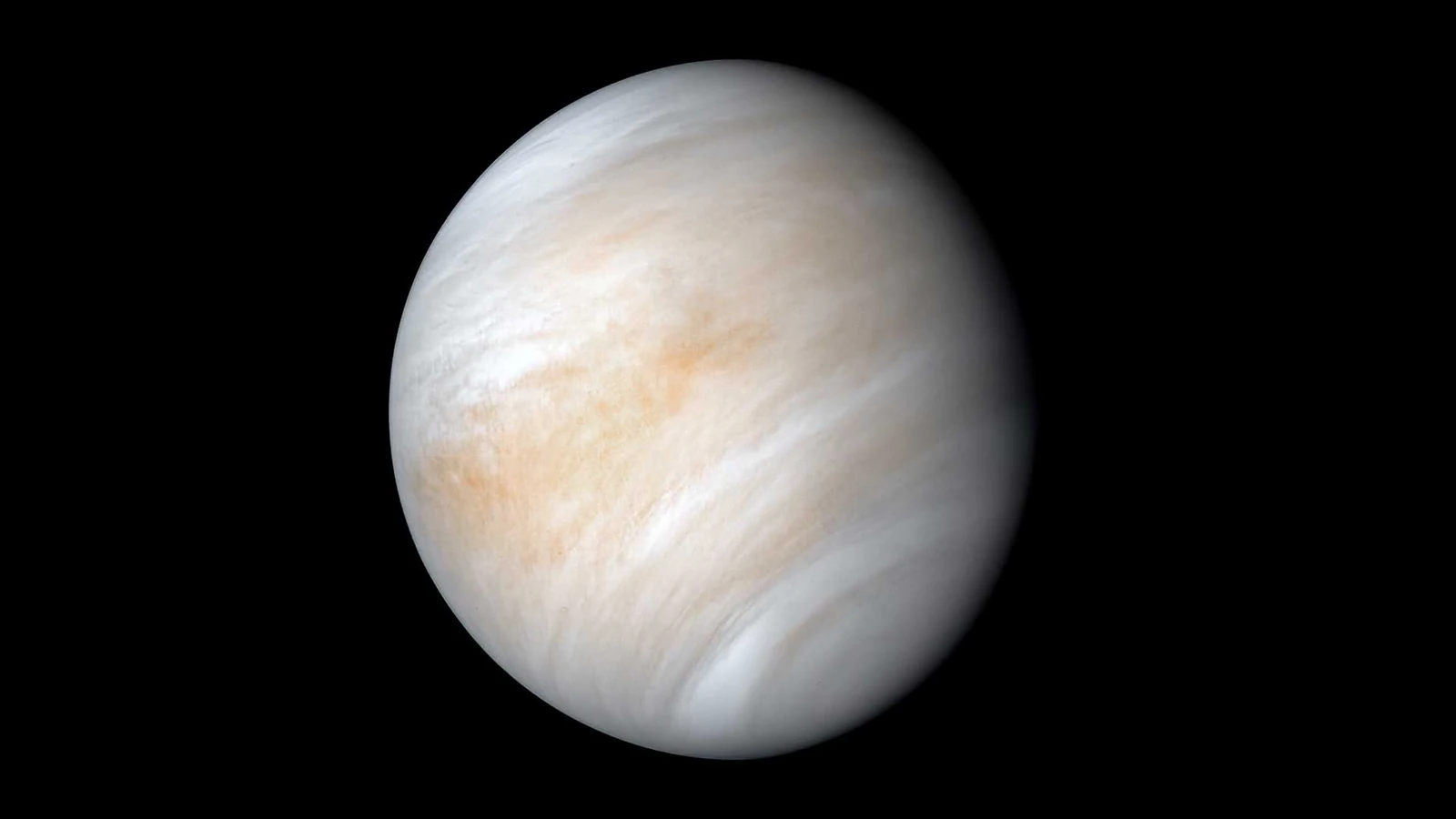
Venus can reach its greatest brilliance while a telescope shows only a crescent. A nearly full Venus exposes more of its sunlit hemisphere, yet that does not necessarily deliver more light to Earth. The missing part of the explanation is distance: a closer crescent can look much larger than a distant, almost fully illuminated disk.
The effect has a timely example this month. The September 2026 skywatching guide identifies September 18 as Venus’s peak brilliance during its current evening appearance. It recommends looking low in the west shortly after sunset, with an unobstructed horizon.
Two changes compete as Venus approaches Earth
Because Venus travels inside Earth’s orbit, we see different portions of its illuminated hemisphere as the planets move. When Venus is on the far side of the Sun, its sunlit face points largely toward us, but the planet is far away and appears small. As it comes around toward the near side, the disk grows while the illuminated fraction shrinks.
Keep exploring
Continue with Curiosmos
Think of comparing two photographs taken at the same magnification. A small, nearly full disk can contain less bright area than a much larger crescent. Counting the percentage illuminated without considering the size of the whole disk therefore gives the wrong answer.
The JPL explanation of Venus’s phases describes how the closer position compensates for the smaller illuminated fraction. The brightest appearance falls between the extremes: Venus is relatively close, but enough of its illuminated side is still visible to send substantial reflected light our way.
At its closest approach, most of the illuminated hemisphere faces away from Earth. The planet is also close to the Sun in the sky. Being nearest therefore does not make it the best evening target, just as being nearly full does not make it the brightest.
The light comes from the clouds
Venus has a highly reflective cloud cover. Spacecraft observations of the planet show an atmosphere that hides the surface from ordinary visible-light views. Its conspicuous white brilliance in twilight comes primarily from reflected sunlight, not from a naked-eye view of glowing ground.
This is separate from the greenhouse effect that makes Venus so hot. A planet can reflect a substantial amount of incoming sunlight and still have an intensely hot surface if its atmosphere strongly restricts the escape of thermal energy. Bright clouds and extreme surface heat are not competing descriptions of the same process.
Greatest brightness is not greatest elongation
Elongation is the angle between Venus and the Sun as seen from Earth. Greatest elongation means the largest such separation during an appearance. It is a geometric milestone, whereas greatest brightness concerns the total light received from the planet.
Neither term supplies a universal observing time. Your latitude, the tilt of the planet’s path to the horizon and local obstructions affect how high Venus sits after sunset. A very bright planet can still be difficult to spot behind a building or through a hazy layer near the horizon.
For this September appearance, start with the clear western horizon recommended in the monthly guide. To examine the phase with optical equipment, wait until the Sun has fully set; never sweep binoculars or a telescope near the Sun. The naked-eye view shows Venus’s brilliance, while a telescope reveals the crescent responsible for the apparent paradox.