Why is Venus the hottest planet when Mercury is closer to the Sun? The answer is not distance alone but an atmosphere that traps heat so efficiently that the surface reaches roughly 467 degrees Celsius—hot enough to melt lead. A thick carbon-dioxide atmosphere, sulfuric-acid clouds and crushing pressure turn Venus into a natural experiment in runaway greenhouse warming.
The planet is often called Earth’s sister because the two worlds are similar in size and composition, but their climates followed very different paths. Venus shows what happens when an atmosphere becomes so dense that cooling cannot keep pace with incoming sunlight. For comparison, see how Earth’s seasons work and why distance from the Sun is only one part of a planet’s climate.
How Does Venus Trap So Much Heat?
Sunlight passes through Venus’s upper clouds and warms the ground. The hot surface radiates energy upward as infrared light. Carbon dioxide absorbs much of that infrared radiation and re-emits it in different directions, including back toward the surface.
The process does not trap heat like a sealed lid forever; energy eventually leaves the planet. The difference is that Venus must reach a much higher temperature before the outgoing radiation balances the sunlight it receives. Its dense air makes that balance extremely hot.
Pressure makes the difference
Temperature alone does not describe the surface environment. Venus’s atmosphere presses down with the force found nearly a kilometre beneath Earth’s ocean. Carbon dioxide becomes dense enough to behave in ways that are unfamiliar at ordinary pressures, while the thick cloud deck keeps the lower atmosphere in near darkness.
Heat is also carried sideways by the atmosphere. Winds near the cloud tops race around the planet, and slower circulation below them moves energy between the day and night sides. That circulation is why the surface temperature changes little from one side of Venus to the other, despite the planet’s very long day.
Why Mercury is not hotter
Mercury receives more sunlight, but it has almost no atmosphere to redistribute and retain heat. Its dayside becomes extremely hot, while its nightside loses heat quickly. Venus rotates slowly too, but its dense atmosphere moves energy around the planet, keeping the surface hot on both the day and night sides.
Venus’s surface pressure is about 93 times Earth’s sea-level pressure. At the ground, carbon dioxide behaves under crushing pressure, and a spacecraft must survive a corrosive, high-temperature environment. NASA’s Venus facts page describes the planet’s atmosphere as mostly carbon dioxide with clouds made of sulfuric acid.
What happened to Venus’s water?
Venus may once have had more water than it does today. As the planet heated, water vapour became a stronger greenhouse gas, raising temperatures further. Ultraviolet sunlight then split water molecules high in the atmosphere, and lightweight hydrogen escaped to space. Oxygen could react with rocks or be lost through other processes.
The exact history is still being investigated. Scientists are comparing the planet’s atmospheric chemistry, surface minerals and volcanic features with climate models. Venus is not a simple picture of Earth’s future, but it is a powerful natural experiment in how a rocky planet can change.
Clouds hide a volcanic world
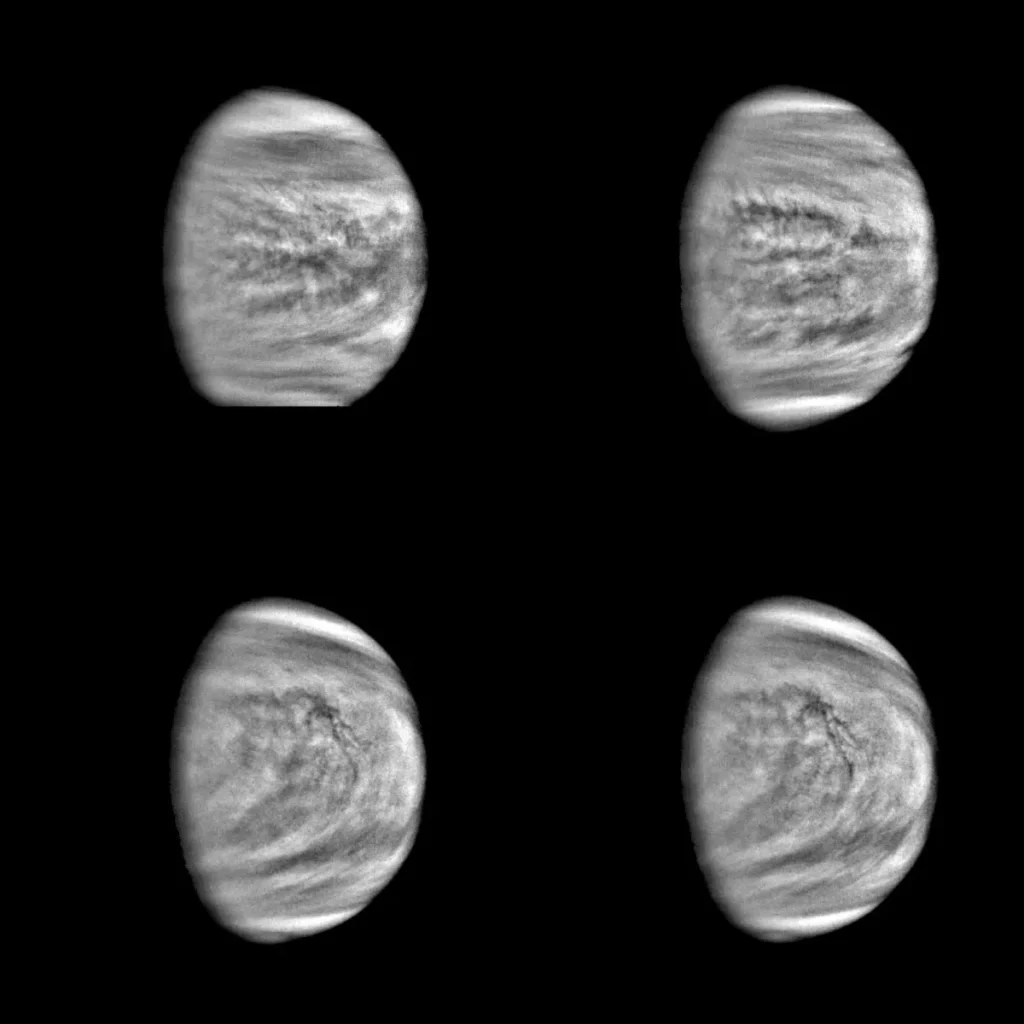
The clouds that make Venus bright from Earth are not made of water droplets. They contain sulfuric-acid aerosols and reflect a large fraction of the sunlight that reaches them. Beneath the clouds are volcanoes, broad plains and deformed mountain belts mapped largely by radar.
The surface may still be geologically active. Lava flows, volcanic gases and unusual cloud patterns are among the reasons planetary scientists continue to study Venus. Curiosmos has looked back at Venera 3, the first spacecraft to reach another planet, a reminder of how difficult it is to send instruments into this hostile atmosphere.
Could anything live above the surface?
Venus’s ground is far beyond the limits of known Earth life. Higher in the atmosphere, however, temperatures and pressures are less extreme. Some researchers have considered whether microbes could persist in droplets at an altitude of about 50 kilometres. That idea remains unproven, and the clouds are chemically harsh.
Finding a possible habitat is not the same as finding life. Any future claim would require careful measurements that distinguish biology from atmospheric chemistry. Venus’s heat has an obvious cause; its cloud chemistry still holds harder questions.
A warning written in planetary climate
Venus is valuable because it lets scientists study a world with a familiar rocky body and a very different climate. The lesson is not that Earth is about to become Venus. It is that atmospheres are active parts of planets, and small differences in water, sunlight and carbon chemistry can lead to very different outcomes over geological time.
That contrast is also visible in the record of early planetary exploration. Curiosmos’s account of the first surface images from Venus shows how little of this cloud-covered world can be understood from visible light alone.