Twenty-seven faint objects beyond Neptune are giving astronomers a rare look at the planet-building material that survived when the outer solar system stopped growing.
The outer solar system is not empty. Beyond Neptune, in the cold region known as the Kuiper Belt, countless small bodies travel around the Sun. Most are so faint that even powerful telescopes see them as little more than points of light. Yet these objects may preserve something much larger than their size suggests: a record of how the planets began.
A new study using the Hubble Space Telescope and the James Webb Space Telescope has now examined 27 of the smallest and faintest trans-Neptunian objects ever measured in this way. The result is curious. The bodies appear to retain the same colour relationships seen in their larger relatives, even though astronomers expected collisions to have altered their surfaces.
Keep exploring
Continue with Curiosmos
What if the smallest objects beyond Neptune are not battered remnants at all? What if some of them still carry the chemical and physical memory of the disk from which the planets formed?
What did Hubble and Webb find?
The teams observed two groups of trans-Neptunian objects, or TNOs. One group follows relatively circular orbits close to the original plane of the solar system. Astronomers call these the dynamically “cold” population. The other group travels on more elliptical, inclined paths. These “hot” objects probably formed closer to the young Sun and were pushed outward when the giant planets moved early in solar-system history.
Hubble measured the objects in visible light, while Webb observed them in infrared wavelengths. That combination allowed researchers to compare their colours, surface properties, sizes and orbits. The objects are extremely faint: NASA says the smallest body in the sample is about 5 kilometres across, roughly five times smaller than the limit reached by the most sensitive ground-based telescopes.
The observations also found fewer small TNOs than some planet-formation models predicted. That difference matters because the number of small bodies records how much fragmentation and collisional grinding occurred after the original planetesimals formed.
Why do their colours matter?
Colour is more than an appearance in this study. In the outer solar system, the way an object reflects visible and infrared light provides clues about the material on its surface. A body that is redder or darker may have a different mix of ices, minerals and radiation-processed organic compounds than one with a different spectrum.
Astronomers expected the smallest objects to look different from the larger ones. A long history of impacts should expose fresh layers, cover old surfaces with debris and change the chemistry through heating and radiation. If that process were common, the small TNOs would have lost the colour relationships inherited from their birthplaces.
Instead, the new observations show that the small bodies in both the hot and cold populations follow the same broad colour patterns as larger members of those groups. The surfaces appear to have preserved a signature of where the objects formed, even after their orbits were rearranged.
That is the sense in which the objects “remember” the past. They do not contain a literal record. Their colours and compositions retain a trace of the conditions in the early disk.
Did collisions shape the Kuiper Belt less than expected?
Collisions still happen beyond Neptune. The question is how often they happen, how violent they are and whether they change an object from the inside out.
The colour result suggests that impacts may not have erased the original surface properties as efficiently as some models assumed. Perhaps the number of collisions is lower than expected. Perhaps many impacts are too gentle to excavate and mix deep material. Or perhaps the surfaces can rebuild or preserve their chemistry after an impact.
The data do not yet select one explanation. They do, however, give researchers a new test. If small objects in other parts of the Kuiper Belt show the same colour relationships, the survival of primordial surfaces becomes harder to dismiss as a feature of one sample.
The finding also changes the way astronomers think about small bodies. A tiny TNO may be a damaged fragment, but it may also be a remarkably intact leftover from the stage before full-sized planets formed. Size alone does not tell us how much history an object has lost.
Why are the hot and cold populations so important?
The two populations formed in different parts of the early solar system. The cold objects appear to have stayed relatively close to their original orbits. The hot objects were probably scattered outward by the migration of Uranus and Neptune, carrying material from a warmer region into the distant Kuiper Belt.
If their colours and size distributions are similar, the process that built planetesimals may have worked in more than one environment. The disk could have produced comparable building blocks even where its temperature, density and composition differed.
The Webb observations found that the two groups have surprisingly similar size distributions. That is another clue about planetesimal formation. The process may have produced a characteristic range of object sizes that was not strongly controlled by local conditions.
This does not mean the early solar system was uniform. The objects still preserve differences between their populations. It means that some part of the planet-building process may have been more robust than astronomers expected.
What does this tell us about the birth of planets?
Planets did not begin as finished worlds. They grew from dust and pebbles that gathered into planetesimals—solid bodies that could be kilometres or tens of kilometres across. Some collided and merged. Others were scattered outward. Many remained small.
The TNOs observed by Hubble and Webb are survivors from that unfinished stage. Because they never became planets, they may preserve conditions that were erased inside larger worlds by melting, differentiation and geological change.
That makes the distant Kuiper Belt a kind of natural archive. Its objects are faint and hard to find, but their surfaces can tell us about the disk that once surrounded the young Sun. The smallest body in the new sample is not important because it is large or bright. It is important because it may have remained close to the material from which an entire planetary system emerged.
The work also shows why two telescopes are better than one for this problem. Hubble can measure the visible colours of these tiny bodies, while Webb can detect their faint infrared light. Neither view alone gives the full picture. Together, they reveal both how the objects look and how they may have formed.
What happens next?
The teams still need to explain why the smallest TNOs are so scarce and why their surfaces remain similar to those of larger bodies. More observations could determine whether the pattern holds across different orbital regions and whether some objects have genuinely preserved primordial material beneath a thin altered layer.
Future surveys may also find even smaller bodies. Every new size, colour and orbit measurement will help distinguish between competing histories: a Kuiper Belt shaped by constant collisions, a region where impacts are relatively rare, or a population whose surfaces can recover after being disturbed.
For now, the most intriguing result is also the simplest. The objects beyond Neptune are not just leftover rocks in the dark. They may be small time capsules from the moment when the solar system was still deciding what it would become.
And if their colours really do remember where they were born, the next question is unavoidable: how much of the young Sun’s original planet-building disk is still moving through the darkness, waiting for Hubble and Webb to see it?
NASA’s report on the Hubble and Webb observations describes the 27 objects. The underlying studies are published in The Astronomical Journal and a companion paper in the same journal.
Related reading
- What Is a Galaxy? How Stars, Gas, Dust, and Dark Matter Stay Together
- How Fast Does Light Travel? The Cosmic Speed Limit Explained
- Satellites Are Changing the Night Sky. What Astronomers Can Still See
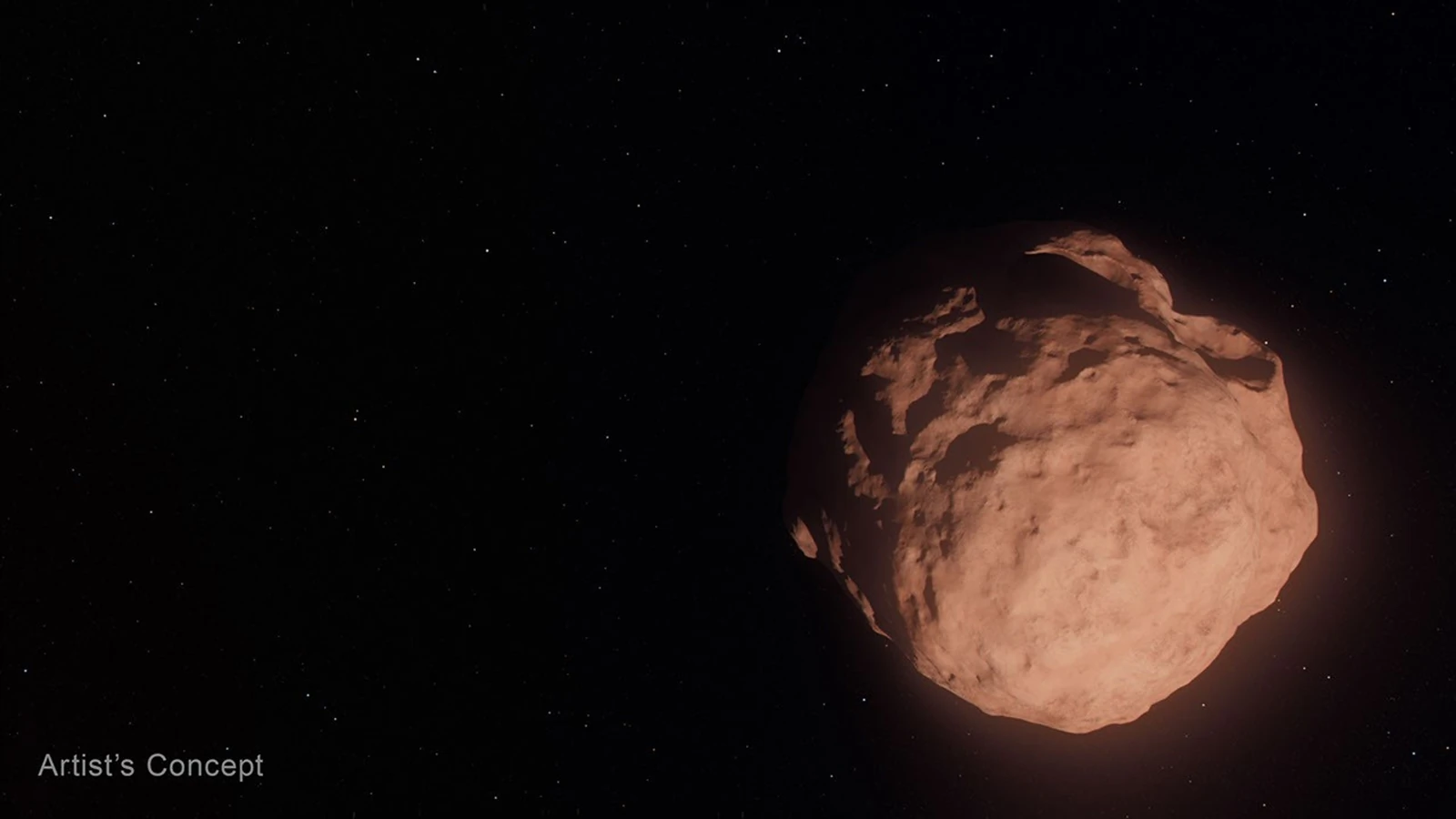
Image: Artist’s concept of a trans-Neptunian object. NASA, ESA, Leah Hustak (STScI).