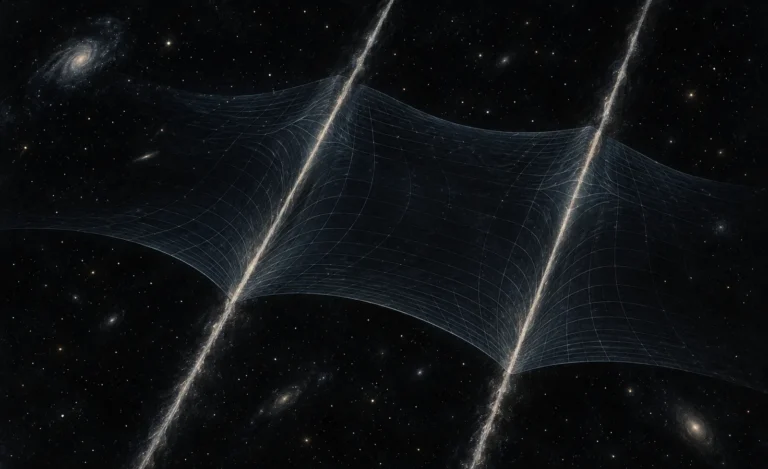
Satellites are changing the night sky in a way that has little to do with the old glow of city streets. When a satellite constellation passes through a telescope’s field of view, it can leave a bright line across an exposure. A single trail may be removed during data processing. Thousands of trails, arriving from many directions, are a much harder problem.
The issue has grown with the rapid expansion of commercial satellite networks. These spacecraft provide useful communications and navigation services, but their reflective surfaces also catch sunlight after sunset and before sunrise. From the ground, some appear as moving points. To a long-exposure telescope, they can become streaks that cover faint galaxies, asteroids or other targets.
Why astronomers care about a streak
A telescope does not simply take a photograph. It collects light and measures how that light changes across the sky and over time. A satellite trail can saturate a detector, hide a real object or leave behind residual marks that resemble a feature in the data. Even when a computer recognises the line, the pixels underneath it may be lost.
The problem is especially serious for surveys that photograph large areas repeatedly. Astronomers use those surveys to find supernovae, track near-Earth asteroids, measure how galaxies are distributed and test how the universe has expanded. A trail that appears in one image may be manageable. A trail that repeats across many observations can reduce the quality of an entire sequence.
This is different from ordinary light pollution. Streetlights brighten the background sky from below. Satellites cross the field of view from above, sometimes while the sky is otherwise dark. The two problems can combine: a brighter background makes it harder to see faint trails and faint celestial objects at the same time.
How many satellites are enough to matter?
There is no single number that applies to every telescope. The effect depends on the satellite’s brightness, orbit, orientation, altitude and the camera’s exposure time. A dark-sky observatory taking short images may be affected differently from a survey telescope taking long exposures over a very wide field.
A 2026 study discussed by the European Southern Observatory examined what very large satellite populations could do to optical and infrared astronomy. Its warning was not that every satellite makes astronomy impossible. The concern is that a large population of bright spacecraft could raise the artificial brightness of the sky and put more trails through the images used for research.
The practical response is a mixture of engineering and regulation. Operators can reduce reflections, change the orientation of spacecraft and share accurate orbital information with observatories. Telescope teams can plan exposures around satellite passages and develop software that identifies and masks trails. Those measures help, but they do not restore the information hidden beneath a bright line.
Will the public notice?
People who watch the sky may already have noticed strings of moving lights soon after launch. Those objects are often satellites travelling together before spreading into their operational orbits. Once a constellation is established, the most visible passes may look like individual stars moving steadily across the sky.
The effect is easiest to understand by comparing it with a familiar observation. When stars twinkle while planets usually look steadier, the difference is caused by Earth’s atmosphere and the apparent size of the source. Satellite streaks are an entirely different phenomenon: the light is coming from objects much closer to Earth that are moving across the camera’s view.
What is at stake for discovery?
Modern astronomy depends on finding rare, faint and rapidly changing events. A supernova may appear in a galaxy for only a short time. A small asteroid may be visible in just a few frames. The earliest galaxies can be so faint that a small loss of clean pixels matters. If those observations are repeatedly interrupted, some discoveries will be delayed or missed.
That does not mean the sky is being closed to science. Observatories can still work, and engineers are improving both spacecraft design and image processing. But the night sky is a shared scientific resource. The same darkness that lets a telescope detect a distant galaxy also lets people see the Milky Way with their own eyes.
Our article on how astronomers measure distance in space shows how much information can be extracted from a small change in light. Satellite trails complicate that work by putting bright moving streaks across the same images astronomers use for precise measurements. Protecting a clear view is now part of exploring the universe.
As telescopes reach deeper and surveys become larger, the question is no longer whether satellites belong in orbit. It is how to keep useful access to space from making the sky harder to read.