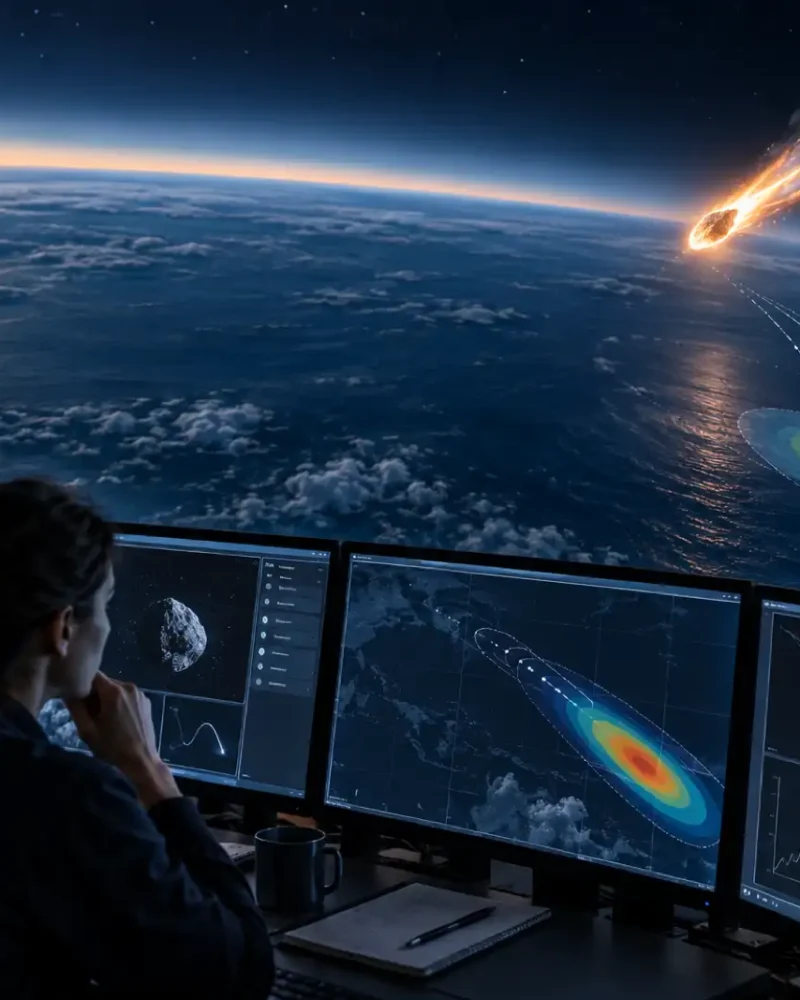
A fast radio burst lasts only a fraction of a second. Then it is gone, leaving behind a faint clue in the way its radio signal reached Earth.
Different radio frequencies arrive at slightly different times because free electrons in space slow the waves by different amounts. That delay, called the dispersion measure, records the column of ionised gas along the burst’s path. Add the burst’s distance, and a brief flash becomes a kind of pencil line through the cosmic web.
A new study in Nature Astronomy has used 114 localised fast radio bursts to ask a bigger question: where is ordinary matter hiding around galaxies, and how has it been pushed around by the engines inside them?
Keep exploring
Continue with Curiosmos
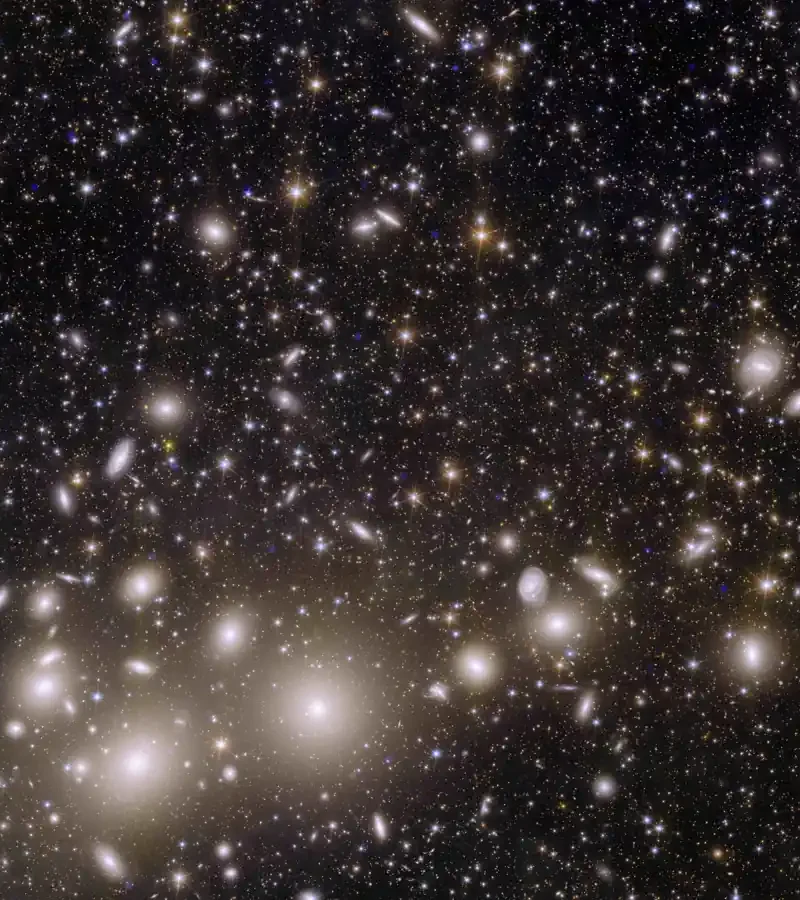
The answer matters because the universe contains far more matter than we can see in stars. Most ordinary matter is diffuse gas, spread through the space between galaxies and around galaxy groups and clusters. It is difficult to observe directly, yet its distribution affects the maps astronomers use to study dark matter, dark energy and the growth of cosmic structure.
What does a radio burst measure?
The dispersion measure is not a photograph of a cloud. It is the total number of free electrons stacked along one line of sight. A larger value can mean that the signal crossed denser gas, travelled farther, or passed through several environments in combination.
That is why the study needs both a dispersion measure and a redshift for each burst. The redshift provides a distance estimate; the radio delay supplies a measurement of the ionised material encountered on the way. By comparing many sightlines, researchers can look for patterns in the baryon field instead of treating each burst as an isolated curiosity.
The team analysed bursts at redshifts below about 0.3, a nearby part of the universe where galaxy groups and clusters can be connected to the foreground structures along each sightline. The analysis focuses on matter-power-spectrum scales from roughly 0.1 to 3 h Mpc⁻¹. In plain language, it examines how unevenly matter is arranged from group-sized regions down to much smaller structures.
Why would gas change the matter map?
Galaxies are not closed islands. Young stars pour out radiation and stellar winds, while material falling into a supermassive black hole can drive powerful outflows. These feedback processes can heat gas and push it beyond a galaxy’s halo.
Move enough gas outward and the matter distribution becomes smoother on small scales. The dark-matter skeleton is still there, but the ordinary matter no longer follows the same compact pattern. That difference changes the weak-lensing signal expected from a region and can bias attempts to infer cosmological parameters if it is not modelled correctly.
The new analysis uses a halo model to connect the burst measurements with gas fractions and the suppression of the matter power spectrum. Its result is a new cross-check on information traditionally drawn from X-ray observations, microwave measurements and gravitational lensing. The paper reports constraints that are already competitive with those established tracers in the regime it tests.
This is a different use of an FRB from the question explored in our earlier report on a repeating deep-space radio signal. There, the burst itself is the mystery. Here, the tiny delay between frequencies is the measuring instrument.
Is this a direct inventory of the missing baryons?
Not quite. The bursts do not reveal the complete contents of every galaxy group, and they do not identify a single cloud beside a particular galaxy. The inference depends on a statistical model of halos, on estimates of the Milky Way and host-galaxy contributions to each dispersion measure, and on assumptions about how gas is distributed inside and outside halos.
That distinction is important. The study is testing how feedback changes the way matter clusters, rather than weighing the universe one burst at a time. Its value is the combination of many imperfect lines of sight. With only 114 well-localised bursts, the present sample is still small; the patterns become more useful as future surveys find many more bursts with secure positions and distances.
The authors make that future easy to picture. A much larger sample could be combined with galaxy maps and weak-lensing surveys, allowing the radio measurements to help separate the physics of galaxy formation from the cosmological signal. In that arrangement, an FRB is more than a transient flash. It is a moving probe that samples the otherwise hard-to-see material between galaxies.
What could the next bursts reveal?
The immediate question is whether the same feedback picture holds across different halo masses and distances. More bursts can test whether the gas is expelled most efficiently from galaxy groups, whether it returns later, and how the pattern changes with cosmic time.
That work will also sharpen other measurements. Future lensing surveys are designed to read very small differences in how foreground matter bends light, but those differences are useful only if the ordinary gas is understood. FRB dispersion offers an independent route to that problem, one based on propagation rather than a visible glow.
A signal that lasts milliseconds can therefore become a map of matter spread across millions of light-years. The burst flashes once. The information it leaves behind can keep expanding, sightline by sightline.
Sources and further reading
- Sharma et al., “Signatures of suppressed matter clustering revealed by fast radio bursts,” Nature Astronomy (8 September 2026)
- Author manuscript and methods, arXiv:2604.17162
- Author-provided data and reproduction code
- Curiosmos: This repeating space signal is coming from deep space
- Curiosmos: When Gravity Bends Light: How Gravitational Lensing Reveals the Distant Universe