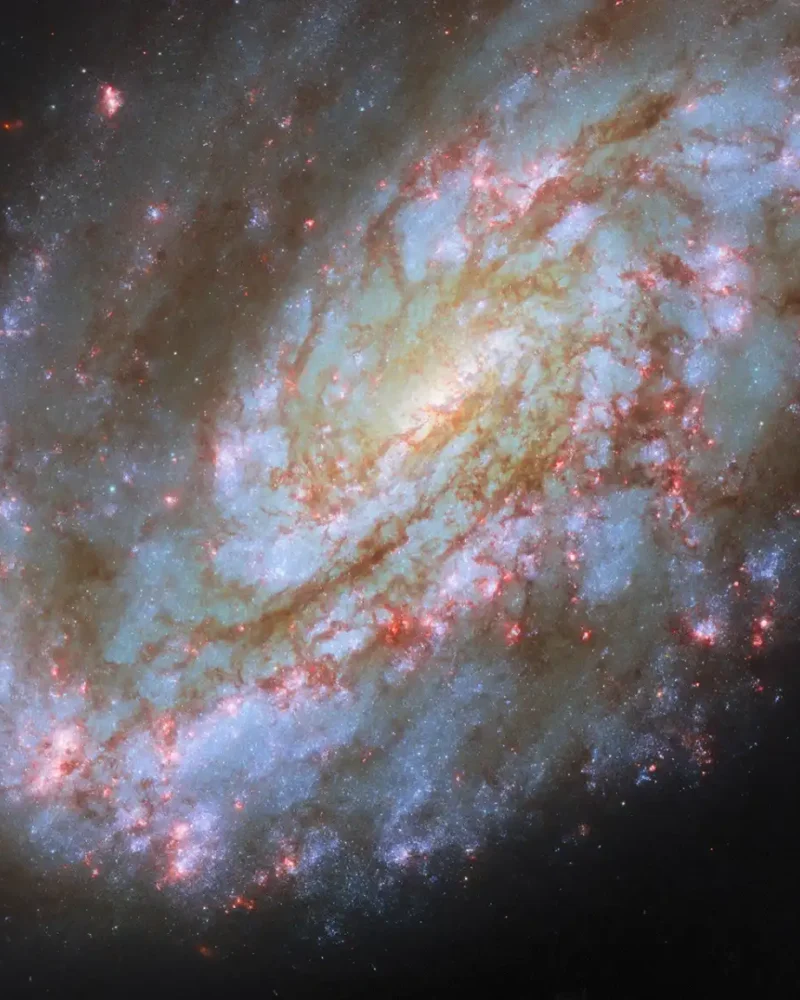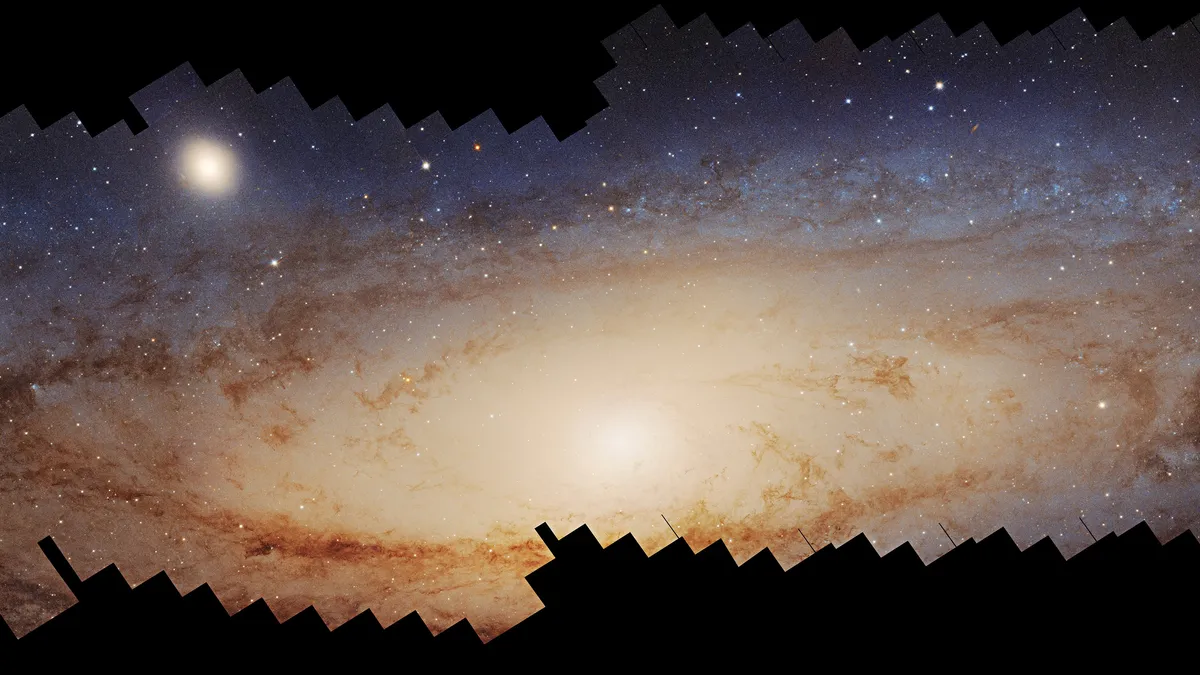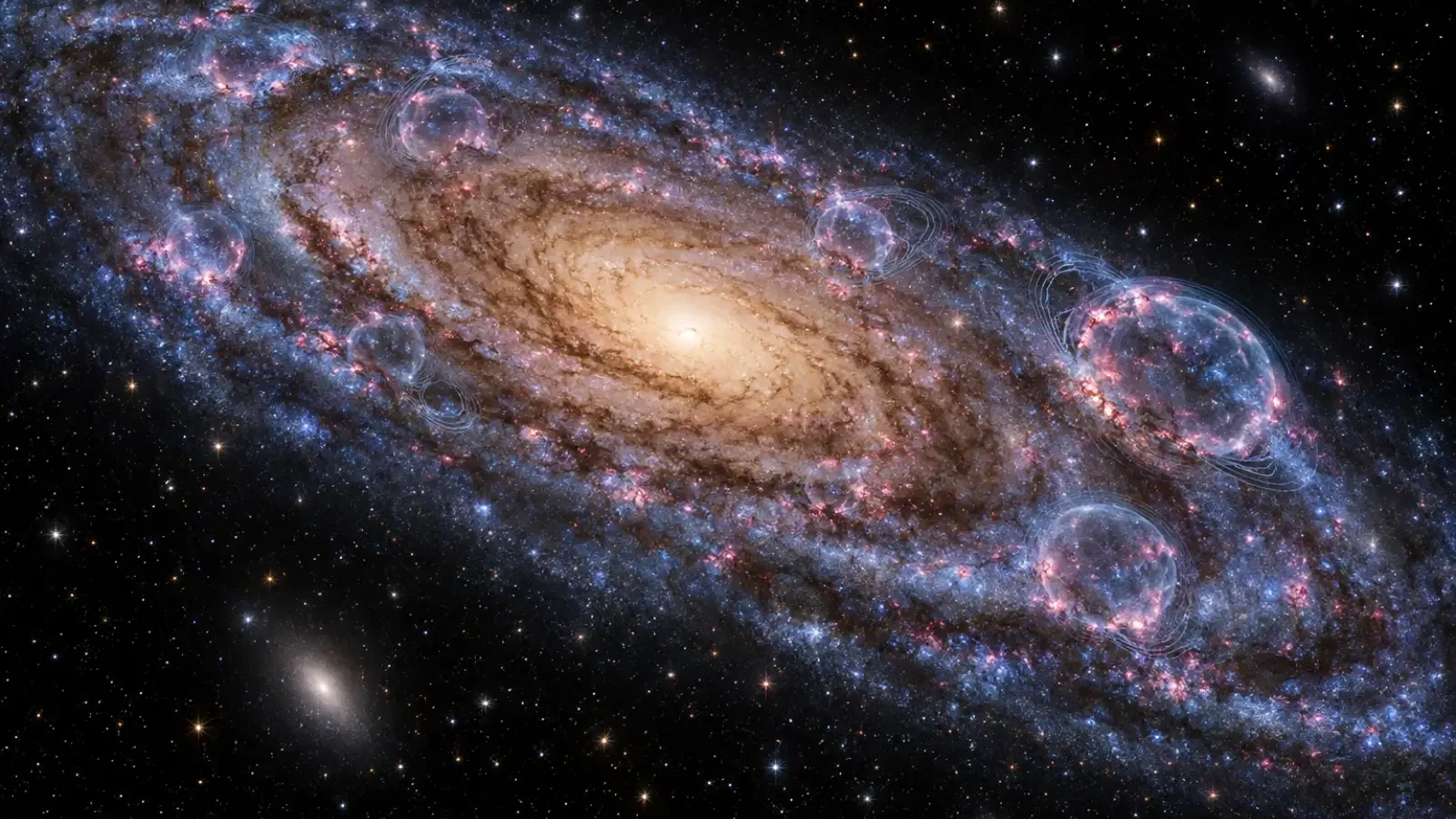
Andromeda looks calm in an ordinary photograph: a broad spiral of stars, dust and faint light about 2.5 million light-years away. Radio observations tell a more restless story. Across the disk of M31, astronomers have now identified 118 expanding shells of neutral hydrogen—structures known as superbubbles—and found that their energy input is enough to account for much of the turbulence in the galaxy’s gas.
That result matters because turbulence is not just cosmic background noise. It helps determine whether gas collapses into new stars, spreads through a galactic disk or remains suspended. The new study asks a deceptively simple question: what keeps all that gas moving?
A galaxy can look quiet while its gas is moving
Andromeda is the nearest large galaxy to the Milky Way, which makes it an unusually useful laboratory. We can see its disk as a whole while still mapping large regions of its neutral hydrogen. This gas is cold enough to be traced through radio emission, and it carries the record of how material moves between star-forming regions.
Keep exploring
Continue with Curiosmos
The researchers combined observations from China’s Five-hundred-meter Aperture Spherical Radio Telescope, or FAST, with archival data from the Jansky Very Large Array in the United States. FAST supplies sensitivity to faint, extended hydrogen emission; the JVLA adds sharper information about the structure and motion of the gas. Together, the surveys cover the galaxy’s disk more completely than either instrument could alone.
The result is a catalogue of 118 expanding superbubbles. These are not empty holes punched through the galaxy. They are shells of neutral hydrogen whose size, shape and expansion speed can be measured. Some are relatively young, while the oldest structures in the sample have dynamical ages of up to about 40 million years.
What is a superbubble?
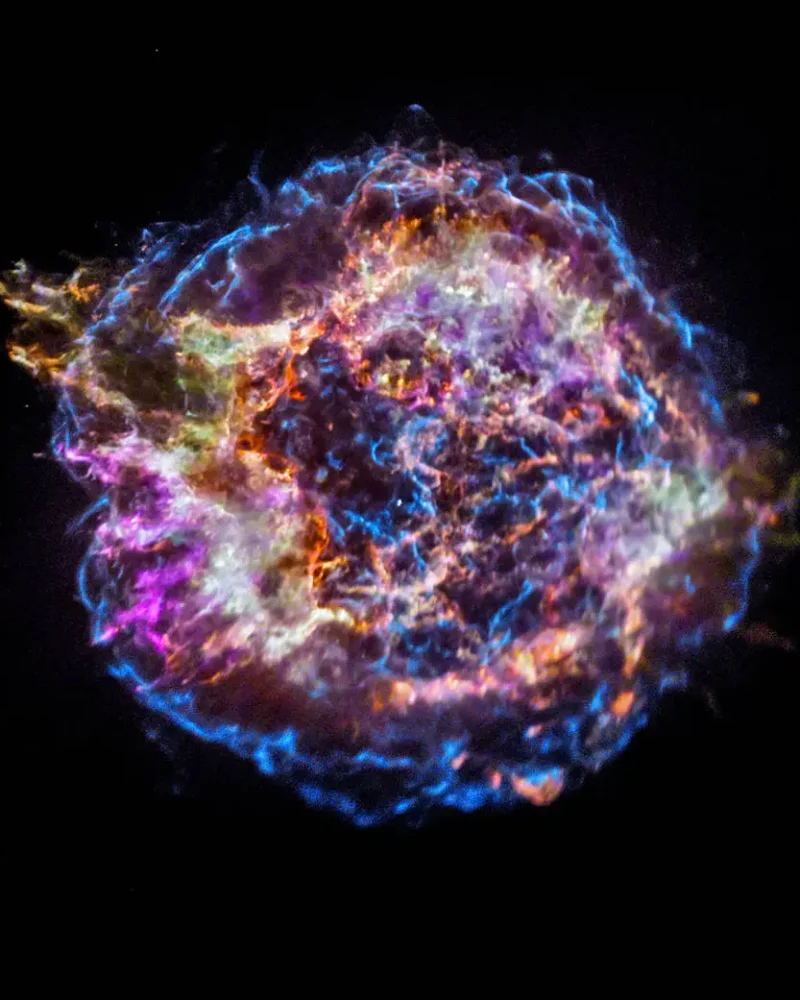
A single supernova can drive a shock through the gas around a star. But massive stars are often born in clusters, and many of them end their lives within a few million years of one another. Their winds and explosions combine, sweeping surrounding gas into a growing shell. That larger structure is a superbubble.
The word can make the process sound more orderly than it is. A shell expands into a lumpy interstellar medium, encounters other clouds and can be pushed by several generations of massive stars. The radio data do not show an animated explosion. They show the present-day hydrogen distribution and the velocity patterns from which the team reconstructed expansion and energy.
How did the astronomers connect bubbles to turbulence?
For each superbubble, the team estimated its size, expansion speed and the density of the surrounding gas. Those measurements provide an energy-injection rate: an estimate of how much kinetic energy clustered supernovae are putting into a given part of the disk over time.
The authors then compared that rate with an independent estimate of how quickly turbulence dissipates in the same hydrogen data. The two quantities match in both their overall scale and their change with galactic radius. In the study’s model, supernova feedback supplies enough energy to maintain the observed large-scale turbulence.
That agreement is stronger than a visual resemblance between a bright shell and a star-forming region. It is an energy budget. The researchers are asking whether the proposed source can pay the physical cost of keeping the gas stirred, and the numbers are consistent across the disk.
Why does a turbulent disk matter?
Gas that is completely still would not automatically make stars, and gas that is violently disturbed would not necessarily make them either. Turbulence creates dense pockets, supports other regions against collapse and redistributes material. The balance helps set the pace and location of star formation.
The result is more than a catalogue of unusual radio shapes. If clustered supernovae can regulate the neutral gas in a nearby spiral, the same feedback process may help explain how other galaxies maintain their structure. It also gives astronomers a way to compare the energy budget of a real galaxy with the feedback recipes used in computer models of galaxy evolution.
Andromeda has another advantage: its disk is close enough for the survey to track structures across an entire galaxy rather than in a few selected patches. That makes the 118 superbubbles a test of whether a local explanation still works when it is applied at galactic scale.
What the survey cannot settle yet
The observations do not identify every source of motion in M31. Galactic rotation, magnetic fields, gravity and other forms of stellar feedback can all influence the gas. The study shows that clustered supernovae are sufficient to sustain the measured turbulence in the analysed model; it does not mean that every turbulent eddy was created by a single explosion.
There is also a time problem. A superbubble preserves evidence of activity over millions of years, while star formation changes from region to region. Future surveys can test how the shells interact with molecular clouds and whether the same energy balance holds in galaxies with different masses, gas contents and star-formation histories.
So the next time Andromeda appears as a quiet smudge in the sky, it is worth imagining the disk underneath. Hundreds of expanding hydrogen structures may be carrying the mechanical memory of clustered stars, and their combined push may be what keeps an entire galaxy from falling silent.