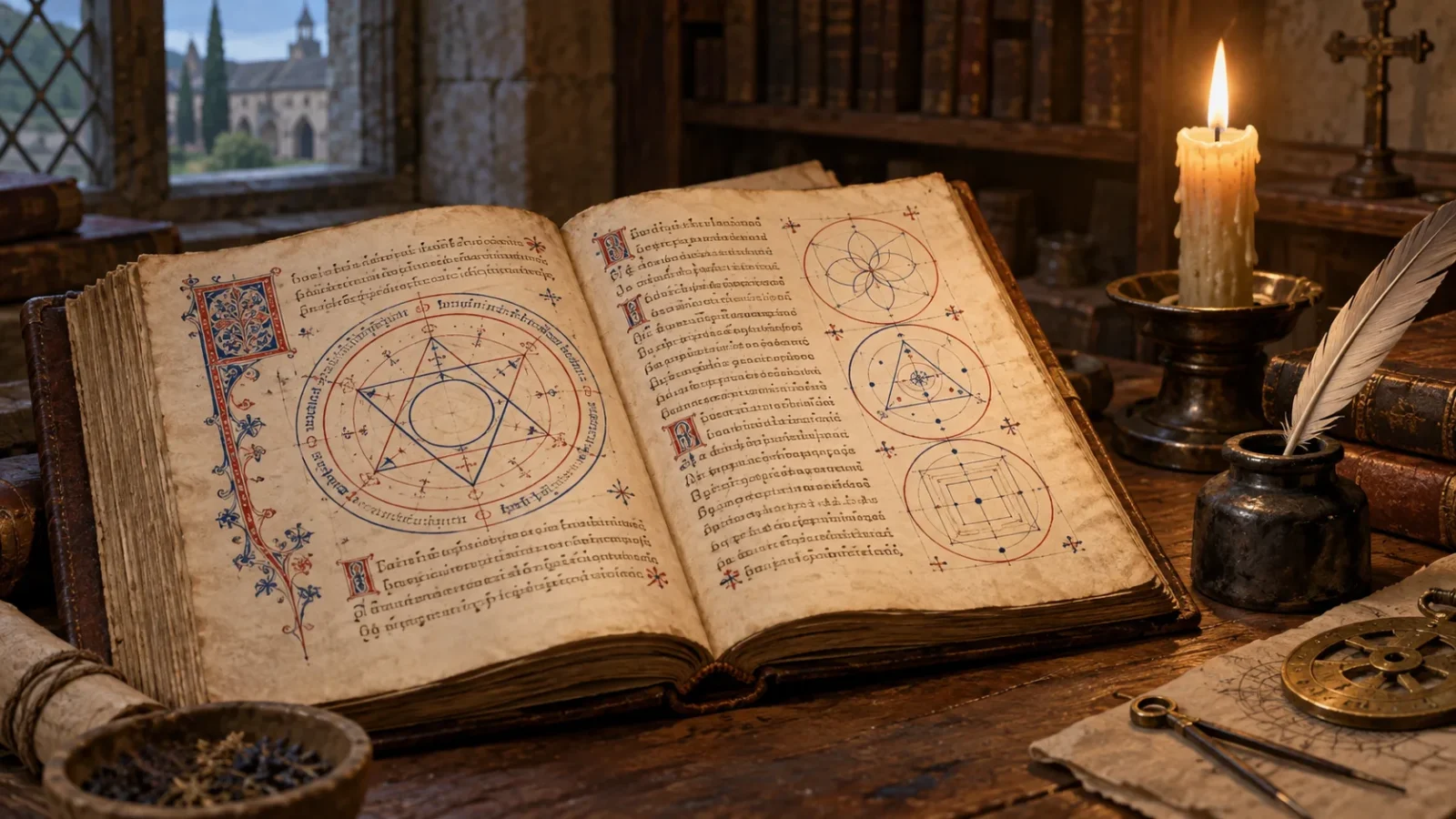
A medieval student opens a book and finds circles, unfamiliar signs and prayers set beside lessons in grammar, rhetoric and astronomy. The instructions promise something extraordinary: memory, eloquence and knowledge granted through prayer.
This is the Ars Notoria, or “Notory Art,” a medieval tradition that linked study with ritual. It did not promise a chest of treasure. Its ambition was intellectual: help a reader master the arts that formed a medieval education.
A manuscript for learning
The British Library catalogue describes two Ars Notoria texts in the thirteenth-century volume Sloane MS 1712. They contain prayers, holy and angelic names, geometric figures called notae, and instructions tied to subjects such as grammar, rhetoric and astronomy.
Keep exploring
Continue with Curiosmos
The work presents its knowledge as sacred. It was associated with Solomon, whose legendary wisdom gave the text authority, and described learning as something that could be granted by God through heavenly intermediaries. That framing placed the book close to a boundary medieval readers cared about: when did prayer become magic?
The diagrams are not illustrations in the modern sense. They belong to a procedure. A reader prepared themselves, recited prayers and contemplated a figure, asking for understanding or stronger memory. The text treated attention and devotion as part of study.
Prayer, memory and the promise of a shortcut
Medieval scholars used repetition, ordered images and structured places to help remember large amounts of material. The Ars Notoria put those habits inside a theological claim: knowledge ultimately came from God, and a disciplined ritual could make learning more direct.
That does not show that a reader suddenly mastered astronomy after staring at a diagram. It shows what the authors thought learning involved. A student could copy a figure, repeat a prayer and return to a difficult subject with a new routine, whether or not the promised revelation came.
The practice could look devotional to one reader and magical to another. Its prayers used Christian language, while its angelic names and ritual instructions raised suspicions among churchmen. Medieval people were already debating where prayer ended and forbidden arts began.
A changing book with an ancient name
The association with Solomon does not establish when the text was written. Sloane MS 1712 is a thirteenth-century manuscript, and the British Library catalogue also records a related work, the Opus Operum, attributed to John of Morigny.
Modern scholarship treats the Ars Notoria as a developing tradition rather than one fixed volume. An earlier version consisted largely of prayers and notae; a later version added ritual instructions and a history of the art, according to Penn State Press’s overview of Invoking Angels. The contents could differ from one copy to another.
That matters when reading modern summaries. A thirteenth-century manuscript, a later English translation and an occult edition printed centuries afterward are not interchangeable. The book’s story changed as people copied and interpreted it.
Why readers copied it
Learning in the Middle Ages took time, books and access to teachers. A text promising stronger memory and fluency would have appealed to students and clerics who spent their lives among difficult material. It offered a routine as well as a supernatural promise: prepare, repeat, focus, then study.
A study published through Persée describes the work as a form of theurgic magic that developed in the early thirteenth century, with angels and visionary revelation at its centre. Historians cannot verify those visions. They can study what the text says people hoped to receive and how its readers imagined the mind could be trained.
Picture a student in a cold stone room, copying a diagram and repeating a prayer before returning to grammar or astronomy. The image is easy to imagine; the outcome is not. The surviving manuscripts show a culture looking for a path through knowledge that joined discipline, devotion and the hope of a gift from beyond the classroom.