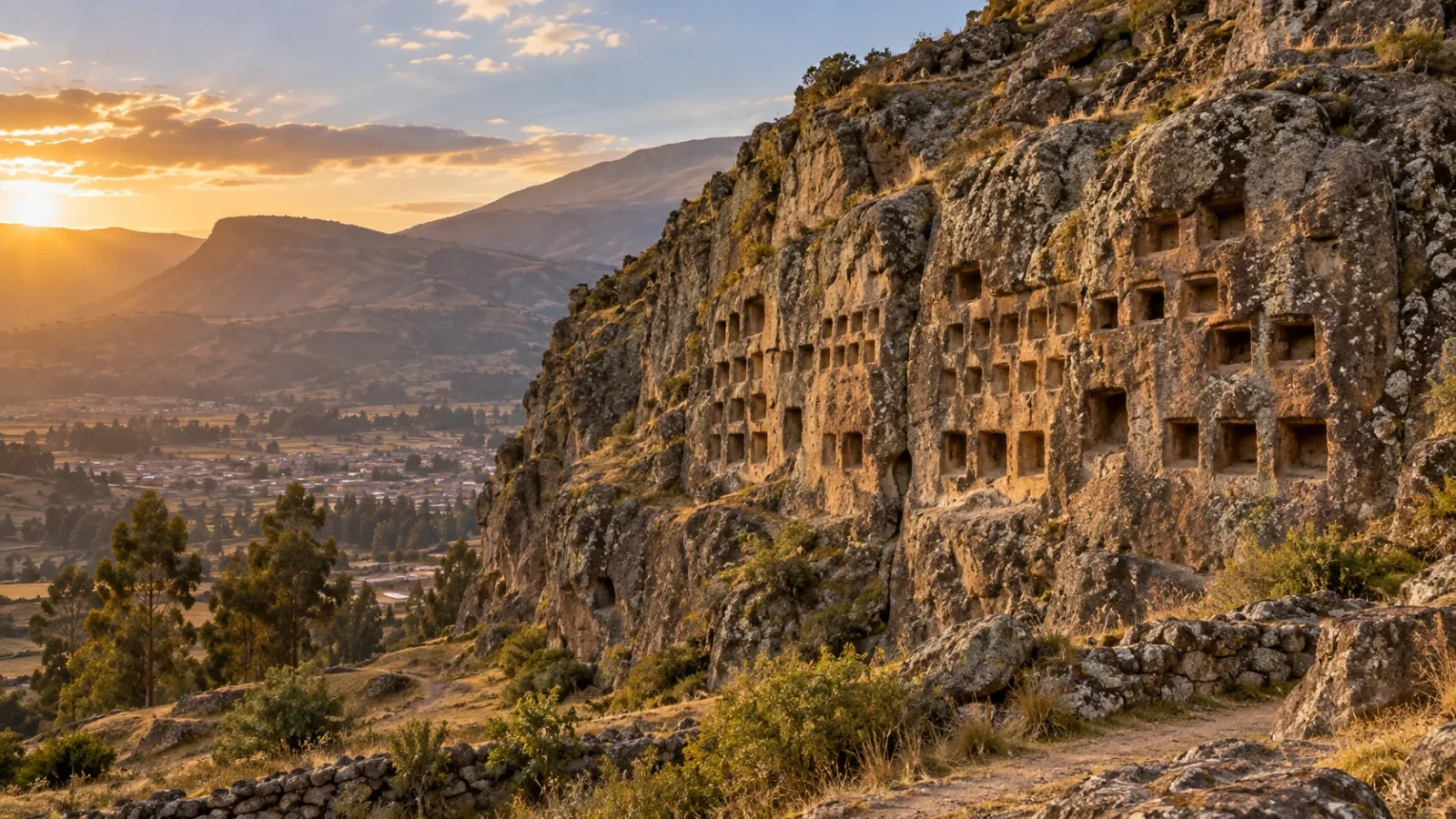
From across the valley, the rock face near Cajamarca looks as if someone cut a row of little windows into the mountain. Walk closer and the openings resolve into chambers carved in volcanic stone. The site is called Ventanillas de Otuzco—“little windows of Otuzco”—and archaeologists associate it with the Cajamarca tradition of pre-Hispanic northern Peru.
These were not windows for looking out. Peru’s official heritage inventory classifies the complex as a cemetery. Its chambers differ in shape and size, and some connect into galleries. The variety hints at a place used and altered over time, rather than one uniform tomb plan.
A cemetery shaped into the cliff
The Ministry of Culture describes the openings as individual and collective tombs. The tourism inventory also raises the possibility of secondary burial: bones may have been moved from an earlier grave and placed in a rock-cut chamber. Because complete skeletons are not present in every opening, that remains an interpretation rather than a full account of what happened in each niche.
Keep exploring
Continue with Curiosmos
Some passages reportedly extend eight to ten metres into the rock, while individual cavities can be only half a metre to about 60 centimetres high. Such differences suggest multiple designs or stages of use. The form of a chamber alone cannot tell us how many people were buried there or exactly when it was cut.
Ventanillas de Otuzco belongs to the Cajamarca cultural tradition, whose communities occupied the northern Peruvian highlands before and during the expansion of the Inca state. “Pre-Inca” is a useful chronological label, but it can make the region sound as if nothing changed until the Inca arrived. Cajamarca had its own communities, styles and connections long before that expansion.
Water, stone and the living
Rainwater was a concern for the people who made the chambers. Peru’s official inventory records channels shaped to carry water away from ledges and openings. The detail is practical: in a highland climate, water entering cracks could damage both the cliff and the burials inside it.
Stone slabs with relief decoration have also been reported in connection with the chambers. They may have closed or marked some openings, though the surviving fragments cannot reconstruct every entrance. The cemetery was part of a visible landscape that people could return to, maintain and change.
Archaeologists still need more secure dates for individual chambers. Pottery from the wider area can show activity at different times, but an object found nearby does not automatically date the carving. A specialist study of burial practices in Cajamarca describes ventanillas as one form among several and calls for further bioarchaeological work.
The cliff is at risk
Recent geological work has shifted attention from the age-old question of who made the openings to the condition of the site. In a 2023 assessment, Peru’s geological and mining institute, INGEMMET, documented fractured, weathered volcanic deposits, steep slopes and signs of rockfall.
The report identified moved blocks between about half a metre and 2.5 metres across and classified the area as high hazard during exceptional rain or earthquakes. Water can seep into fractures above the niches; poorly maintained drainage makes that problem worse.
INGEMMET recommended maintaining diversion channels, sealing critical fractures and carrying out conservation under archaeological supervision. These repairs matter because a falling block or washed-out ledge could destroy evidence that cannot be put back.
What the openings preserve
The chambers show that Cajamarca communities invested labour in a shared place for the dead. Their shapes, water channels and setting help archaeologists study how burial, geology and memory came together. The missing bones, offerings and dates leave important questions open, but the cliff has already preserved a great deal.
The next work is practical as well as archaeological: establish which chambers belong to which periods, learn more about the people buried there, and keep the rock face stable enough for future study. The little windows are carved into a living landscape, one still shaped by rain and gravity.
Curiosmos has also examined how ancient stone sites change our understanding of the past. At Otuzco, protecting the cliff is part of protecting the history inside it.
Sources
- Peru Ministry of Foreign Trade and Tourism, Ventanillas de Otuzco inventory.
- Peru Ministry of Culture, Ventanillas de Otuzco virtual tour and mortuary context.
- Silverman, D’Altroy and colleagues, “Theorizing residential burial in Cajamarca, Peru.”
- INGEMMET, 2023 technical assessment of rockfall hazard at Ventanillas de Otuzco.