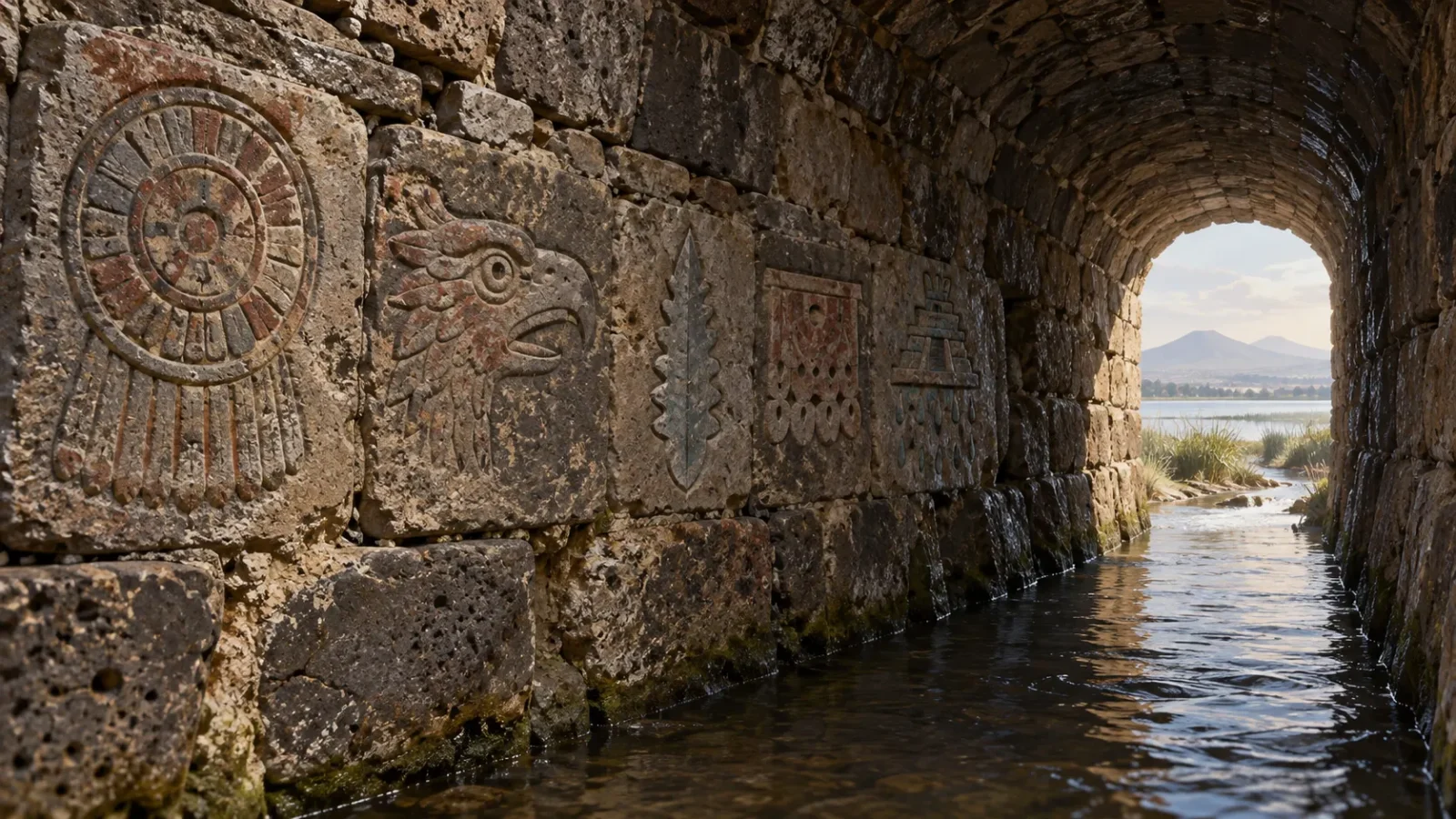
At first, the tunnel through the Albarradón de Ecatepec looks like a piece of colonial engineering. Then the carvings come into view: a round war shield, a bird of prey, a flint point and a relief that archaeologists have linked to a temple and the rain god Tlaloc.
The tunnel was built centuries after the Spanish conquest, but its walls carry images made before 1521. The stones tell a story of reuse. Older material and local knowledge became part of a water system that was rebuilt more than once.
A dike between the lakes
The Albarradón de San Cristóbal, also called the Albarradón de Ecatepec, lies between the former lakes of Xaltocan and Texcoco, north of Mexico City. INAH describes it as a major part of the region’s hydraulic landscape. The dike helped separate fresh and saline water and reduce flood danger to Tenochtitlan.
Keep exploring
Continue with Curiosmos
The structure has several chapters. A Mexica–Texcoco dike existed before the conquest. Fighting around Tenochtitlan damaged it, and after a severe flood in 1604 it was substantially rebuilt. Repairs continued through the colonial period and later centuries, so the surviving structure cannot be assigned to a single construction date.
Eleven images in an eight-metre passage
In 2019, an INAH rescue excavation documented an 8.4-metre gate tunnel through the dike. Researchers recorded eleven pre-Hispanic images carved or modelled in stucco along the sides and arch. They include a chimalli, or war shield, a bird of prey’s head, a flint point and a motif archaeologist Alfonso Caso had described as a paper ornament.
Above the arch, a relief on the keystone resembles a teocalli, a temple form. Three lobes and stucco details like falling drops led the excavators to associate it with Tlaloc, the deity linked with rain and fertility. That is an interpretation of the imagery; no label beside the relief names the god.
Old stones in a new water system
Some blocks were likely reused from earlier buildings, though the evidence does not show that every carved stone came from one temple. Colonial projects across central Mexico incorporated material from pre-Hispanic structures. The Albarradón was a major undertaking: a contemporary account cited in reports on the excavation says about 3,000 Indigenous workers built the early seventeenth-century dike under Spanish supervision.
Those workers knew the landscape and its flooding. The project combined Spanish authority with local labour and materials from a region whose waterworks predated the conquest. Some carvings may have come from pre-Hispanic centres such as Ecatepec and Chiconautla; others may have been finished or placed during the colonial work. The stones do not reveal when each mark was made.
A Tlaloc relief above the water
The relief’s position above a gate where water moved through the dike catches the eye. It may have been older masonry fitted into a convenient place. Its location may also have felt suitable to builders working on a structure that controlled water. Both are possibilities; the excavated context cannot tell us exactly what the builders intended.
Water in the Valley of Mexico shaped crops, travel, political power and the risk of floods. The image’s connection to Tlaloc brings that older religious world into a structure designed for a very practical job. The tunnel may have held different meanings for people who built, repaired and passed through it over the centuries.
More than carved stones
INAH’s reports also mention colonial glass, porcelain and majolica, fragments of statues, four iron nails and two wooden beams about 6.5 metres long. These finds show that the tunnel was used and repaired over time. It was infrastructure, a work site and a place where earlier objects were carried into a new setting.
The Albarradón’s layered construction makes preservation especially important. Remove a stone from its wall and it becomes harder to tell when it was carved, where it first stood or how it worked as part of the water system. INAH’s heritage record documents later channels and gate structures, some threatened by traffic, debris and water damage.
The tunnel holds two histories in the same passage: the older images and the colonial structure built around them. The carvings did not have to stay in their first setting to remain part of the landscape. They were carried into a new one.
Curiosmos has also reported on caves and tunnels beneath Teotihuacan, another example of how water and underground spaces shaped Mesoamerican sites.