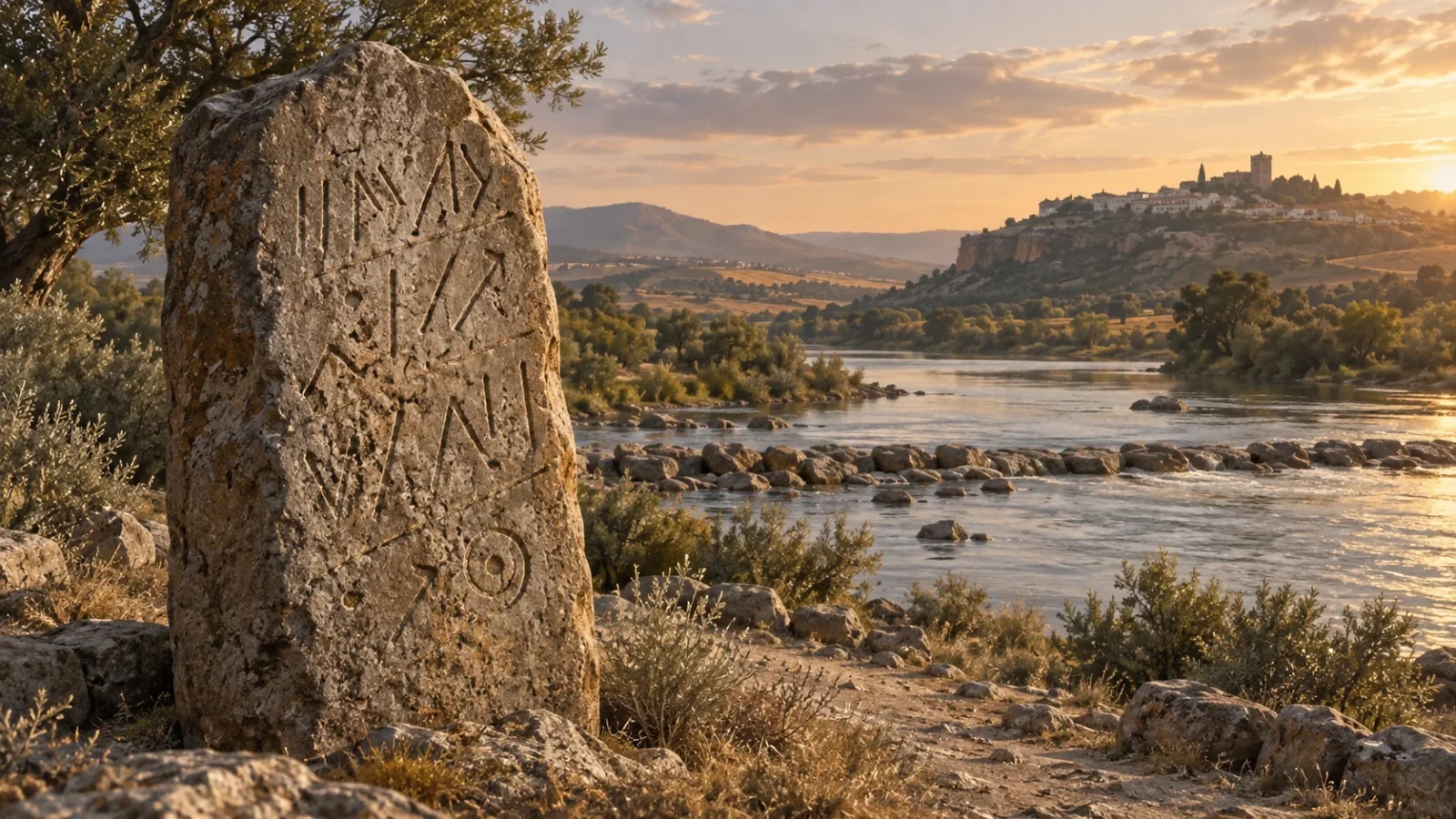
A tractor uncovered the Montoro stela in a field near the Guadalquivir River in southern Spain in 2002. The stone stands about 1.5 metres tall. Its surface carries dozens of engraved marks, several of which resemble signs from known writing systems.
Researchers have not been able to read them as a text. The stela may preserve an early encounter with writing, or it may use familiar signs for a purpose other than spelling words. Its date and original setting remain uncertain.
A stone beside an old river crossing
The farmer found the monument near Torre de Villaverde. Researchers believe it probably stood close to its original position, although the discovery did not come from a sealed archaeological context. The carved face shows little obvious weathering.
Keep exploring
Continue with Curiosmos
The stela is about 1.5 metres high, 85 centimetres across at its widest point and up to 31 centimetres thick. Geological analysis identified a sedimentary subarcose rock available near Montoro, so the stone likely came from the surrounding region.
Its location near an old route and a ford across the Guadalquivir may help explain why the monument was visible to people moving through the valley. Decorated stones from later prehistoric periods in southwest Iberia also appear near river crossings and routes between settlements.
Thirty-one marks, several possible scripts
The research team recorded 31 engraved motifs. Some are shallow and hard to see in ordinary light. Reflectance Transformation Imaging, digital recording and three-dimensional survey helped researchers follow faint grooves and overlapping marks.
They considered 21 motifs possible writing signs; 13 were clear enough to discuss as potential graphemes. Several resemble signs used in Iberian traditions, while others invite comparison with Proto-Canaanite, Proto-Sinaitic and South Arabian scripts. The set does not resolve into any one of those systems.
A shape that resembles a letter is not automatically a letter. Signs have to recur in patterns and behave consistently before scholars can identify a script or attempt a reading. The Montoro marks have not produced a sequence that researchers can translate.
Rongorongo offers a useful comparison: the undeciphered Rongorongo tablets also preserve carefully ordered signs without giving researchers a reading that holds across the surviving corpus.
Two possible histories
The researchers discuss two broad possibilities. If the stela is early, its makers may have encountered literate visitors from the eastern Mediterranean and adopted signs without using them to write a language. In that case, the marks could have borrowed some of writing’s visual authority while remaining part of a local tradition of monumental stones.
A later date would put the monument in a period when the area had contact with Carthaginian and Iberian communities. Its makers might then have understood the signs but used them as emblems, identifiers or codes rather than ordinary sentences.
The evidence cannot yet choose between those readings. Fieldwork around the stone did not find a sealed layer that would fix its date. A geophysical survey detected a large rectangular feature nearby, but excavation and radiocarbon dating would be needed to show whether it belonged to the same monument.
Writing, image or something in between?
The Montoro stela may eventually help explain how writing reached communities in Iberia. For now, it does not establish the earliest writing in the region, and its motifs cannot be translated. The authors of the 2017 study raised the possibility that it was an early monumental script, while making clear that its date and function remained unresolved.
The stone’s marks still record a moment of cultural contact—or a community’s use of signs that looked powerful and familiar. The people who made them chose a prominent stone near a river route. We can describe the shapes and compare them with other scripts; we cannot yet say exactly what the monument said to the people who passed it.
Sources
- García Sanjuán et al., “The epigraphic stela of Montoro (Córdoba): the earliest monumental script in Iberia?”, Antiquity 91 (358), 2017, DOI 10.15184/aqy.2017.86.
- University of Seville research summary on the Montoro stela.