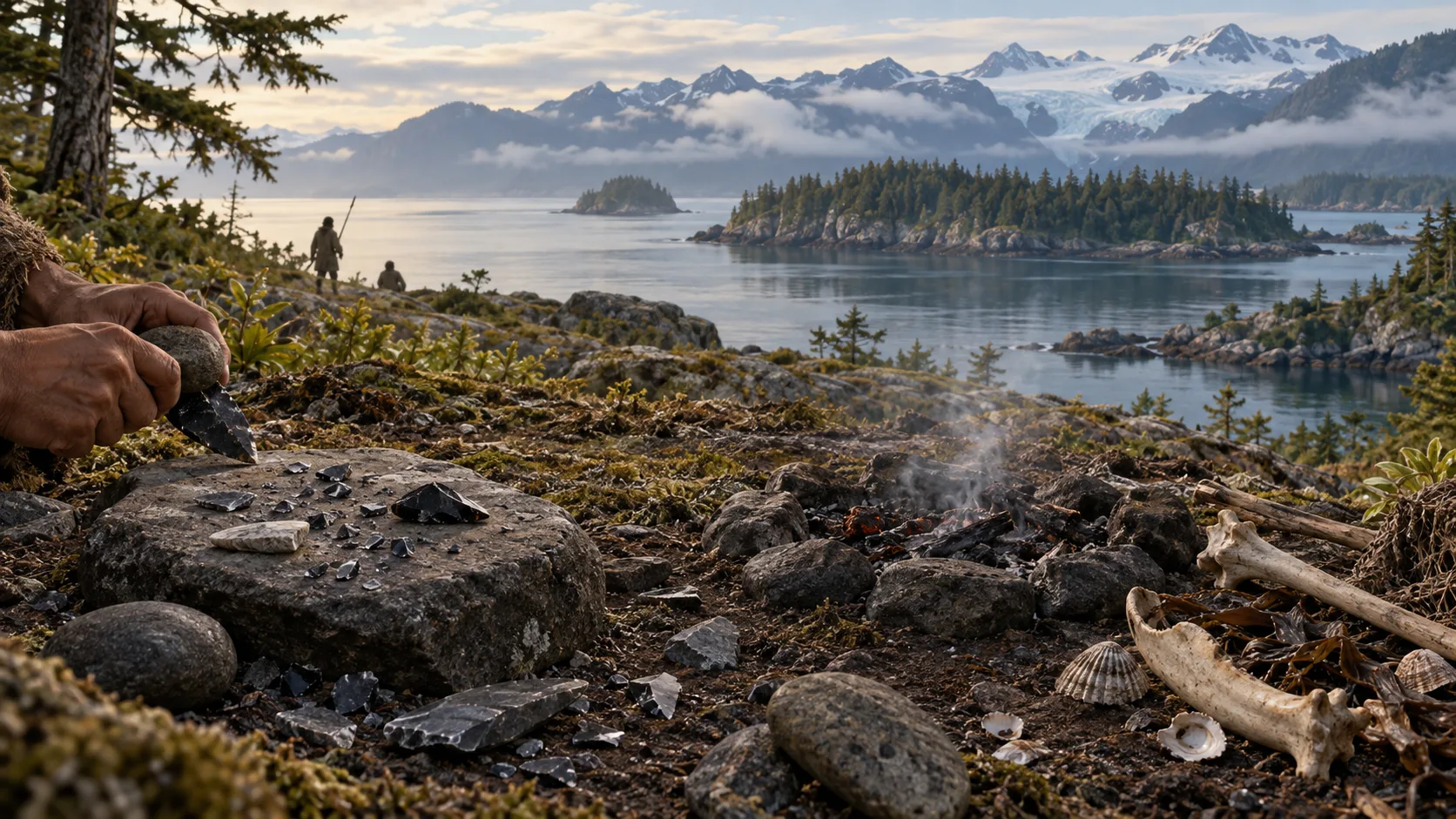
A small stone anvil lay on a terrace above the water at Triquet Island, on British Columbia’s central coast. Charcoal nearby was later dated to between about 14,802 and 13,748 years ago. The finding places people on the island near the end of the last Ice Age, when glaciers still covered parts of the region and the shoreline looked very different.
Archaeologists record the site as EkTb-9. Haíɫzaqv researchers call the long sequence Gáḷgḷ̓a. Hearths, tools and food remains show that people returned to the island repeatedly across thousands of years.
What the earliest date means
The radiocarbon result comes from charcoal found beside the anvil. It dates the burned wood, while the layer and position of the nearby stone help archaeologists assess whether the two belong together. The result supports human activity at the site by the end of the Ice Age; it does not make every object on Triquet Island 14,000 years old.
The wider sequence extends through the early Holocene. Instead of a single visit, researchers see people coming back to a coastal place that remained useful as the climate and landscape changed.
A shoreline that kept moving
Coastal sites are easily lost. Waves wear away camps, rising seas cover old beaches and sediment buries traces of earlier settlements. Around Triquet Island, relative sea levels were comparatively stable after the last glacial period, leaving the terrace accessible to archaeologists.
The region itself had been changing. Geological evidence indicates that some areas were free of glacial ice by about 16,800 years ago. That makes earlier human activity possible, although researchers have not found a camp at Triquet Island that old.
What survives shapes what archaeologists can see. A missing camp may have been destroyed, drowned or left in a part of the coast that has not yet been excavated.
Food and tools over generations
More than 14,000 animal bones have been recovered. Early layers include many marine mammals; later inhabitants relied more on fish and other resources. The change may reflect new tools, shifts in animal populations or a changing coast. The sequence lets researchers follow those choices over time rather than treat coastal life as one unchanging way of living.
Obsidian from Anahim Peak, more than 200 kilometres away, reached the island. The volcanic glass could have travelled through exchange, direct journeys or both. Its presence links Triquet to people and places well beyond the shoreline.
A fragment of an atlatl from a later layer, dated to around 7,000 years ago, adds another stage to the record. Tools changed as people returned to the island and adapted to the work at hand.
Reading the tsunami layer with care
A gray sediment layer records a powerful marine event that may have been a tsunami or another sudden disturbance. Haíɫzaqv oral histories preserve accounts of earthquakes and waves. Researchers compare those histories with the sediment, regional geology and dating evidence.
The deposit alone cannot identify a particular earthquake or prove that one oral account describes that exact event. The collaboration matters because Haíɫzaqv knowledge, language and place names shape which questions researchers bring to the site. Community members worked with archaeologists to sift more than five cubic metres of soil and interpret what was found.
A coastal history, not a single migration map
Triquet Island provides strong evidence for people living and travelling along British Columbia’s coast by the end of the Ice Age. Its hearths, marine food, tools and distant obsidian show a community connected to both sea and interior.
One site cannot map the first settlement of the Americas or establish a single route for every early population. Camps older than the one at EkTb-9 may lie beneath the sea or under younger deposits. What the island preserves is a long record of people returning to a place, adjusting how they lived and maintaining connections across a changing coast.
Curiosmos has also reported on ancient settlements in the Amazon, another early record of communities adapting to a landscape over time.
Sources
- Triquet Island/Gáḷgḷ̓a project, Hakai.
- University of Victoria thesis on EkTb-9 and Haíɫzaqv archaeological interpretation.
- University of Victoria report on the 14,000-year-old site.
- Geoarchaeology and paleoshoreline research at Triquet Island.
- Journal of Archaeological Science: Reports, DOI 10.1016/j.jasrep.2023.103884.