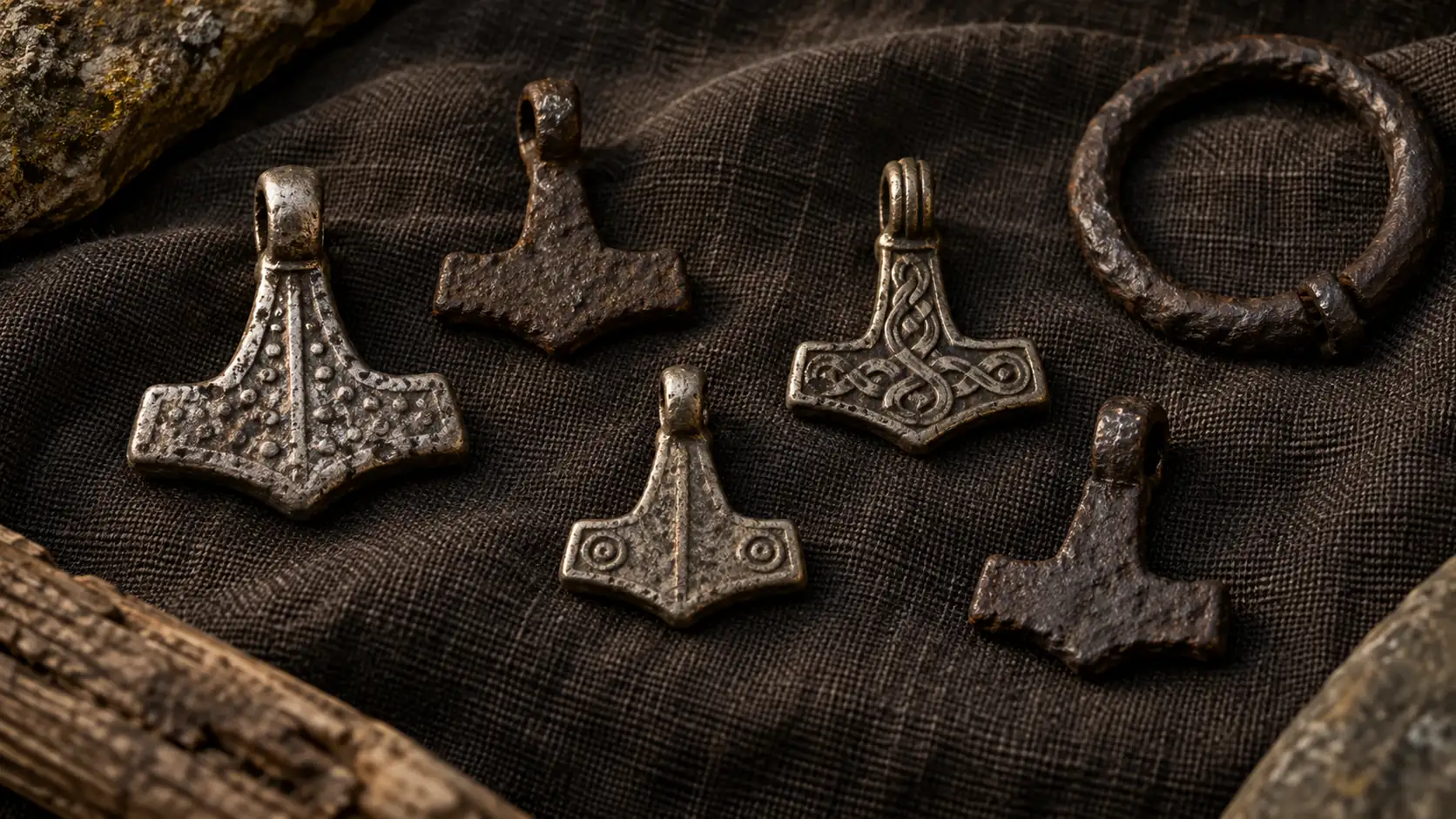
A Viking-age pendant from Købelev in Denmark carries an unusually helpful message. A runologist read its inscription as “This is a hammer.” Someone had named the little object that archaeologists would find centuries later.
That solves one question about its shape. Why people wore such objects, placed them in graves or kept them among valuables takes us further into the lives around them. A hammer from a burial urn has a different history from one recovered among household debris.
The pendant that names itself
In a June 12, 2014 report, the National Museum of Denmark described the tenth-century Købelev find as just 2.5 centimetres long. Runologist Lisbeth Imer identified two words, separated by a mark, naming it as a hammer. The carver had omitted a vowel and reversed one rune.
Museum archaeologist Peter Pentz explained why this mattered. Some researchers had questioned whether the short-handled, symmetrical pendants really represented hammers. The inscription supports that identification in the words of someone from the Viking Age.
We can be more confident about the object the carver meant to show. The inscription still leaves us wondering what its wearer asked of it.
Compare the grave with the settlement
The Swedish History Museum describes small iron hammers threaded onto larger rings in cremation graves around the Mälaren Valley. Their position near the top of burial urns suggests a part in the funeral or an offering to the dead.
At Viby Gård in Sollentuna, a ring dated to the ninth or tenth century came from a settlement layer containing nails, knife blades, a whetstone and pottery. Fragmentary hammer rings also appeared in the nearby burial ground. A single area therefore gives us both a settlement find and funerary examples to compare.
The museum’s overview counts around fifty silver hammers, chiefly from hoards and some graves. That figure concerns silver examples in its account; it is not a total for every material or all Viking-age finds.
Material and placement let us ask more precise questions. Was this piece selected for a funeral? Did it enter a hoard with other valuables? Was it lost or left at a settlement? The answer changes where we begin interpreting it.
A hammer and a cross could share a life
In her 1989 study “Viking and medieval amulets in Scandinavia”, art historian Signe Horn Fuglesang discusses a casting mould from Trendgården in Jutland that could produce crosses and a hammer. The two forms were being made together.
She also identifies Birka grave 750 as containing both a cross and a Thor’s hammer. These finds complicate the idea that every hammer was a declaration against Christianity. A workshop could serve different customers; one burial could contain both symbols. Neither tells us that everyone used them alike.
The Swedish museum supplies another close example: a fragmented ring from Skälby, object 878094_HST, lay at the foot of a skeleton grave it describes as Christianized.
What if a person wanted the protection associated with more than one symbol? Pentz raises that interpretation in the Danish museum’s account. It fits some mixed finds, although an individual wearer’s reasons remain a matter of interpretation.
The small differences deserve our attention
In the Danish silver hoard covered by Curiosmos, identifying a small cross or hammer also requires close attention to its form. Købelev offers the rare advantage of an inscription. Most pieces leave archaeologists to work with shape, material and where they were found.
Thor’s hammer becomes more interesting when we follow those differences. The urn-top ring, the settlement find and the mixed burial put the familiar symbol into particular moments: a funeral, life around a dwelling, a meeting of religious customs. Calling all of them the same statement would lose those histories.
Sources
- National Museum of Denmark: Runer bekræfter: Thors hammer er en hammer, June 12, 2014.
- Swedish History Museum: Thor’s hammer rings, including the Viby Gård find.
- Swedish History Museum: Skälby hammer ring, object 878094_HST.
- Signe Horn Fuglesang: “Viking and medieval amulets in Scandinavia”, Fornvännen 84 (1989), pp. 15–27; hammer and cross discussion on pp. 16–18.