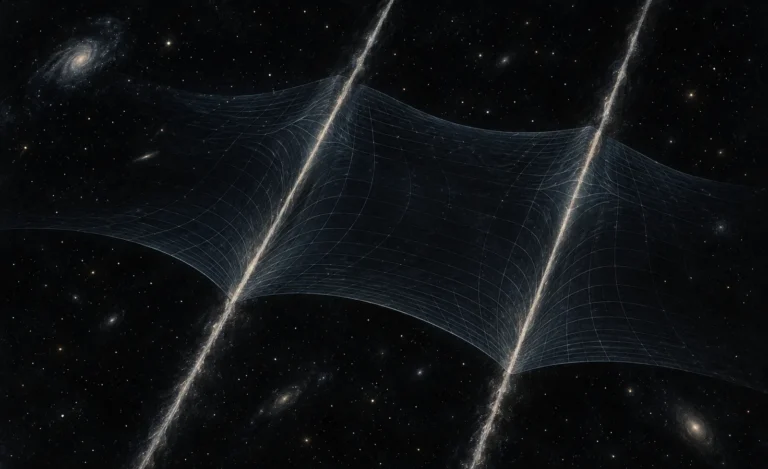
A neutron star only about 20 kilometres across is orbiting a blue hypergiant nearly 60 times the Sun’s diameter. Every 41.5 days, the compact object moves through a stream of gas flowing away from its enormous companion. The encounter produces powerful X-ray flares.
That sounds like a scene from a science-fiction film, but it is a real binary system called BP Crucis. What makes the latest observation special is the way astronomers followed the gas. Using the Japan-led XRISM observatory, they measured the fingerprints of iron in the X-ray light and found evidence that the plasma was moving toward the neutron star at about 540,000 kilometres per hour.
The result raises a beautiful question: how can a telescope tell that gas is falling onto something it cannot see directly?
A star that is losing itself into space
BP Crucis contains a blue hypergiant known as Wray 977 and a neutron star called GX 301−2. Wray 977 is roughly 40 times as massive as the Sun and about 60 times as wide. Its outer layers are so hot and loosely held that gas continually escapes as a stellar wind.
The wind is not an empty breeze. It is a flow of ionised atoms—gas whose electrons have been stripped away by the star’s intense radiation. GX 301−2 travels through this outflow as it follows its elongated orbit. When the neutron star passes through a particularly dense part of the stream, its gravity captures some of the material.
GX 301−2 is also a pulsar. It rotates once every 11 minutes and sends a beam of X-rays toward Earth. The neutron star is the crushed core left by an earlier stellar explosion: more than a Sun’s worth of matter compressed into a city-sized object. Curiosmos has previously explained why that combination of size, mass and rotation makes neutron stars so extreme in our guide to neutron stars.
What happens to the captured gas?
The falling material does not necessarily drop straight onto the surface. As gas approaches the neutron star, its motion can give it enough angular momentum to form a turbulent accretion disk. The gas circles, collides with itself and heats up, releasing X-rays.
The system changes as the pulsar moves through the wind. Near the beginning of the dense stream, a messy disk can form. Deeper inside, the flow may carry too little angular momentum to keep the disk stable. It can break apart, allowing material to move more directly toward the neutron star. As GX 301−2 leaves the stream, another disk can form with the opposite sense of rotation.
This is a model of a rapidly changing process, rather than a film taken by a camera. The important evidence comes from the light that the gas produces and absorbs along the way.
Reading motion in an iron line
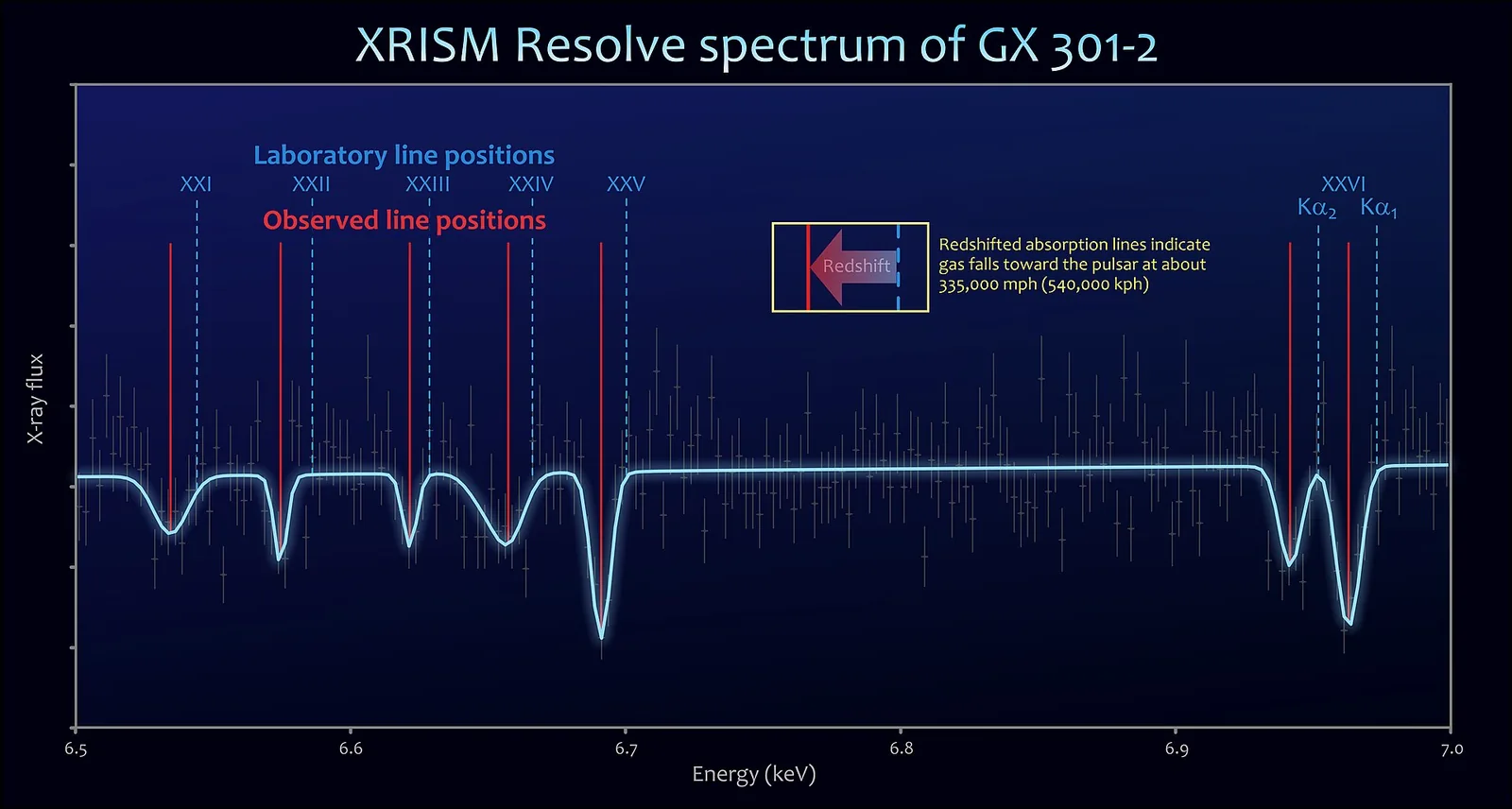
XRISM watched BP Crucis for about 16 hours on February 1, 2025, near the end of one of the system’s stronger flares. Its Resolve instrument separates X-ray energies with unusual precision. That lets researchers identify absorption lines made by highly ionised iron in the gas around the pulsar.
Every chemical element has a set of preferred energies at which it absorbs or emits light. If the gas is moving, those lines shift. In this case, the iron absorption lines were displaced toward lower observed energies. That redshift indicates that the absorbing gas is moving away from Earth—toward the pulsar on the far side of the flow.
The amount of the shift gives the speed. The team calculated that the plasma was moving toward GX 301−2 at around 540,000 kilometres per hour. The observation does not show a glowing stream in an ordinary photograph. It shows the stream through the way its atoms alter X-rays passing through it.
That distinction matters. Astronomers often study objects that are too small, distant or energetic to resolve directly. They reconstruct what is happening from changes in light, timing and motion, much as a listener can infer a passing train from the changing pitch of its horn.
Why this observation is different
Astronomers have long understood that compact objects can draw material from a companion’s wind. The challenge has been to catch the flow close to the neutron star and measure its direction while the system is flaring.
The Science Advances study describes the XRISM spectra as direct spectroscopic evidence of matter falling onto a compact stellar object. The word “spectroscopic” carries the weight here. It means the conclusion comes from resolved patterns in the light, including the displaced iron lines, rather than from brightness alone.
The observation also helps test how wind-fed accretion works. A model can predict that the pulsar should encounter a dense stream and flare, but high-resolution spectra reveal whether the gas is actually moving as expected near the neutron star. Future observations at other points in the orbit can show whether the pattern repeats and how the disk changes from one passage to the next.
What remains unknown?
The system is a remarkable laboratory, but one observation is still one view of a complicated orbit. The researchers observed BP Crucis during a strong flare and inferred the structure of the flow from its X-ray lines. They did not resolve every part of the accretion disk, measure the wind at every distance or prove that all pulsars feed in the same way.
There is also a useful difference between “captured” and “consumed.” The neutron star’s gravity can pull gas into its surroundings, but some material may be redirected, heated or expelled before reaching the surface. The changing disk is part of that story.
For readers who want the wider context, Curiosmos has also looked at how astronomers distinguish neutron stars from black holes and how X-ray observatories reveal objects that cannot be seen in ordinary light.
A blue hypergiant shedding its outer layers and a city-sized remnant gathering some of that gas may sound like a cosmic collision. It is more subtle than that. The two objects keep their orbit, while the neutron star briefly passes through a river of plasma and lights up as it does so.
The next question is just as interesting as the first: when XRISM watches another passage, will the iron lines trace the same flow—or reveal that the stream changes every time?
Sources and further reading
- NASA Science: NASA-JAXA XRISM Mission Sees Pulsar Gathering Companion’s “Wind”
- Rahin et al. 2026, “Direct spectroscopic observation of matter falling onto a compact stellar object,” Science Advances
- NASA Scientific Visualization Studio: BP Crucis / GX 301−2 visualisation and media
- XRISM mission overview