Radiation remains one of the hardest problems in sending people beyond Earth’s protective atmosphere. A vest tested during NASA’s uncrewed Artemis I mission could reduce the dose received by astronauts during severe solar particle events, according to a new analysis of the mission’s measurements.
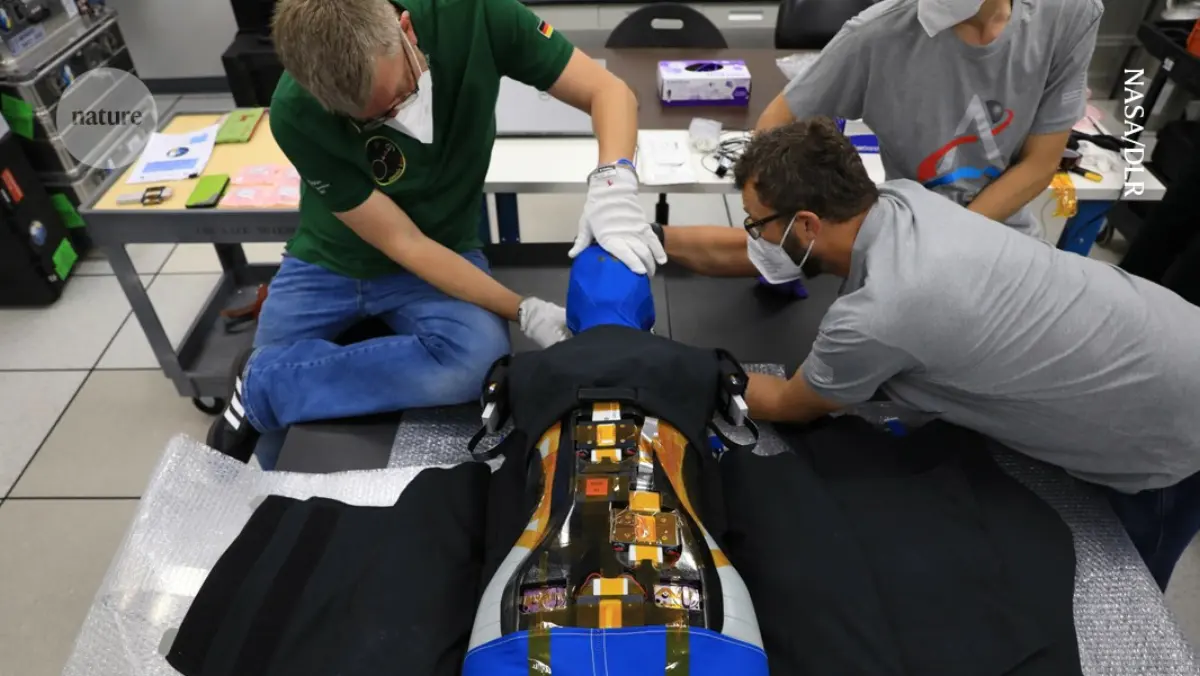
The AstroRad vest was worn by a mannequin named Zohar inside the Orion spacecraft during the 25-day flight around the Moon and back in 2022. A second mannequin, Helga, flew without the vest. Both carried radiation sensors, allowing researchers to compare how much energy reached the body in the same spacecraft and under the same flight conditions.
Why solar storms are dangerous
The main threat is not the steady background radiation alone. Powerful eruptions from the Sun can send bursts of energetic protons through space. A direct hit during a lunar or Mars mission could raise the risk of acute radiation sickness and long-term illnesses, particularly in tissues such as bone marrow, lungs, stomach and reproductive organs.
Building an entire spacecraft with enough shielding to stop every particle would make it too heavy to launch. The vest takes a more focused approach. It covers organs and tissues that are especially sensitive to radiation while leaving the rest of the spacecraft and suit design unchanged.
The Artemis I test
Artemis I did not encounter a major solar storm during its flight, so the researchers used the sensor measurements from the mission to model what would have happened during historic events. Their analysis considered a solar particle event similar to the storm of August 1972 and another comparable to the 1989 event that disrupted electrical systems on Earth.
The results suggest that the vest could reduce the effective dose by about 60 per cent in a 1972-level event and by nearly 40 per cent in an event like the 1989 storm. The exact benefit would depend on the spacecraft’s position, the storm’s energy spectrum and how long the crew remained exposed.
The comparison is based on the distribution of radiation inside Orion, not a direct encounter with either historic storm. Artemis I flew during relatively quiet solar conditions, so the team used the mannequin sensors to reconstruct how those particle events would have moved through the spacecraft. That makes the figures modelled estimates, but they are grounded in measurements from an actual deep-space vehicle rather than a laboratory simulation alone.
Those percentages do not mean the garment makes a solar storm harmless. They mean that the protected tissues would receive a substantially smaller dose than they would without the vest. The difference could be important during missions that last weeks or months, when crews cannot simply wait for the radiation to pass without consequences.
The weight problem remains
Zohar’s vest weighed about 26 kilograms. That is a significant mass for a mission in which every kilogram competes with fuel, life-support equipment and scientific instruments. The researchers are therefore working on lighter materials and are examining whether a spacecraft could use supplies already on board to create additional shielding during a storm.
The test also shows why uncrewed missions remain valuable even when their primary goal is not human health. The Orion mannequins recorded the radiation environment in deep space without placing a crew at risk. Those measurements give engineers a way to test protective equipment before astronauts spend longer periods near the Moon or travel toward Mars.
The vest is designed for the moments when a crew cannot reach the most protected part of the spacecraft. It covers the torso and organs that are especially vulnerable, but it does not turn the whole cabin into a storm shelter. Mission designers still need warnings from solar observatories, a protected area and a plan that lets the crew reach it quickly.
Future crews will still need forecasts, shelters and operational plans. A vest cannot replace a well-shielded spacecraft or a storm shelter. It could, however, add another layer of protection when an astronaut must move through the vehicle or work outside a heavily shielded area.
The Artemis I results do not solve the radiation problem. They show that protection can be designed around the human body rather than added to every surface of a spacecraft, giving mission planners another practical tool as deep-space expeditions become longer.
Further reading
the first Moon base before astronauts arrive, why Mars missions need layered protection, and why stars twinkle while planets usually do not
Sources
Nature research highlight · DLR report on the MARE experiment · Science Advances study