Murujuga in Western Australia holds one of the world’s largest concentrations of rock art, with engravings made over roughly 50,000 years. New research suggests that historic sulfur pollution may have altered a wider area of the carved rock than earlier assessments recognised, while current monitoring has not found evidence that today’s emissions are rapidly speeding up the deterioration.
The finding comes from a long-running program involving five Aboriginal language groups and more than 50 Curtin University scientists. The work combines air measurements, rock chemistry and detailed studies of the surface on which the petroglyphs were made. That distinction matters: the study is examining how the rock changes, not claiming that every mark at Murujuga is being erased by present-day industry.
A record written into stone
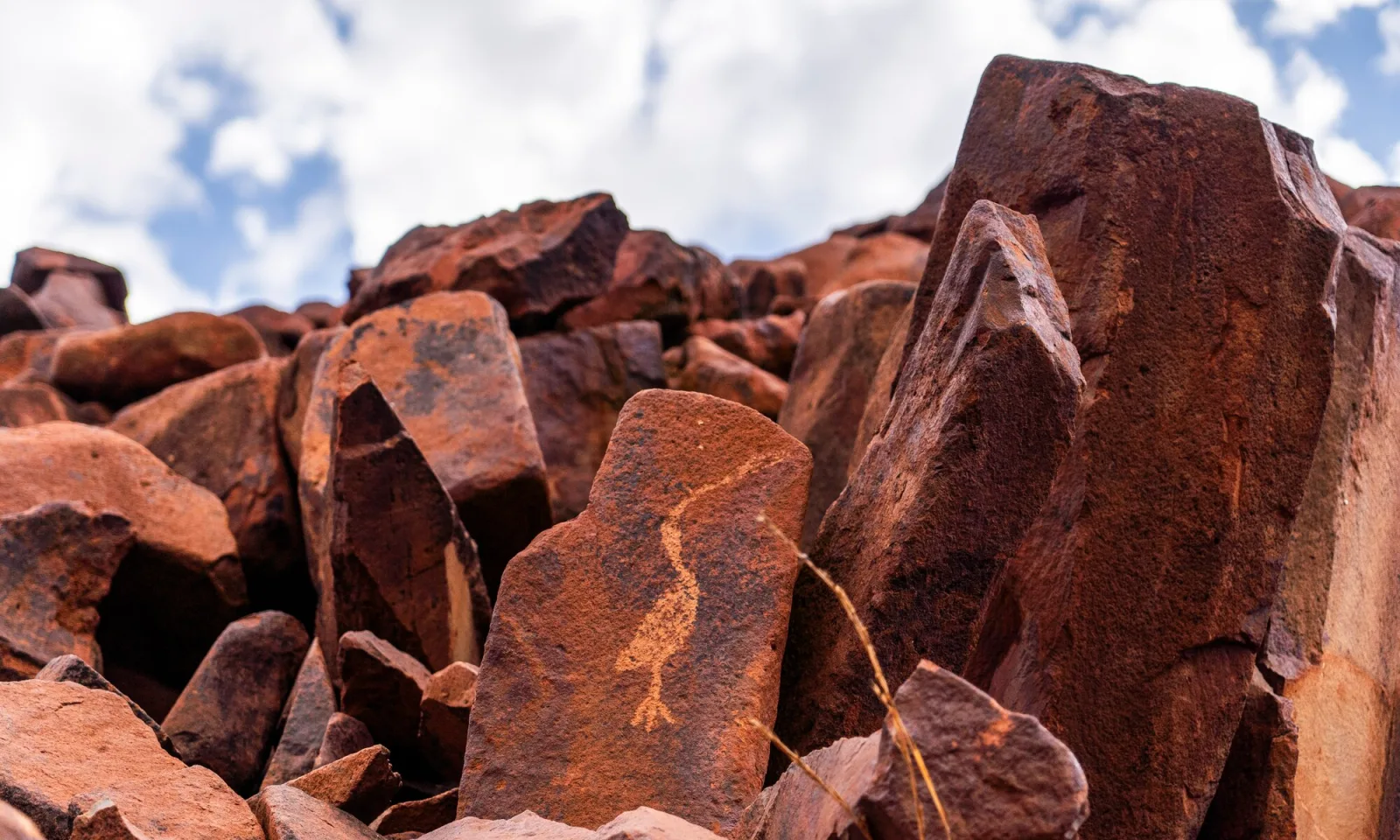
Murujuga’s engravings include human figures, animals, tools and images of species that are no longer found in the region. Some are tens of thousands of years old. The pictures were cut into dark rock coatings, so weathering changes both the surface and the contrast that makes the designs visible.
The rocks are exposed to salt, wind, rain and heat even without industrial pollution. Scientists therefore need to separate natural weathering from chemical changes associated with the atmosphere. The monitoring project compares sheltered and exposed surfaces, measures the chemistry of the outer layers and records how the engraved areas change through time.
What sulfur changed
A study published in Scientific Reports found higher porosity in the outer rock layer at locations where historic sulfur dioxide emissions had been greatest. Porosity describes the tiny spaces within a material. When the outer layer becomes more porous, water and salts can move through it more easily, potentially making the surface less resistant to weathering.
The pattern does not match a simple story in which today’s air quality alone explains the damage. Researchers reported that rain at the site is not unusually acidic and that recent air measurements do not map neatly onto changes in surface pH. The strongest relationship was with the history of sulfur emissions, which were higher during earlier industrial activity than they are now.
That is why the team describes the damage as likely historic. A chemical change can continue to affect a rock after the original pollutant has declined. The present monitoring work is testing whether the altered surface remains stable or whether natural weathering now becomes the larger influence.
Why the result is difficult to interpret
Rock art is not a single material. Different stones weather at different rates, and the pigment or dark coating around an engraving can respond differently from the lighter rock underneath. An apparent loss of contrast may reflect surface chemistry, biological growth, salt movement or a combination of processes.
The researchers are also working with a place that is culturally active. Murujuga’s Traditional Custodians are not simply observers of a laboratory site; they hold knowledge about the landscape and decide how the heritage is documented and cared for. The monitoring program brings that knowledge together with measurements from geology, chemistry and atmospheric science.
Curiosmos has previously examined how archaeologists interpret early monumental sites and what new excavations can reveal about ancient communities. Murujuga adds another kind of evidence: the environment itself can alter the record, so protecting the rock is part of preserving the history written on it.
The next phase is measurement
Scientists are continuing to measure sulfur levels, surface chemistry, porosity and visible change at selected locations. The goal is to establish a baseline that can show whether the rate of deterioration is stable, increasing or slowing. That baseline is more useful than a single dramatic comparison because it can separate a short-lived fluctuation from a persistent trend.
The current evidence supports a careful conclusion. Historic sulfur emissions appear to have changed the outer rock at Murujuga, but the available monitoring does not show that present-day pollution is accelerating the damage across the site. The work now underway will determine how those older changes affect the survival of the petroglyphs in the decades ahead.
Protection begins with a baseline
Recording the condition of the rocks is a practical conservation tool. If a new crack, colour change or increase in porosity appears in a monitored area, scientists can compare it with the earlier measurements and identify whether the change is natural or associated with a local exposure. The same record can guide decisions about access, shelter and future industrial planning.
The project also shows why a cultural landscape cannot be reduced to a single pollution number. Murujuga is a living place with Aboriginal custodians, archaeological sites and an industrial region operating around it. Long-term protection depends on combining the community’s priorities with transparent environmental measurements, so that the people responsible for the heritage can see what is changing and why.