Neptune’s smallest moons look like minor members of the solar system. They are difficult to observe, tucked close to the planet and its rings, and far less familiar than Triton. Yet new James Webb Space Telescope observations suggest that these little satellites may be carrying the chemical fingerprints of a much more violent past.
A team led by Caltech researchers studied three of Neptune’s inner moons—Larissa, Galatea, and Proteus—and parts of the ring system. The spectra contain hydrated, magnesium-rich clay minerals that are difficult to explain if the moons formed as small, cold bodies in their present locations. The leading interpretation is that they are remnants of larger icy worlds destroyed when Triton arrived at Neptune.
Triton changed the system
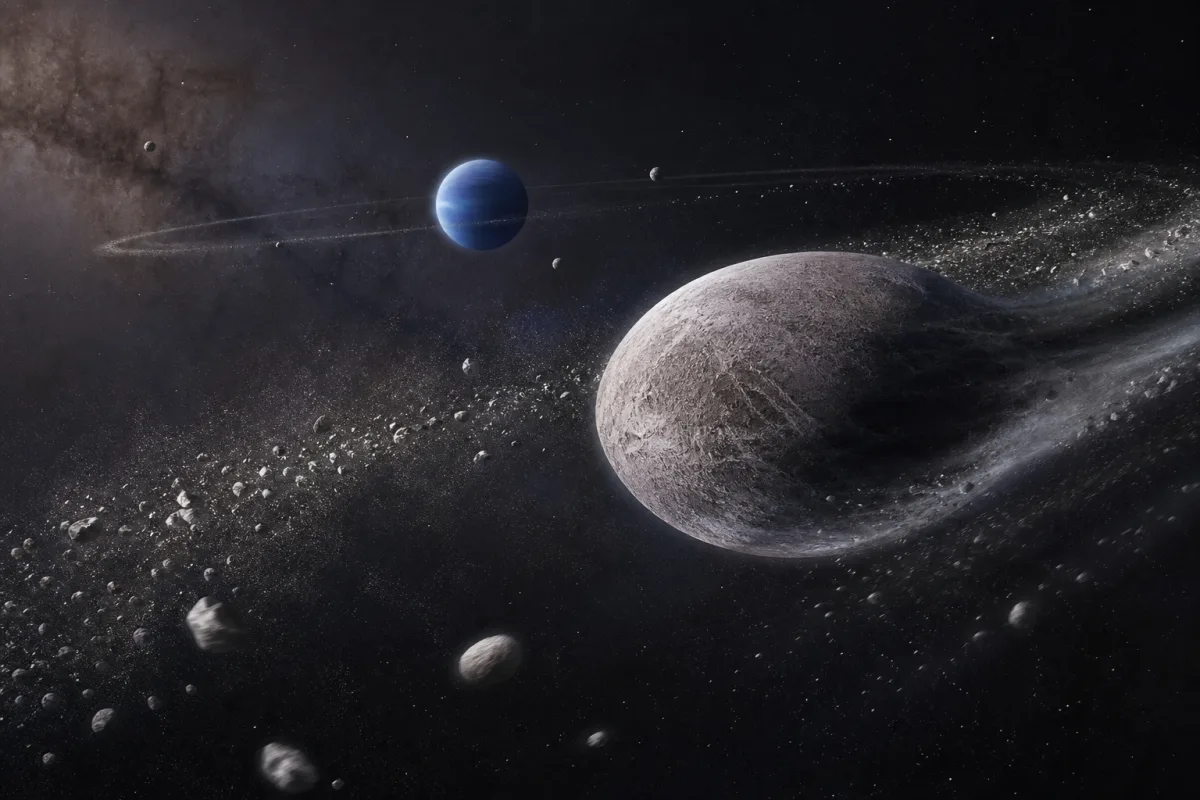
Triton is not a typical large moon. It travels around Neptune in a retrograde orbit, opposite to the direction in which the planet rotates, and is widely thought to have originated in the Kuiper Belt. Capturing an object that massive would have disturbed anything already orbiting Neptune.
The Caltech team’s reconstruction is that Neptune once had a more orderly system of sizeable moons. When Triton was captured, its changing orbit destabilised that arrangement. Collisions and tidal disruption could have smashed the older moons apart. Some of the debris would have fallen into Neptune, some may have escaped, and a small fraction could have settled into the rings and the small inner moons seen today.
That is not a direct movie of the event. It is a model built from several clues, including the moons’ chemistry, their orbits, and the unusual structure of Neptune’s satellite system. The researchers favour this explanation, but they also note an alternative: a single large Kuiper Belt object could have been torn apart by Neptune and supplied similar material.
What JWST found
Spectroscopy lets astronomers read the chemical makeup of a distant body from the way it reflects and absorbs light. In the JWST data, Larissa, Galatea, and Neptune’s rings show magnesium-rich phyllosilicates. On Earth, related clay minerals form when rock and water interact. The observations also show no obvious water ice on the surfaces examined, making the result especially puzzling in the cold outer solar system.
The minerals probably did not form inside the tiny moons themselves. Their presence suggests that the material was once buried inside a much larger body that became warm enough for water and rock to react. A collision that broke such worlds apart would expose that interior material and leave it available to build new moons.
Proteus complicates the picture. It is the largest of the three moons studied but does not show the same phyllosilicate signature. The difference could mean that Proteus formed from another part of the debris, or that later heating altered its surface. The team also found an unidentified hydrated mineral on all three moons, a reminder that Neptune’s system still contains chemistry missing from current reference libraries.
A system we have only glimpsed
Neptune has been visited by only one spacecraft, Voyager 2, in 1989. Much of what we know about its moons comes from faint observations made across enormous distances. JWST has opened a new way to study them, but it has not removed the need for a future mission.
The most useful next step would be a spacecraft that could map the moons directly, measure their surfaces, and reconstruct the dynamics of Triton’s capture. Until then, Neptune’s inner moons remain a kind of archaeological site in space: small bodies that may preserve material from worlds that no longer exist.
For background, read our explainers on the Kuiper Belt beyond Neptune and the most puzzling moons in the solar system.
Sources and further reading: Science Advances study of Neptune’s inner moons and rings; Caltech research report; Phys.org research report.