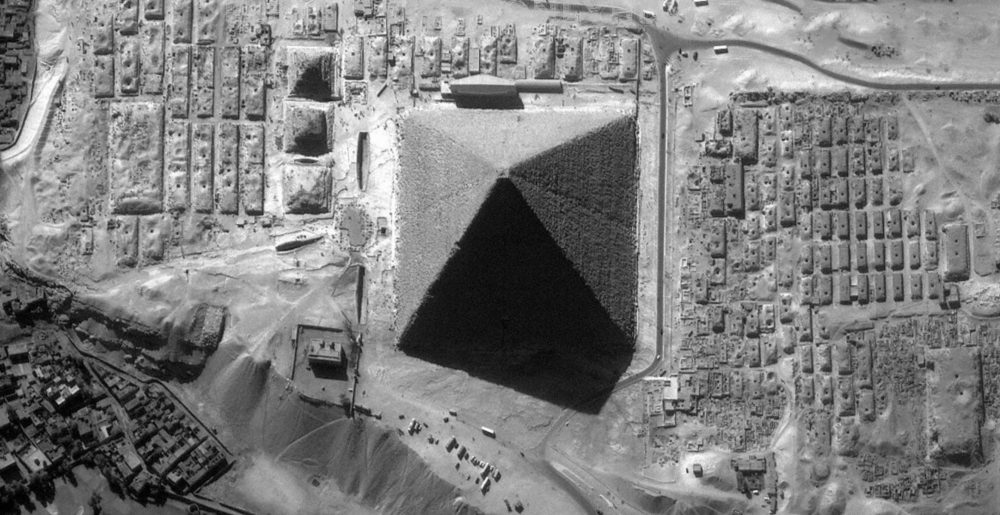
The Great Pyramid of Giza is usually drawn as a four-sided monument with a square base. From the ground, that is exactly how it looks. From the air, however, each face shows a very slight inward dip along its centre. Under the right light, those shallow depressions divide the four faces into eight visible planes.
That is why the Great Pyramid is often described as having eight sides. The phrase is useful, but it needs a little care: Khufu’s pyramid is not an octagonal tower, and the evidence does not show that all three Giza pyramids were deliberately designed as eight-sided structures. What we can say is that the Great Pyramid’s faces are subtly concave, an unusual feature that has been discussed by surveyors and Egyptologists for more than a century.
What “eight sides” actually means
A normal square pyramid has four flat triangular faces. Khufu’s monument still has a square plan and four main faces, but the surface of each face is not perfectly flat. The middle of each face falls inward slightly, producing a central line and two shallow planes on either side.
Keep exploring
Continue with Curiosmos
Seen from above, or in photographs taken when the sun throws a long shadow across the stone, the effect can look like an extra ridge running from the base towards the apex. That visual break is what creates the “eight-sided” appearance. It does not mean that the pyramid has four hidden faces, a second inner shell, or a conventional octagonal footprint.
The distinction matters because photographs can exaggerate a shallow change in slope. The casing stones that once gave the pyramid a smooth, bright exterior were largely removed in later centuries. What is visible today is mostly the core masonry, weathered and repaired in places. A modern image therefore cannot show exactly what the finished Fourth Dynasty surface looked like.
How the concavity was documented
Early observers did notice that the faces were not perfectly straight. The nineteenth-century surveyor Flinders Petrie described a hollowing or groove along the middle of each side while measuring the monument. Aerial photography in the twentieth century made the pattern easier to see, especially when shadows picked out the shallow depressions. The 1940 photograph associated with Royal Air Force pilot P. Groves helped turn the feature into a popular story, but it was not the first written observation of an uneven face.
Recent scholarship has also urged caution. In a 2022 review of the so-called concave faces, Egyptologist and architect Franck Monnier revisited historical descriptions, photographs and the condition of the monument. His work is valuable precisely because it separates what can be measured from what later images and captions have assumed. The concavity is real as a description of the surviving faces; the reason for it, and how closely it matches the original casing, are more difficult questions.
Was the effect intentional?
There is no surviving construction record that says, “build eight faces.” Nor is there a clear comparison showing that Khufu’s architects used the same treatment on every pyramid in the royal cemetery. Several explanations have been proposed. The inward slope may have helped the courses lock together or resisted outward pressure as the pyramid rose. It may also reflect the way the core and casing were laid out, or the loss of casing stones over time.
Those are engineering possibilities, not settled conclusions. The Great Pyramid’s builders worked with regular courses, careful alignment and a very large margin for error, so a subtle change in a face could have been planned. But the feature is too poorly documented to attach a confident symbolic meaning to it. Claims that the depressions encode the equinoxes, hidden mathematics or a message from the sky go beyond the surviving evidence.
What about Khafre and Menkaure?
The other two main pyramids at Giza are often pulled into the same story. Aerial views can produce lines of shadow on Khafre and Menkaure that resemble the pattern on Khufu. That is worth investigating, but a suggestive photograph is not the same as a measured concavity.
Khafre still retains more of its upper limestone casing, while Menkaure is smaller and has a different history of unfinished and altered surfaces. Those differences make direct comparisons difficult. At present, the most defensible statement is that the Great Pyramid has the clearest documented concavity. Similar-looking shadows on the other monuments do not prove that all three were built as eight-sided pyramids.
How the feature fits the wider Giza design
The detail is one part of a much larger engineering project. Khufu’s pyramid was laid out with a square base, closely aligned to the cardinal directions, and built from millions of blocks on a plateau that had to be levelled first. The interior arrangement—descending passage, Grand Gallery, King’s Chamber and other spaces—shows a design that changed as construction progressed.
That broader context is useful. The eight-side question is not evidence that the accepted archaeology has failed; it is an example of how much information can be hidden in a familiar monument. Careful surveying can reveal a feature that is invisible to visitors standing at the foot of the pyramid, while still leaving its original purpose open.
So, does the Great Pyramid have eight sides?
In the everyday sense, it has four faces and a square base. In the technical sense used in discussions of its surface, each face has a slight central concavity, giving the monument an eight-sided profile when viewed from above or under favourable lighting. That is a real and unusual feature.
What remains unresolved is the intention behind it. The evidence supports a careful description of the stonework, not a confident claim that the Egyptians built an octagonal pyramid or left a hidden message in its shadows. Until new measurements or ancient records change the picture, the honest answer is both more modest and more interesting: the Great Pyramid’s faces are subtly folded, and we still do not know exactly why.
Further reading
- Franck Monnier, “The so-called concave faces of the Great Pyramid: Facts and cognitive bias,” Interdisciplinary Egyptology
- Encyclopaedia Britannica, Great Pyramid of Giza
- Inside the Great Pyramid: chambers, hidden spaces and three videos
- How large is the Great Pyramid? Blocks, volume and construction