The Humayma chess piece is small enough to fit in your hand, but it carries a surprisingly large question.
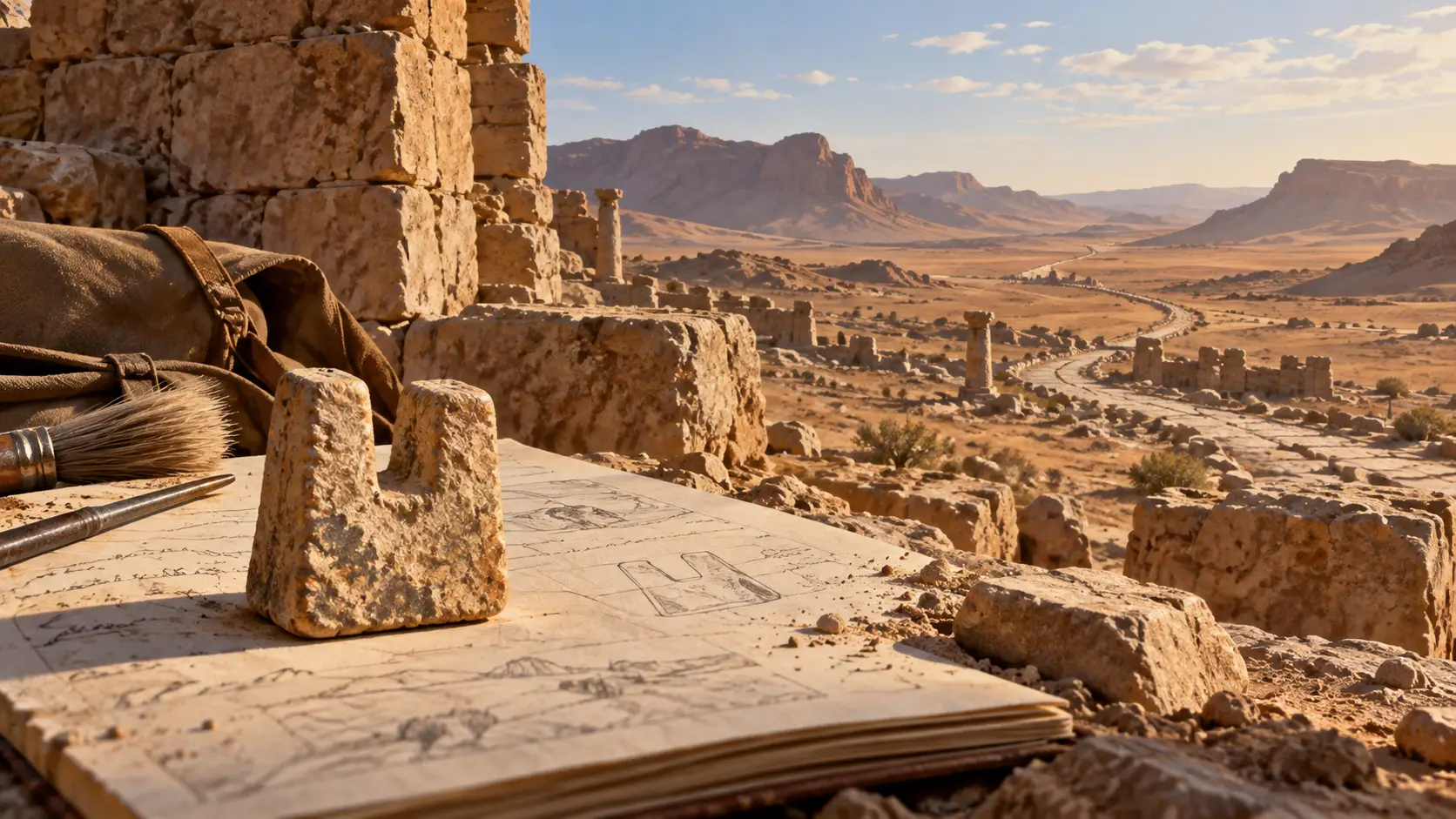
In 1991, excavators working at Humayma in southern Jordan found a rectangular stone object with two splayed projections at its top. Decades later, archaeologist John Oleson proposed that the object was not a small altar or a fragment of architectural equipment, but a chess rook.
If that interpretation is correct, the object could be one of the earliest physically documented chess pieces yet found. But the wording matters. The excavation record confirms that a chess piece was recovered from Humayma. The claim that this particular object was a rook comes from its shape and comparisons with later pieces, not from an inscription that names the game.
The find matters for two reasons. It may preserve an early trace of chess outside the game’s likely South Asian birthplace, and it shows how archaeologists identify ordinary objects whose original use was never written down.
What was found at Humayma?
Humayma, ancient Hawara or Hauarra, sits in southern Jordan between Petra and the Red Sea port of Aqaba. The settlement occupied a route later known as the Via Nova Traiana and passed through Nabataean, Roman, Byzantine and early Islamic phases.
The Humayma excavation project recovered evidence from all of those periods. The published excavation report lists many small finds, including inscriptions, altars, betyls, loom-weight candidates, door-socket stones, pounding stones and a chess piece. That list places the object in a documented archaeological assemblage rather than leaving it as an isolated story about a mysterious stone.
The object itself was found in an Early Islamic context. The American Schools of Oriental Research abstract describing the find says the context dates to the seventh century. Later reporting places the object broadly between about 680 and 749 CE, when the Abbasid family was connected to the settlement.
The piece is small and made from local sandstone. Smithsonian reporting described it as less than an inch high. That material and scale do not prove who owned it, but they make the object different from the luxury chess sets usually preserved in written histories—those made from ivory, precious stone or other expensive materials.
Why does it look like a rook?
Oleson’s identification rests on comparison.
The object is rectangular in section and ends in two horn-like projections. At first, the excavators thought it might resemble a Nabataean betyl, a type of sacred stone or altar. Oleson later argued that its shape matched a simplified form of the chess piece that English speakers now call a rook, or castle.
The comparison is not based on the modern castle shape alone. Early Islamic chess pieces often used abstract forms rather than literal figures. The rook’s earlier identity was connected to the Persian rukh, usually translated as “chariot.” When the game moved into Europe, players eventually interpreted the piece’s projections as the battlements of a tower.
The ASOR abstract notes that later rooks from Jordan and other parts of the Near East, carved in stone, wood or ivory, are close to the Humayma object in both design and scale. That pattern gives the identification a material basis. It is stronger than saying that the object merely “looks a bit like” a chess piece.
But that remains an interpretation. There is no known inscription on the object saying that it belonged to a chess set, and the shape of a small carved stone can support more than one interpretation.
How could chess have reached Jordan?
Humayma also fits the known route by which the game moved west.
Most histories place the game’s earliest development in India during the sixth century. From there, forms of the game moved west through Persia and into the Islamic world. The ASOR abstract notes references to chess playing in Islamic texts as early as 643 CE and says the game was popular across the Islamic world by the end of the Umayyad period.
Humayma stood on a route that connected the Near East with wider commercial and political networks. Merchants, soldiers, travelers and administrators moved through the settlement. A board game did not need a royal palace to travel: a small, inexpensive piece could move with ordinary people along the same roads as more valuable goods.
The site also has a connection to the Abbasid family. ASOR’s excavation summary describes an Abbasid manor and mosque at Humayma, and says the family later moved to Iraq before leading the revolt that overthrew the Umayyads in 750. The political connection does not show that the chess piece belonged to an Abbasid household. It does show that people and information moved through the settlement as part of the wider early Islamic world.
Here, the place where the object was found matters as much as its appearance. Archaeological context can tell us more than a spectacular object photographed by itself.
Is it really the oldest chess piece?
The age is better established than the object’s identity.
The Humayma object has a strong claim to being an early physical example because its archaeological context is tied to the seventh century. Oleson’s abstract says it may be the earliest known example of the simplified abstract design, and possibly the earliest chess piece found at all.
“Possibly” is doing real work in that sentence. The object’s date comes from its archaeological context, while its identity comes from comparison. Other pieces may have been made earlier but found outside a secure context. Some objects identified as chess pieces may also be misidentified, especially when they are small, portable and separated from the board or other pieces that would reveal their use.
The defensible claim is narrower: a seventh-century sandstone object from Humayma is a plausible early chess rook, and the excavation context makes it an important candidate for one of the oldest documented physical chess pieces. It is not proof that chess began in Jordan, and it does not settle every debate over the earliest surviving pieces.
What does the piece actually tell us?
Whoever owned the Humayma object, we cannot tell. Nor can one piece show how common chess was at the settlement. But if Oleson is right, someone carved a plain sandstone block into a form that worked as a rook. That puts a possible chess piece at Humayma as early as the seventh century, on a route connecting Petra and Aqaba with the wider region. It is a small, specific trace of a game moving through daily life—not proof that chess was widespread in Jordan or that Humayma shaped its spread.
Sources and further reading
- John P. Oleson, “The World’s Earliest Known Chess Piece, from Humayma (Jordan)?,” in the 2019 ASOR Annual Meeting abstract volume, pp. 66–67.
- John P. Oleson et al., Humayma Excavation Project, 2, American Schools of Oriental Research Archaeological Reports.
- John P. Oleson, Humayma Excavation Project, 3, ASOR, 2024.
- Jason Daley, “Is This Chess Piece Unearthed in Jordan the World’s Oldest?”, Smithsonian Magazine, 2 December 2019.
- For broader context on games and everyday life, see Curiosmos’ guide to medieval entertainment.