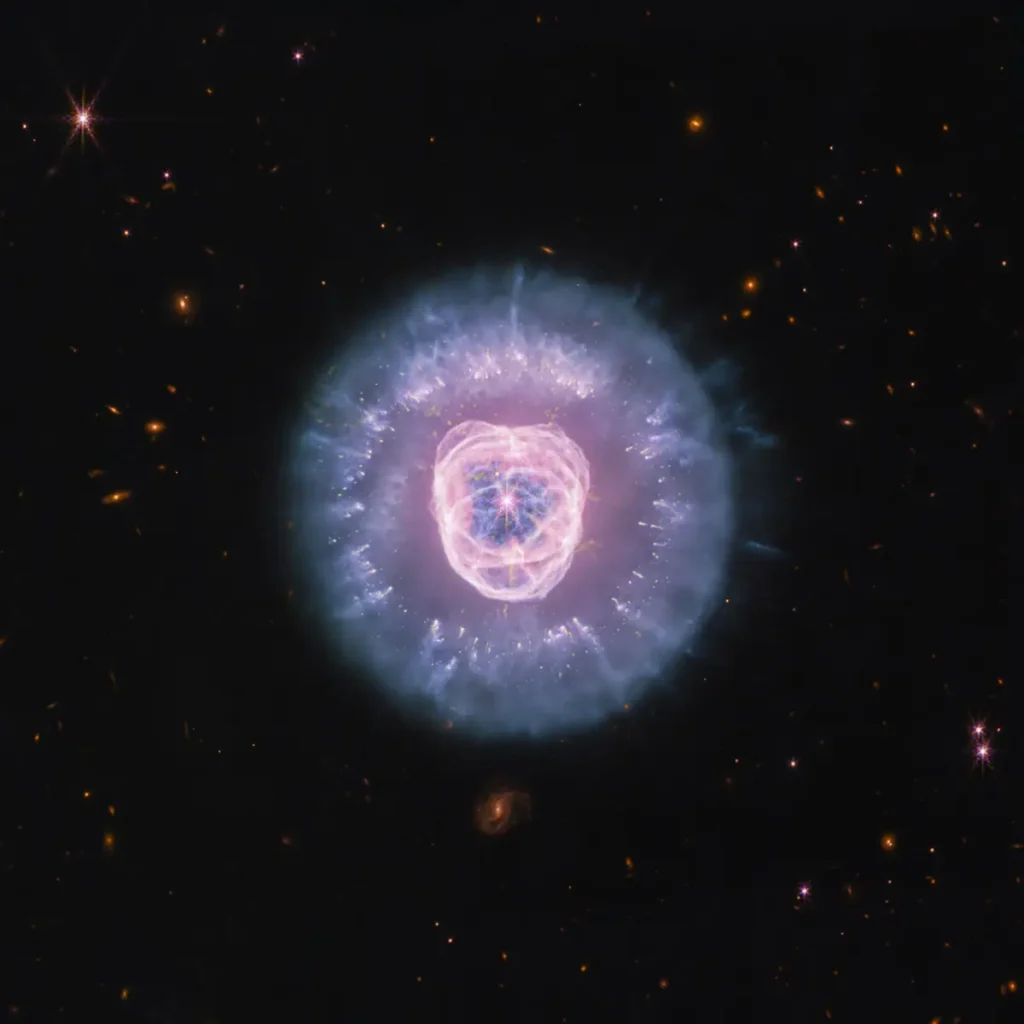
The Lion Nebula looks like a face because a dying star has spent thousands of years shaping the material around it. NASA’s James Webb Space Telescope has now photographed the planetary nebula NGC 2392 in infrared light, showing the bubbles, rings, and dusty clumps that surround its exposed stellar core.
The nickname is easy to remember, but it can hide the science. NGC 2392 is not a planet and it is not the result of a star exploding as a supernova. It is the remains of a lower-mass star that shed its outer layers near the end of its life.
Two Webb instruments, two views
Webb used its Near-Infrared Camera, or NIRCam, and Mid-Infrared Instrument, MIRI, to examine the nebula. The combined view follows the structure of the gas and dust in different infrared wavelengths. That helps astronomers separate the glowing ionized gas from cooler material that would be difficult to see in ordinary visible light.
Hubble photographed NGC 2392 in 2000. The older image already showed a face-like outline and the hazy features sometimes called the mane. Webb’s sharper infrared view brings out compact knots of dust, filaments, and layers inside the larger shell.
The differences do not mean the nebula changed between the two pictures. They show how much a target can reveal when it is observed with different instruments and wavelengths. Curiosmos has explained why stars twinkle while planets usually do not; Webb’s work is another reminder that the light reaching us carries information about both an object and the way we observe it.
The new image is also a study in scale. The bright face is made from gas spread across a region much larger than the original star, while the white dwarf at its centre is only about the size of Earth. The nebula is thin enough that the material would be considered a vacuum by everyday standards, yet there is enough of it for atoms to glow when the central remnant supplies energy.
Astronomers can compare the arcs and knots with models of stellar winds. If a shell is moving outward, its position and brightness can reveal when it was expelled and how the star’s wind changed. Webb’s image does not freeze the story at its beginning; it gives researchers a detailed frame from a process that is still under way.
A white dwarf at the centre
At the middle of NGC 2392 is a white dwarf—the hot, dense core left behind after the star lost its outer layers. Its radiation powers the glowing bubble around it. Some of the dust is being destroyed by that radiation, while denser clumps survive and cast shadows into the surrounding gas.
Those surviving clumps help give the nebula its mane-like appearance. They are not fixed decorations. The gas is moving outward, the dust is being heated or broken apart, and the shape will continue to change.
The central remnant is also a record of the star’s earlier life. A star with a mass similar to the Sun does not end in a single blast. It swells, becomes unstable, and releases its outer atmosphere in stages. The exposed core then illuminates that material as a planetary nebula.
The nebula will not last forever
NASA estimates that the Lion Nebula will disperse in roughly 10,000 years. That sounds long by human standards, but it is brief compared with the lifetime of a star. As the gas expands and thins, the white dwarf will gradually lose the surrounding cloud that makes it visible.
The image therefore captures a temporary phase. Webb is seeing the aftermath of a star’s final transformation, not a permanent structure. The details of the shells may help astronomers work out how the star lost mass and why the material formed such a complicated pattern.
NGC 2392 is also a useful bridge between familiar night-sky objects and the wider question of cosmic time. The observable universe contains stars at every stage of their lives. Webb’s Lion Nebula is one nearby example of what happens after a Sun-like star runs out of fuel in its core.