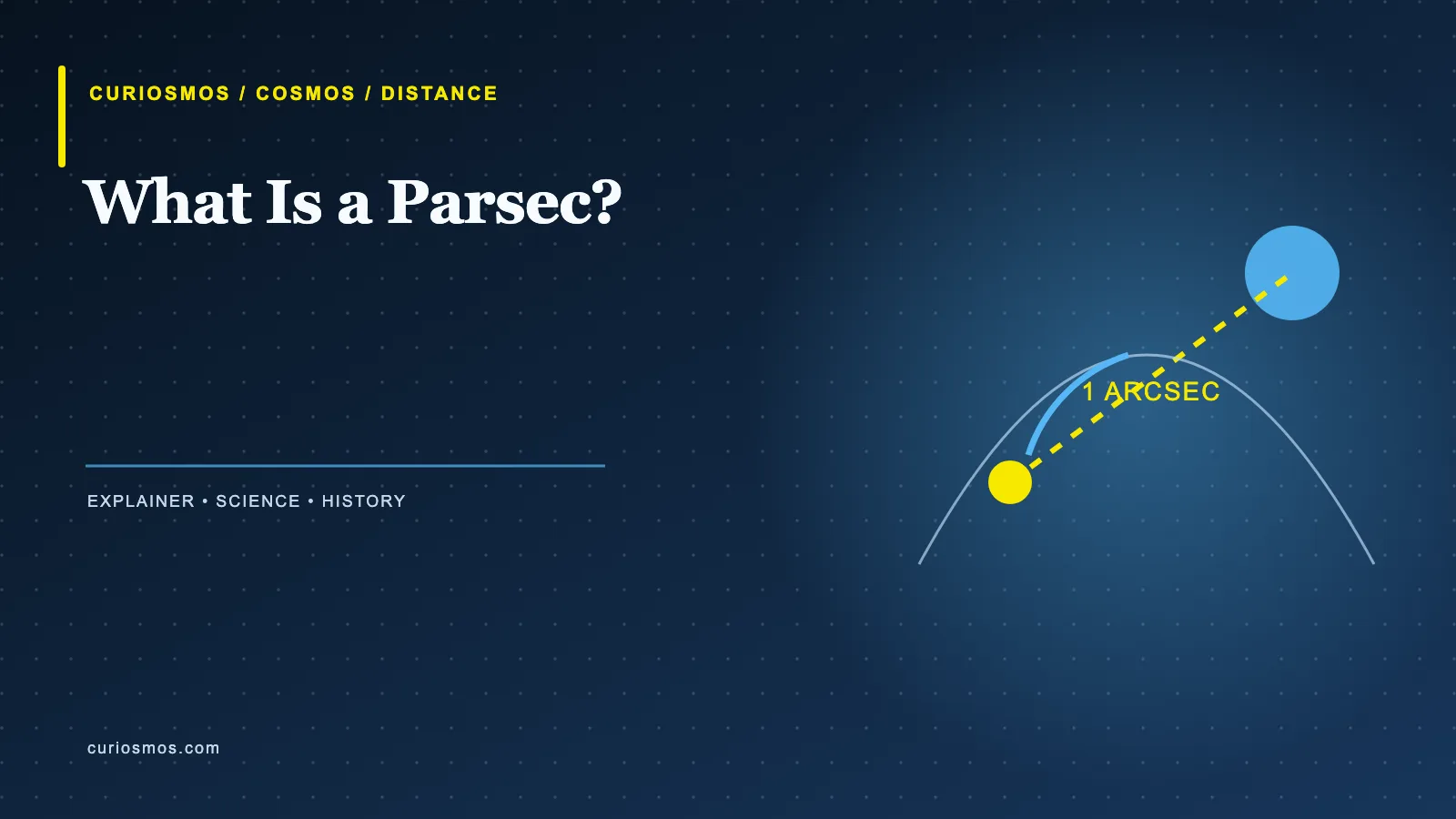
A parsec is a unit of distance equal to about 3.26 light-years, or roughly 31 trillion kilometres. Its definition uses a baseline of one astronomical unit (AU), approximately the Earth–Sun distance. At one parsec, that baseline subtends one arcsecond, as the US Naval Observatory’s glossary explains.
That definition connects the unit to a real observation. Astronomers do not need to stretch a tape between the stars. They measure how a nearby star appears to shift against the distant background as Earth changes position during its orbit. This apparent shift is called parallax, and it is the foundation of the parsec.
How parallax creates a distance
Hold a finger in front of your face and look at it first with one eye, then the other. The finger seems to move against the background because your eyes are viewing it from two different positions. Earth gives astronomers the same kind of baseline on a much larger scale.
In January, Earth is on one side of the Sun. Six months later, it is on the other side. A nearby star therefore appears to move slightly when compared with stars that are much farther away. The angle is tiny, which is why measuring it requires precise instruments and careful calibration.
The annual parallax angle uses a one-AU baseline. It is half the full angular shift measured between opposite sides of Earth’s orbit. A parallax of one arcsecond corresponds to approximately one parsec; half an arcsecond corresponds to about two parsecs. Distance in parsecs is given by d = 1/p, where p is the parallax in arcseconds.
Why not just use light-years?
Light-years and parsecs measure the same quantity and can be converted into each other. The parsec’s definition comes from parallax geometry, but a distance expressed in parsecs may have been measured by another method. Kiloparsecs and megaparsecs remain useful far beyond the range of direct stellar parallax.
Both units are used in public science writing. Astronomers often prefer parsecs in research papers because the numbers scale neatly. A thousand parsecs is a kiloparsec, written kpc. A million parsecs is a megaparsec, written Mpc. The distance from the Sun to the centre of the Milky Way is about 8 kiloparsecs. The separation between galaxies is commonly described in megaparsecs.
How astronomers measure greater distances
Parallax is most reliable for relatively nearby stars. As the distance grows, the apparent shift becomes too small to measure directly, even with space telescopes. Astronomers then use a sequence of other methods, each calibrated against the one before it. Variable stars, exploding stars and the redshift of galaxies extend the distance scale far beyond the reach of direct parallax.
That sequence is known as the cosmic distance ladder. Our guide to how scientists measure distance in space follows the ladder from radar and parallax to the methods used for distant galaxies. A parsec is one of the first important steps because it gives those later methods a trustworthy local foundation.
What does a parsec look like in the real universe?
One parsec, about 3.26 light-years, is shorter than the distance to the Alpha Centauri system. NASA places Alpha Centauri A and B about 4.3 light-years away. Distances in the local stellar neighbourhood are often expressed in parsecs, while the Milky Way’s structure is measured in kiloparsecs.
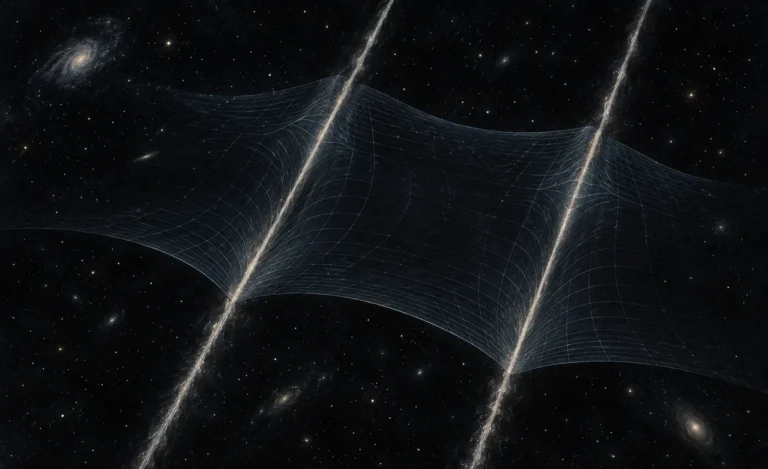
When astronomers map our galaxy’s place in the wider cosmic web, they move to megaparsecs. The Laniakea Supercluster, the broad region that contains the Milky Way and many neighbouring galaxy groups, is described on a scale of hundreds of millions of light-years. At that size, megaparsecs make the distances easier to compare.
The unit also helps explain why looking farther away means looking further back in time. Light from a galaxy one million parsecs away has travelled for more than three million years before reaching Earth. At still greater distances, cosmic expansion stretches the light toward redder wavelengths and changes how distance is described.