What is a quasar? The short answer is a distant galaxy with an extraordinarily bright centre. The longer answer begins with a supermassive black hole, a huge reservoir of gas and dust, and gravity strong enough to turn a region no larger than a solar system into one of the brightest objects in the universe.
Quasars are often drawn as brilliant stars, but that picture is misleading. Their name comes from “quasi-stellar radio source,” because early observations made them look like points of light. They are not stars. They are active galactic nuclei: the energetic centres of galaxies whose central black holes are feeding.
How a quasar turns gravity into light
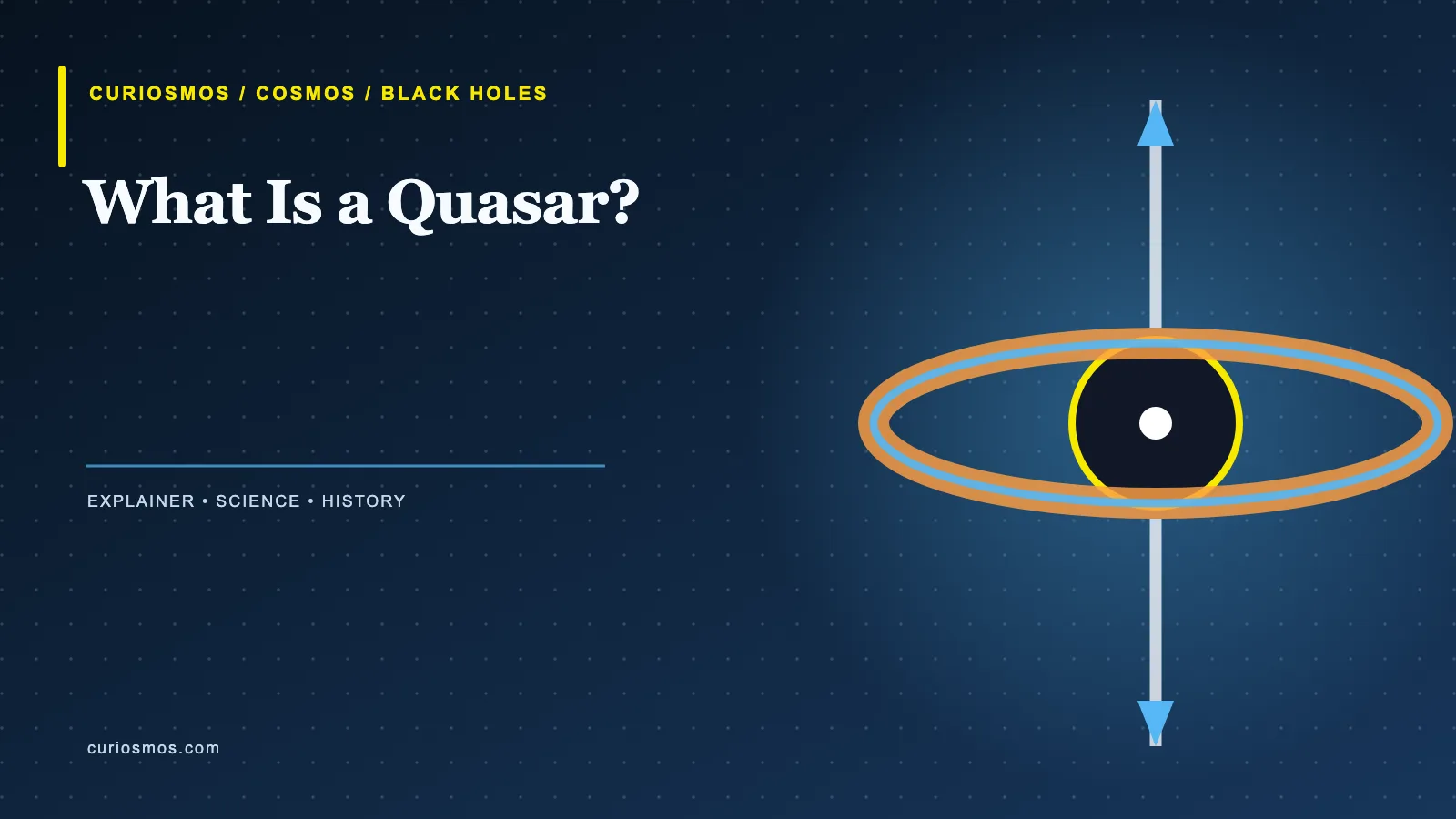
A black hole itself does not shine. Once something crosses its event horizon, no light can escape. The visible spectacle comes from the material outside the horizon. Gas, dust and sometimes entire stars are pulled into a rapidly rotating accretion disk. As the material spirals inward, friction and compression heat it to millions of degrees.
Keep exploring
Continue with Curiosmos
That disk radiates across the electromagnetic spectrum. A quasar can be bright in visible light, ultraviolet and X-rays, while radio observations may reveal narrow jets launched from the black hole’s poles. Magnetic fields help guide some of the hot plasma away from the disk at close to the speed of light. The result is a compact engine that can outshine every star in its host galaxy combined.
This is why quasars are useful even though they are extremely far away. Their light carries information about the gas around the black hole, the galaxy that surrounds it and the material between that galaxy and Earth. In that sense, a quasar is both an object and a lamp shining through the early universe.
Are quasars the same as black holes?
No. A quasar is a phase of activity around a supermassive black hole, not a different kind of black hole. Most large galaxies are thought to contain a supermassive black hole, including the Milky Way. But the black hole at the centre of our galaxy is relatively quiet because it is not currently swallowing enough material to power a quasar.
The distinction matters. If the supply of gas dwindles, the disk fades and the active nucleus becomes much harder to see. The black hole remains, but the quasar phase ends. A galaxy can therefore move between a bright active period and a quieter period over cosmic time.
Why do quasars look like stars?
At the distances involved, even a whole galaxy is compressed into a point in an ordinary telescope image. The bright nucleus overwhelms the much fainter light from the surrounding stars, making the source appear starlike. Spectroscopy reveals the difference. A quasar’s light contains broad emission lines from rapidly moving gas, and those lines are shifted toward the red end of the spectrum when the source is receding with the expanding universe.
That redshift also makes quasars valuable clocks. Because light takes time to cross space, a quasar billions of light-years away is seen as it was billions of years ago. Astronomers can use large quasar surveys to study how supermassive black holes grew, when galaxies assembled and how matter was distributed between galaxies.
How bright can a quasar become?
The answer depends on the amount of matter available and how efficiently the disk converts gravitational energy into radiation. Some quasars shine with the output of hundreds of billions of Suns. Yet the region producing that light can be only a few light-days or light-years across—tiny compared with the galaxy around it.
There is a limit. If a black hole feeds too rapidly, the radiation becomes strong enough to push against the incoming gas. This balance, called the Eddington limit, helps set how quickly a black hole can grow. It also gives astronomers a way to estimate the mass of an unseen black hole from the brightness and motion of the surrounding gas.
What quasars teach us about galaxies
Quasars are not simply bright objects to catalogue. Their winds and jets can heat or remove gas from a galaxy, affecting the raw material needed to form new stars. They may therefore help regulate the relationship between a galaxy and the black hole at its centre.
To understand the observations, astronomers combine the evidence used in other black-hole studies—orbital motion, high-energy radiation and the behaviour of nearby gas. Our guide to how scientists detect a black hole they cannot see covers those clues in detail. Quasars add a second layer: they show what happens when the central engine is actively consuming its surroundings.
When astronomers look at the most distant quasars, they are looking into an era when the universe was young and galaxies were still taking shape. Their light is one of the clearest ways to study how enormous black holes appeared so early—and how those black holes helped shape the galaxies that grew around them.
The universe is not a static backdrop. As our explainer on why the observable universe is much wider than its age might suggest explains, distance and look-back time are connected by cosmic expansion. Quasars make that connection visible: a small, brilliant point can be a record of a galaxy’s past written across billions of light-years.