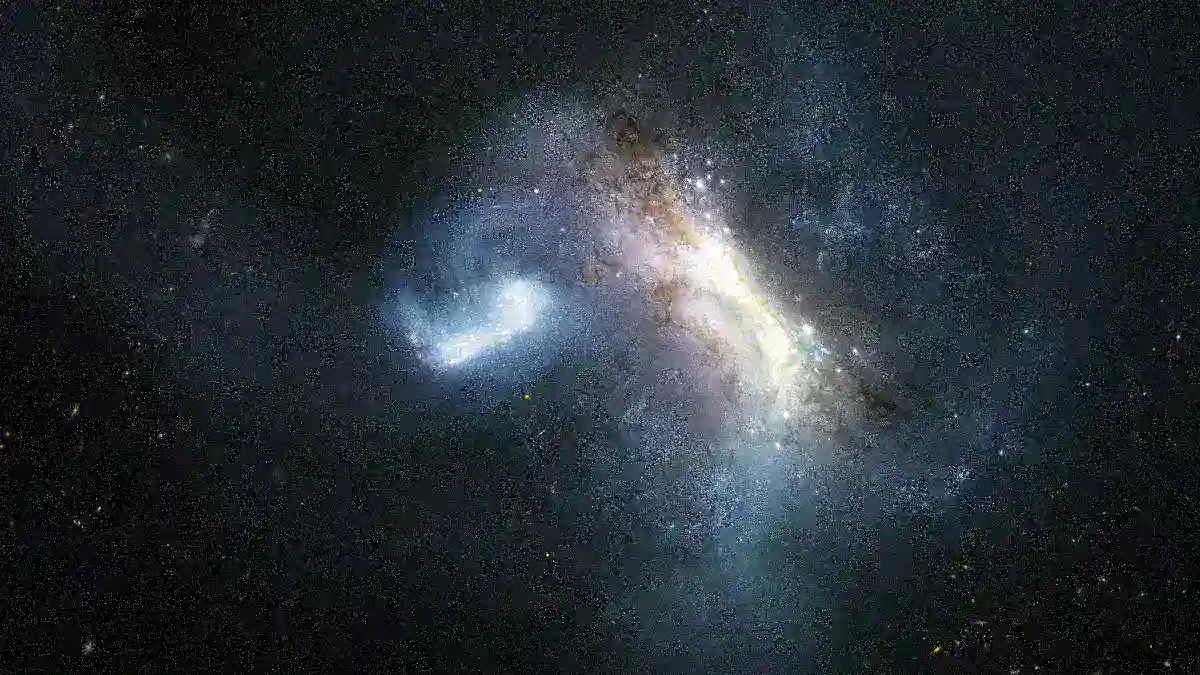
The Milky Way was already growing through collisions when the Universe was only about two billion years old. New observations from the NASA/ESA Hubble Space Telescope show that a young Milky Way absorbed a dwarf galaxy roughly 11.8 billion years ago, extending the known merger history of our Galaxy farther back than before.
The swallowed galaxy has been given the name Low-energy-Kraken-Heracles, or LKH. Researchers did not see the collision directly. Instead, they found its remains in the oldest star clusters orbiting the inner Milky Way. Those clusters still carry the chemical and age signatures of the galaxy that brought them here.
Globular clusters as cosmic archaeology
Globular clusters are dense, roughly spherical groups containing tens of thousands to millions of stars. Many are among the oldest stellar systems in the Milky Way. Because they can survive for billions of years, they act as archaeological sites in space: their stars preserve information about the environment in which they formed.
The team used Hubble observations of 39 globular clusters within the inner 20,000 light-years of the Galaxy. They combined the telescope’s imaging with measurements from the European Space Agency’s Gaia mission. The aim was to compare the clusters’ ages and metallicities—the amount of elements heavier than hydrogen and helium in their stars.
The pattern revealed three populations. One formed in the young Milky Way itself. A second matched stars brought in by the Gaia-Sausage-Enceladus merger about 10 billion years ago. The third group was older than the Gaia-Sausage-Enceladus population but younger than the clusters born in the Milky Way. Its age and chemistry point to an even earlier collision.
A dwarf galaxy with half a billion solar masses of stars
The researchers estimate that LKH contained roughly 500 million times the mass of the Sun in stars. That made it a substantial part of the young Milky Way’s mass at the time. The collision took place about 11.8 billion years ago, around two billion years after the Big Bang.
The estimate comes from matching the clusters’ ages and chemical composition with models of how dwarf galaxies grow. A dwarf galaxy is small beside the Milky Way, but it can still carry hundreds of millions of stars and a large dark-matter halo. When such a system is pulled apart, its stars spread through the larger galaxy while the densest clusters remain recognisable for billions of years.
The result reaches farther back than the previously recognised major mergers in the Milky Way’s history. The Sagittarius dwarf galaxy is still being absorbed today, while Gaia-Sausage-Enceladus merged with the Milky Way about 10 billion years ago. The new evidence places LKH before both events.
That early date matters because the Milky Way was much smaller and more chaotic in its youth. Collisions could rearrange a galaxy’s disk, add new stars and dark matter, and disturb the orbits of objects that were already present. The LKH merger therefore belongs to the period when the basic structure of our Galaxy was still taking shape.
The clusters do not preserve a neat boundary around the vanished dwarf galaxy. Its stars have been stirred into the Milky Way’s inner halo, and later encounters have mixed some of them with stars born here. What survives is a statistical pattern: clusters with similar ages, chemistry and orbits that fit a common origin. That is why the result depends on comparing many clusters rather than identifying one spectacular object.
Why the merger matters
Astronomers have long suspected that an early merger helped build the Milky Way, but the evidence was difficult to separate from later events. As the Galaxy evolved, some of the clearest traces were mixed into the disk and halo. The globular clusters were useful precisely because they retained their own histories while orbiting inside the larger Galaxy.
The team’s analysis shows that stars born outside the Milky Way must be included when reconstructing the Galaxy’s earliest chapters. Its first major building blocks did not all form in one place. Some arrived in a dwarf galaxy that was later absorbed, bringing its stars and chemical history with it.
The researchers plan to study additional globular clusters, including groups that Hubble has not yet examined in detail. Those observations could identify more ancient mergers and help determine how much of the Milky Way’s inner structure came from outside galaxies. The existing clusters already show that the Galaxy we see today was assembled from several smaller systems, and some of those pieces are still orbiting inside it.
Further reading
the Great Attractor and the Milky Way’s motion, how telescopes see the past, and where the Milky Way sits in the cosmic web
Sources
Space Telescope Science Institute release · Nature Astronomy study