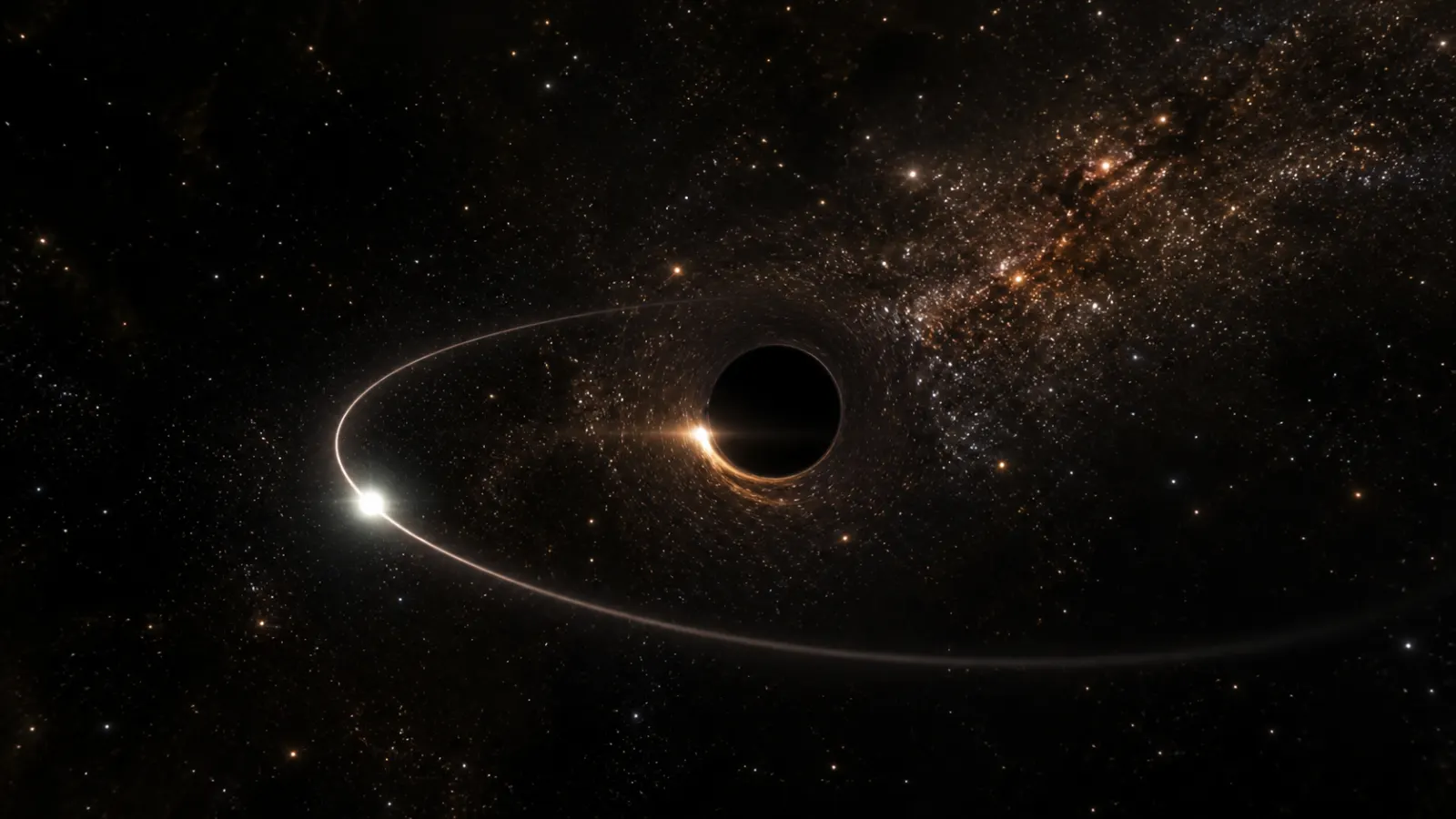
Astronomers have found a faint star taking an extraordinary route around the black hole at the centre of the Milky Way. The star, named S301, reaches about 25,000 kilometres per second—more than eight percent of the speed of light—and completes one orbit around Sagittarius A* in roughly 8.7 years. Its path is so close to the black hole that the star may eventually reveal how the black hole spins. The orbit is a practical example of the method explained in our guide to detecting black holes through their effects.
The discovery was made by the GRAVITY and GRAVITY+ instruments on the European Southern Observatory’s Very Large Telescope Interferometer. The team tracked the star’s position over several years and reported the result in Nature. S301 is now the shortest-period star known to orbit Sagittarius A*, replacing the previous record holder, which took about 12 years to complete an orbit.
Watching a star move through the black hole’s neighbourhood
Sagittarius A* is a supermassive black hole with about 4.3 million times the Sun’s mass. It sits roughly 26,000 light-years away, hidden behind clouds of dust at the centre of our galaxy. The black hole itself gives off no visible surface, but the stars moving around it provide a way to measure its gravity.
S301 is extremely faint, which made it difficult to separate from the crowded field around Sagittarius A*. GRAVITY combines light collected by several telescopes, allowing astronomers to measure positions with far greater precision than a single telescope could achieve. The team found the star in observations made in 2023 and then traced its motion through earlier data.
At its closest approach, S301 comes to within about 1.7 billion kilometres of Sagittarius A*. That sounds enormous, but it is only around 12 times the distance between Earth and the Sun. At that point in its orbit, the star is travelling about 100,000 times faster than a commercial aeroplane.
The speed does not mean the star is falling straight into the black hole. A black hole’s gravity can hold objects in orbit, just as the Sun holds Earth in orbit. S301 is moving sideways fast enough to keep missing the black hole as it falls around it.
The measurement astronomers have been waiting for
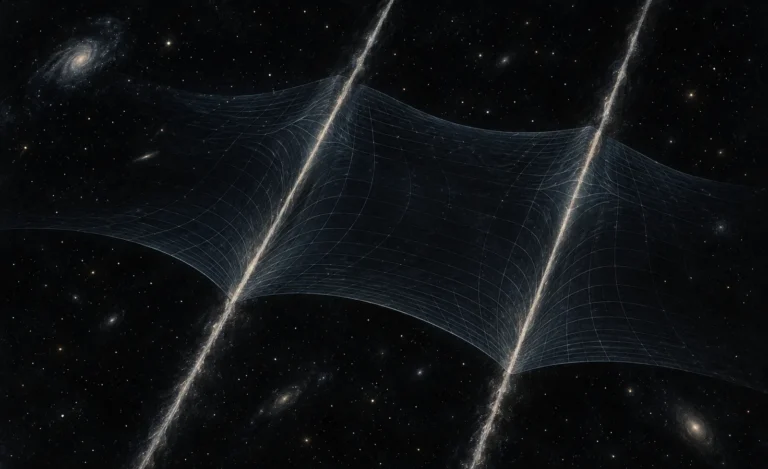
The discovery matters because a rotating black hole does something unusual to space and time. Einstein’s general theory of relativity predicts that the spin of a massive object drags nearby space-time around with it. This effect is called frame dragging.
The dragging is tiny for ordinary objects, but the environment around a supermassive black hole is extreme. As S301 completes more orbits, the black hole’s rotation should gradually shift the orientation of the star’s path. The change will be subtle, so astronomers will need to keep measuring the star for many years.
Previous stars near Sagittarius A* have already helped scientists measure the black hole’s mass and test several predictions of general relativity. S301 comes closer than any of them and moves faster, which makes its orbit more sensitive to the black hole’s spin. The team expects that at least two complete orbits may be needed before the effect can be measured securely.
That means this is a long-term experiment, not a single observation that instantly reveals the answer. Continued work with GRAVITY+ and future extremely large telescopes will be needed to separate the spin signal from the small disturbances caused by other stars and unseen matter near the galactic centre.
S301 may have arrived from a violent encounter
There is another puzzle. Stars are not expected to form so close to a supermassive black hole. The gas clouds needed to make a star would be pulled apart by the black hole’s tidal forces before a new star could grow in place.
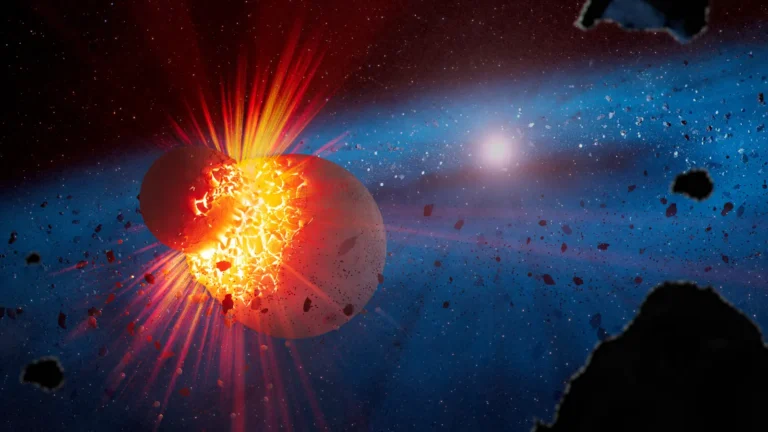
The astronomers therefore suspect that S301 may have been born farther away. One possibility is that it was part of a pair of stars. A close encounter with Sagittarius A* could have torn the pair apart, leaving one star captured on a tight orbit while the other was flung away. This idea is still a proposed history, not a directly observed event.
S301 also gives researchers a new way to test the shape of a black hole’s gravitational field. A spinning black hole should be slightly flattened at its poles rather than perfectly round. Measuring that shape is far beyond what current observations can do directly, but a precisely tracked stellar orbit can carry the imprint of the same physics.
The star will continue circling Sagittarius A* long after this discovery has left the headlines. Each new position measurement will add another point to the orbit and reduce the uncertainty. With enough observations, S301 could turn the black hole’s invisible rotation into something astronomers can calculate from the movement of a single star.