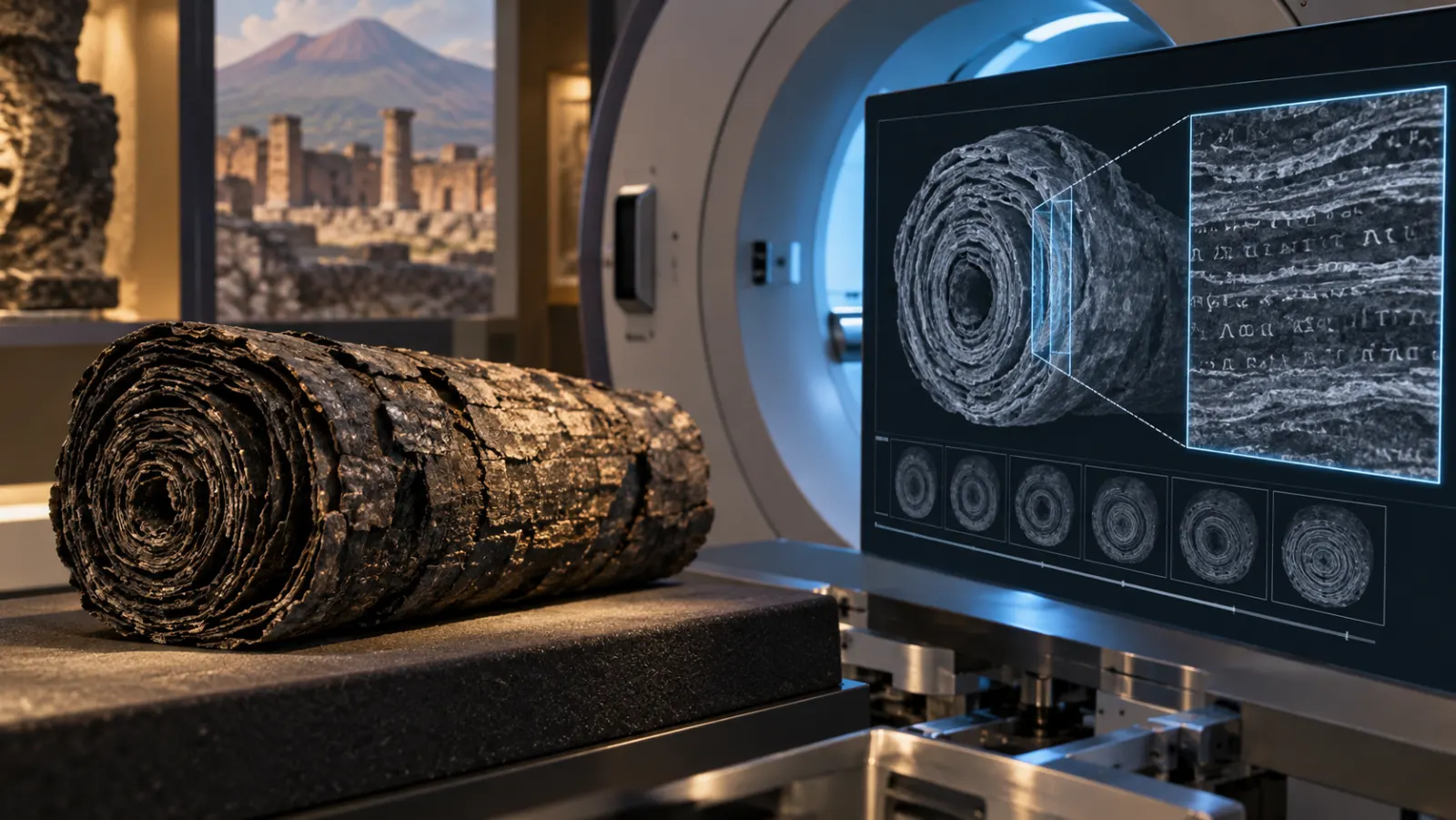
A blackened roll of papyrus looks like the end of a book. At Herculaneum, however, carbonized scrolls may still hold texts that nobody has read since Mount Vesuvius buried the Roman town in 79 CE. The difficult question is how to see writing when both the ink and the papyrus have been turned into carbon.
A new proof-of-concept study points to a surprisingly practical clue: some inks contain lead. When a lead-bearing letter is examined with X-rays, it can stand out far more clearly than ordinary carbon ink against carbonized papyrus.
That does not mean a forgotten library is about to open all at once. It does mean researchers now have a way to screen fragile scrolls and decide which ones are the best candidates for a much closer scan.
Keep exploring
Continue with Curiosmos
What happened to the Herculaneum library?
The Villa of the Papyri was buried when Vesuvius erupted. Heat and volcanic material carbonized the papyrus, preserving the shape of many rolls while leaving them brittle and tightly wound. The collection is remarkable because many of its texts were not copied through later centuries. They are direct survivors from the ancient world.
Early attempts to open the scrolls often produced fragments or ash. The remaining rolls therefore present a cruel problem: the words may be inside, but the object cannot safely be handled like an ordinary book.
X-ray tomography offers a way around that problem. A scanner records many views of a roll, software reconstructs its layers, and algorithms can virtually follow the spiral without physically unrolling it. The method has already revealed small sections of Herculaneum texts, including philosophical writing.
Why is ordinary ink so hard to see?
The traditional black ink used on papyrus was largely carbon-based. After the eruption, the papyrus and the ink ended up with almost the same basic X-ray signature. In a scan, a letter can therefore look nearly identical to the surface beneath it.
The new study, published in PLOS ONE, tested a way to increase that contrast. Douglas Seiler and colleagues made a modern papyrus scroll, wrote on it with lead-spiked ink, carbonized it in a low-oxygen furnace and scanned it with X-ray tomography.
Lead absorbs X-rays much more strongly than carbonized papyrus. In the team’s model, ink containing as little as 25 micrograms of lead per square centimetre could be detected by both X-ray tomography and a handheld X-ray fluorescence instrument. The leaded letters appeared as bright marks against the darker scroll, giving the software a clearer signal to follow.
The researchers also virtually unrolled the model scroll and recovered its writing. The replica was a controlled test, but that control is exactly what makes it useful: the team knew where every letter was before asking the software to find it.
Could this reveal more real texts?
The proposed workflow has two steps. First, researchers could use X-ray fluorescence to look for lead in a scroll without opening it. Then they could prioritise lead-bearing rolls for high-resolution tomography and virtual unrolling.
That would help answer a practical question that has hung over the collection for centuries: which scrolls are most likely to reward an expensive, delicate scan?
The idea is supported by more than the new replica. Earlier analyses have found lead in ink on at least some ancient papyrus fragments, including pieces linked to the Herculaneum collection. Berkeley researchers also report that lead- or copper-bearing inks appear in some papyri from Tebtunis in Egypt. Ancient ink recipes were not identical everywhere, so a screening programme would still have to examine each scroll rather than assume that one chemical recipe fits the entire library.
There is another useful detail here. A handheld X-ray fluorescence scanner is much simpler to deploy than a full tomography beamline. It could act as a first pass, separating promising candidates from rolls whose carbon-only ink may remain extremely difficult to detect.
What the experiment does—and does not—prove
The study does not show that every Herculaneum scroll contains lead or that every leaded scroll will yield a readable book. The model used modern Egyptian papyrus and a modern ink modified with a soluble lead salt. The real library contains different materials, different histories of burial and different levels of damage.
The authors describe the work as a proof of concept. Their next challenge is to measure the chemistry of actual scrolls more systematically and to build better training data for the algorithms that trace letters through a tightly rolled, uneven surface.
That distinction matters. The experiment has not magically decoded a new ancient text. It has identified a physical feature that could make the next generation of scans much easier to interpret.
And this is where the story becomes exciting. The most valuable books in the Villa of the Papyri may not need to be opened at all. If researchers can identify the rolls whose ink carries a strong X-ray signature, a library that once seemed sealed forever could become a carefully prioritised map of possible discoveries—one fragile cylinder at a time.
Sources: the peer-reviewed PLOS ONE study and UC Berkeley News coverage, both published 16 September 2026.