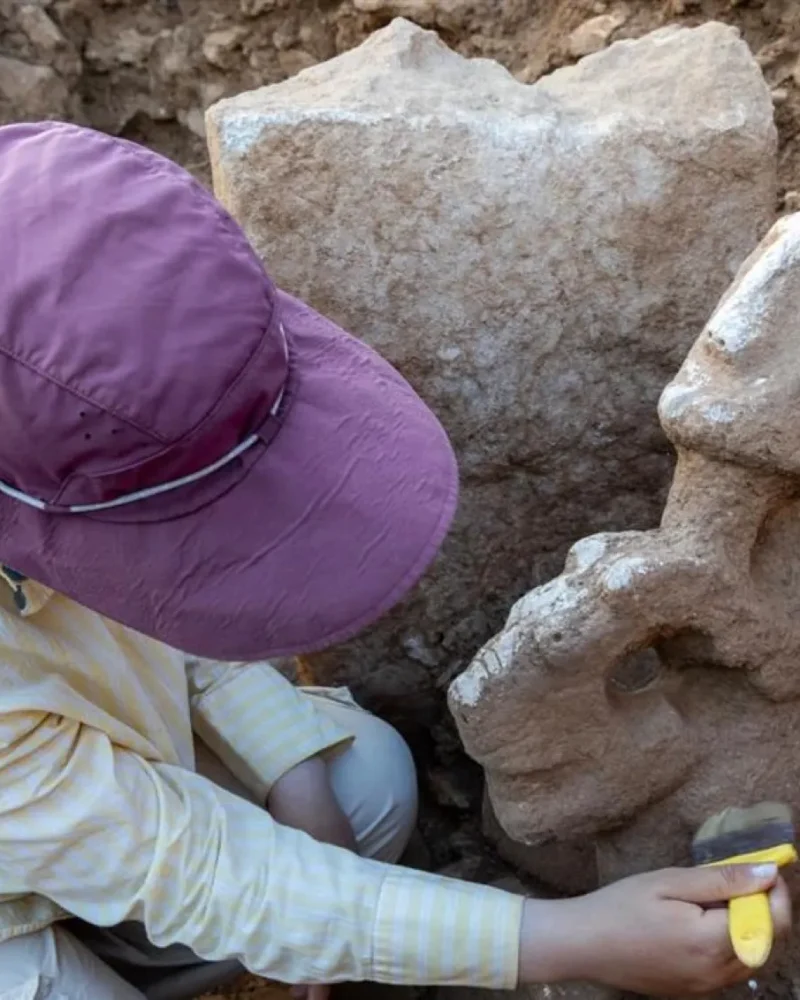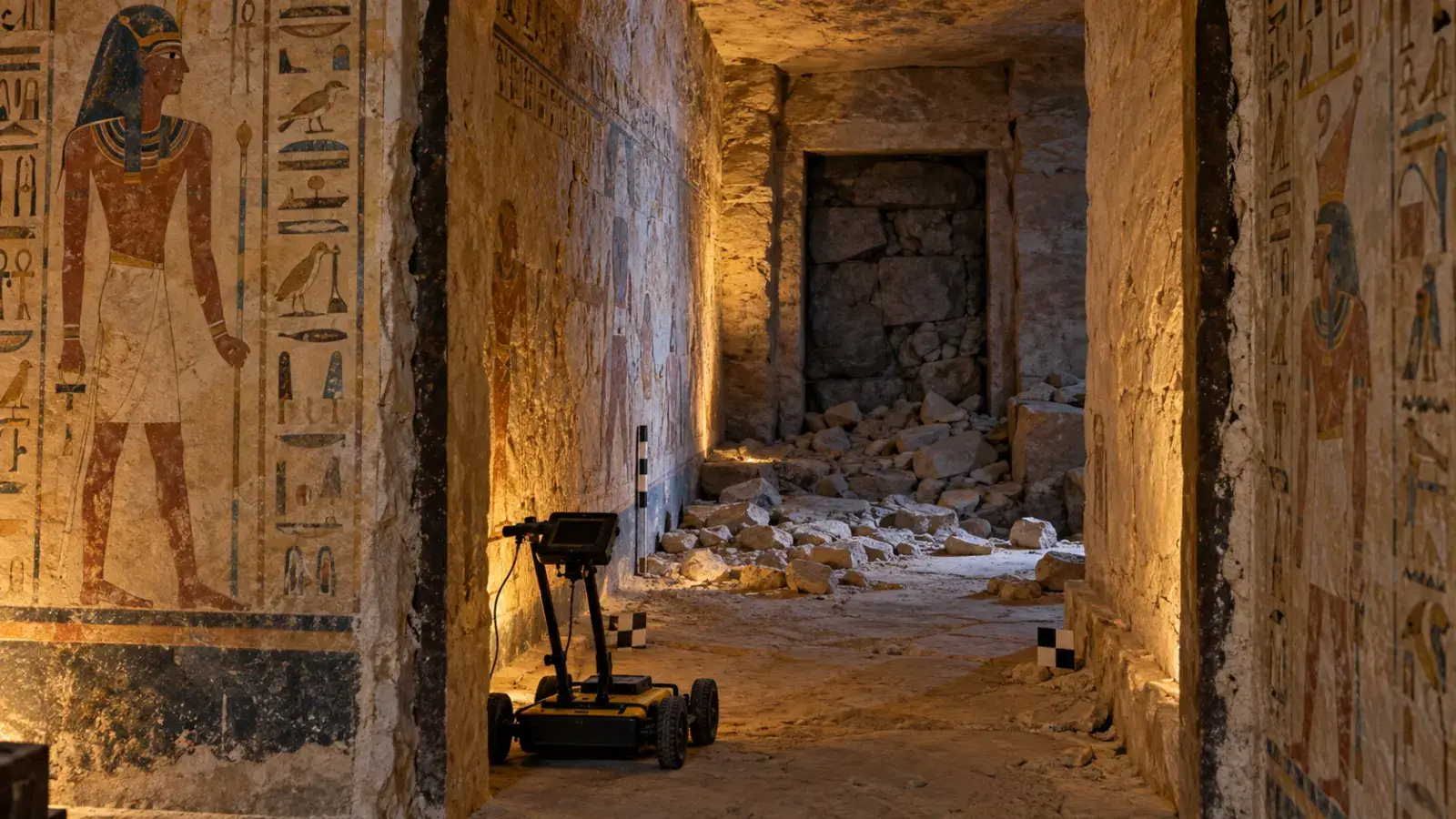
Tutankhamun’s tomb has always looked strangely small for a royal burial. That oddity helped create one of archaeology’s most persistent questions: does the known tomb, KV62, stop where its walls appear to stop, or does part of an older funerary complex continue beyond them?
A new report has put that question back in the spotlight. Researchers working around the tomb say a combination of ground-penetrating radar, microgravity measurements and earlier surveys points to possible structures beyond the burial chamber. The signals may describe a rubble-filled corridor and other spaces. They do not yet amount to a discovered room, a confirmed doorway or the tomb of Queen Nefertiti.
That distinction is the most interesting part of the story. The instruments are looking for changes in density and geometry below and around the tomb. They are not taking a photograph through the stone.
Keep exploring
Continue with Curiosmos
What did the new survey actually measure?
The team used ground-penetrating radar from inside KV62 and added a microgravity survey over the surrounding ground. Microgravity is a non-invasive method that records tiny variations in Earth’s gravitational field. A lower-density space can produce a different signal from solid rock, while a rubble-filled passage may produce a more complicated pattern.
According to Nature’s report on the work, the microgravity team collected more than 1,200 readings across an area of roughly 35 square metres. The researchers say some of the anomalies form right-angled structures aligned with the north wall of Tutankhamun’s burial chamber. One feature, called anomaly 7, contains a mostly low-density zone with a roughly square, higher-density area inside it.
That description is suggestive, but it is also a reminder of the method’s limits. A density anomaly can have more than one explanation. It might reflect a chamber, a corridor packed with rubble, a cut in the bedrock or the effect of another nearby tomb. The data have to be interpreted alongside the shape of the rock, the history of the tomb and the results of earlier surveys.
Why is a corridor important?
The researchers argue that radar signals indicate a corridor about two metres wide leading away from the burial chamber. They say earlier searches may have missed it because they were looking for a large empty void immediately behind the wall.
A corridor filled with rubble would behave differently from an open chamber. It could be difficult for radar to separate from the surrounding stone, especially in a crowded royal necropolis where other cut spaces and tombs complicate the signal. The proposed passage would therefore be a clue about the layout of the site, rather than a ready-made answer about who was buried there.
Earlier work has already shown why caution matters. A 2018 study using electrical-resistivity tomography reported anomalies near KV62, but later interpretations disagreed over whether those signals were connected to the tomb. The existence of a possible feature in one survey does not automatically confirm a feature detected by another. The strongest case would come from independent methods converging on the same shape and position.
Could this be Nefertiti’s burial place?
The idea comes from a proposal made by Egyptologist Nicholas Reeves in 2015. He argued that cracks, wall geometry and changes in the paintings on the north wall suggested that Tutankhamun’s burial chamber might have been adapted from a larger tomb. In that interpretation, the young king’s burial occupied the outer part of an older royal complex, while deeper rooms remained sealed.
Nefertiti became central to the theory because she ruled during the Amarna period and her burial place has never been securely identified. The possibility that a hidden complex could belong to her is thrilling. It is also still an inference layered on top of another inference: first, that hidden spaces exist; second, that they were part of an earlier royal tomb; and third, that the original owner was Nefertiti.
The new measurements cannot resolve all three questions. They may strengthen the case that something artificial lies beyond the known walls, but they do not reveal inscriptions, burial equipment or human remains. Even the researchers quoted by Nature describe the evidence as close to the limits of detection and call for more detail before drawing a firm conclusion.
What happens next?
The most direct test would be a carefully controlled probe. Nature reports that the team has discussed drilling a small access point and sending a miniature camera-equipped vehicle into the suspected space, but any such work would require permission from Egypt’s Supreme Council of Antiquities. The researchers have also not released all of the underlying data.
That means the next step is not to announce Nefertiti’s tomb. It is to make the measurements available for independent scrutiny and to decide whether a non-invasive follow-up can narrow the possibilities without damaging KV62.
Tutankhamun’s tomb has already shown how much history can survive behind an apparently ordinary wall. The new survey offers another reason to look closely. For now, the question remains open: is the signal revealing a hidden funerary complex, or the complicated geology of one of the Valley of the Kings’ most crowded sites? Only a better-resolved measurement, or a carefully supervised view beyond the wall, can answer it.
Sources and further reading
- Nature: “Exclusive: New evidence for hidden chambers beyond Tutankhamun’s tomb” (17 September 2026).
- ScienceDirect: “Geophysical anomalies detected by electrical resistivity tomography in the area surrounding Tutankhamun’s tomb”.
- Curiosmos: The Curse of King Tutankhamun’s Tomb: Separating Fact from Fiction.