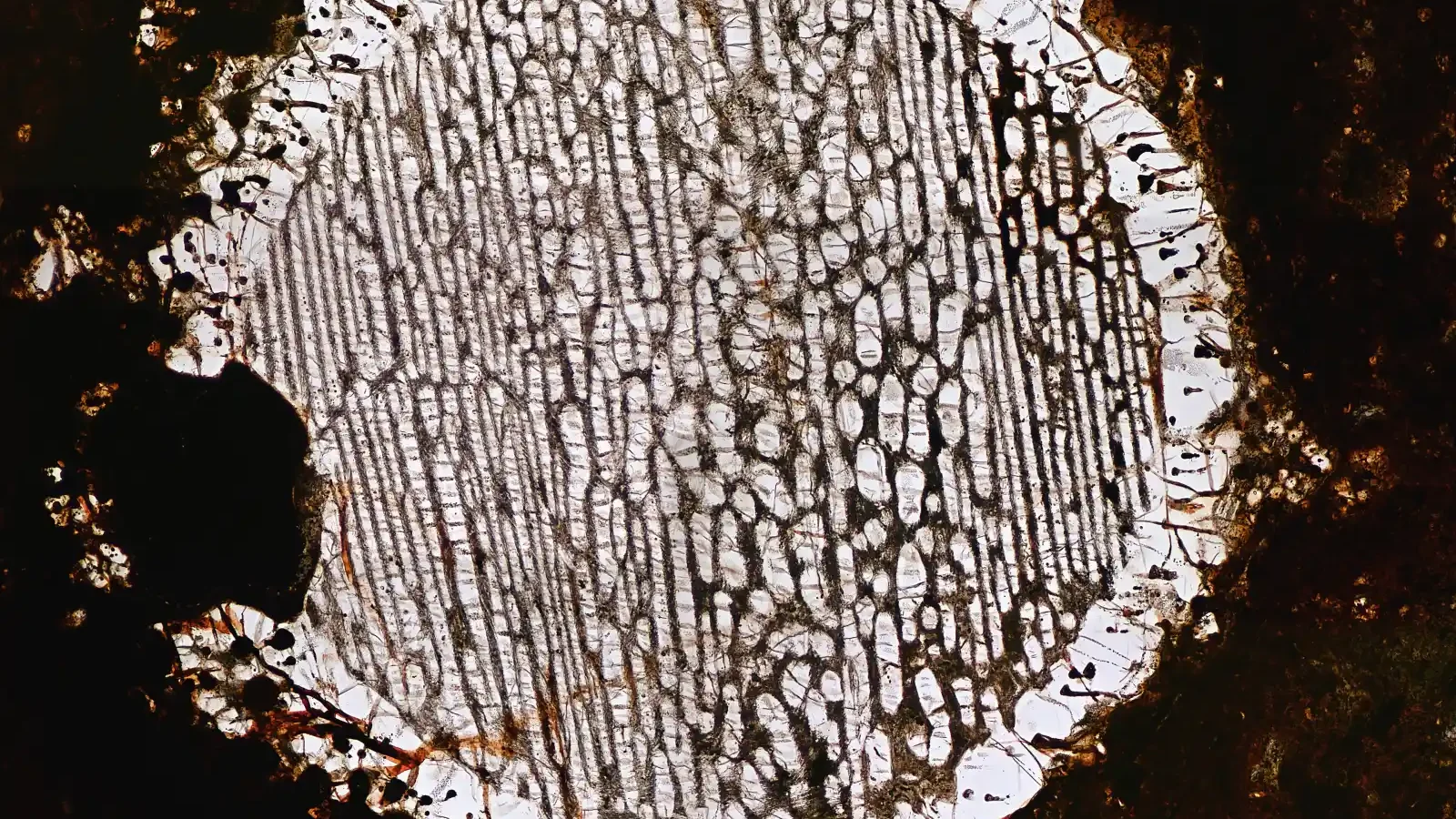
A meteorite can look like an ordinary dark stone until a laboratory cuts it open. Then the surface gives way to a miniature landscape: round glassy grains, metal flecks, crystals that cooled before Earth existed and chemical differences too small to see with the naked eye. How can a rock carry a record that old?
Calling every meteorite a perfect time capsule would overstate what the rocks preserve. Most have been heated, shocked, broken or altered by water on Earth. The useful record survives in particular minerals, textures and isotopes—each preserving a different part of the story.
A meteorite is a sample of a much larger system
Planets are active places. Earth melted, separated into layers and recycled much of its earliest crust. Asteroids also changed after they formed. But some small bodies never reached the temperatures or pressures needed to erase their original material. Fragments from those bodies can fall as meteorites.
Keep exploring
Continue with Curiosmos
Primitive meteorites called chondrites are especially valuable. They contain a fine-grained matrix and rounded particles called chondrules, along with older calcium-aluminium-rich inclusions, or CAIs. NASA describes these objects as leftover building material that did not become part of a planet. They are not untouched samples of the entire Solar System, but they preserve pieces of the disk from which the planets grew.
The difference is crucial. A meteorite does not tell us “what the whole Solar System was like” in one simple reading. It gives researchers a carefully selected sample from one parent body, altered by its own history.
Why are the tiny round grains important?
Chondrules are millimetre-sized beads of once-molten silicate. Their rounded shapes suggest that dust or rock fragments melted briefly and then cooled while floating through the young solar nebula. The exact heating mechanism remains debated. Shock waves, collisions and other short-lived events may all have played a role in different settings.
Under a microscope, a chondrule can preserve several clues at once. Its minerals show how hot it became. Its texture shows how quickly it cooled. Its surrounding matrix records the material that later gathered around it. Some chondrules even contain older grains that survived the melting event, like a small piece of an earlier chapter trapped inside a new one.
Dating a meteorite does not begin with one attractive photograph. They map minerals, measure chemical compositions and compare several grains. The story is assembled from many small observations.
Isotopes work like clocks—and fingerprints
Atoms of the same element can contain different numbers of neutrons. These versions are isotopes. Some are stable; others decay at known rates. If a mineral formed with a radioactive isotope and its decay products stayed in place, the ratio can provide a clock.
One of the most important early Solar System clocks uses the decay of aluminium-26 into magnesium-26. Uranium-lead measurements provide another independent anchor. NASA’s astrobiology programme notes that CAIs have uranium-lead ages of about 4.567 billion years, the reference age commonly used for the Solar System.
Other isotope differences act less like clocks and more like fingerprints. Oxygen, chromium, titanium and nickel isotopes can reveal that material formed in separate reservoirs before being mixed. NASA research on an inclusion in the Allende meteorite found oxygen-isotope values spanning nearly the full range measured in Solar System solids. The result supports a picture in which early material moved between distinct regions of the planet-forming disk.
What does contamination change?
A meteorite begins changing the moment it lands. Rainwater can enter cracks. Minerals can rust. Dust and biological material can settle on its surface. A specimen recovered from Antarctica may be exceptionally valuable, but it still requires careful cleaning, sampling and comparison.
Laboratories reduce that problem by analysing freshly cut interiors, choosing minerals that resisted alteration and comparing results with known terrestrial materials. They also report uncertainty. A chemical signal that looks unusual may reflect the meteorite’s parent body, a later impact or contamination after the fall.
A claim about life or an exotic ingredient cannot rest on one strange molecule. Researchers must show that the signal is indigenous, that the measurement can be repeated and that a non-biological explanation does not fit the data better.
What can a meteorite tell us about the young Solar System?
Taken together, meteorites show that the early Solar System was not a smooth, evenly mixed cloud. Dust moved across the disk. Some regions were hotter than others. Solids formed at different times and were later assembled into larger bodies. Short-lived heating events melted chondrules while older grains survived inside them.
They also reveal a limit. A meteorite is not a diary with every date written in order. It is more like a box of pages from several books, some scorched and others water-stained. Scientists can establish ages, chemical relationships and thermal histories, but they often cannot reconstruct one unique path from the first dust grain to the final asteroid.
That uncertainty is part of the appeal. The next time a meteorite appears in a museum case, the most useful question may not be whether it came from “outer space.” It is which part of its journey is still recorded in the minerals—and which pages disappeared before the stone ever reached Earth.
Sources and further reading
- NASA: Scientists Find Extreme Oxygen Isotope Variation in Meteorite
- NASA Astrobiology: Using Isotopes to Probe the Earliest History of the Solar Nebula
- NASA Technical Reports Server: Chondrules: Ubiquitous Chondritic Solids
- American Museum of Natural History: Meteorites under the microscope
- Featured image: NWA 5930 chondrule thin section, Solar Anamnesis, CC0
Internal reading: meteor, meteoroid and meteorite: what is the difference? and what meteorite grains reveal about the infant Solar System’s magnetic field.