The origin of zero starts with a simple problem: write 105 without the zero and you get 15. The mark looks like nothing, yet remove it and the number changes completely. That small circle sits at the centre of one of mathematics’ longest stories: how an empty place became a quantity that could be added, subtracted and multiplied.
That history does not have a single inventor. It has several turning points, and the evidence is easier to understand when they are kept apart. A dot used to hold a place in a written number is one thing. A rule for calculating with zero is another. A dated inscription is a third.
Why a placeholder was such a big idea
In a place-value system, a symbol can tell us that a column is empty. In 105, the zero keeps the 1 in the hundreds place and the 5 in the units place. Without it, 15 is the natural reading. The mark does not describe a pile of objects; it preserves the structure of the number.
Keep exploring
Continue with Curiosmos
Older societies sometimes handled the same problem with context or special punctuation. Babylonian scribes used marks for an empty position in some periods, and Greek astronomers used a circle in parts of their sexagesimal notation. Those solutions did not automatically turn the empty place into a number that behaved like 3 or 7. The notation and the idea could travel on separate tracks.
What the Bakhshālī manuscript actually shows
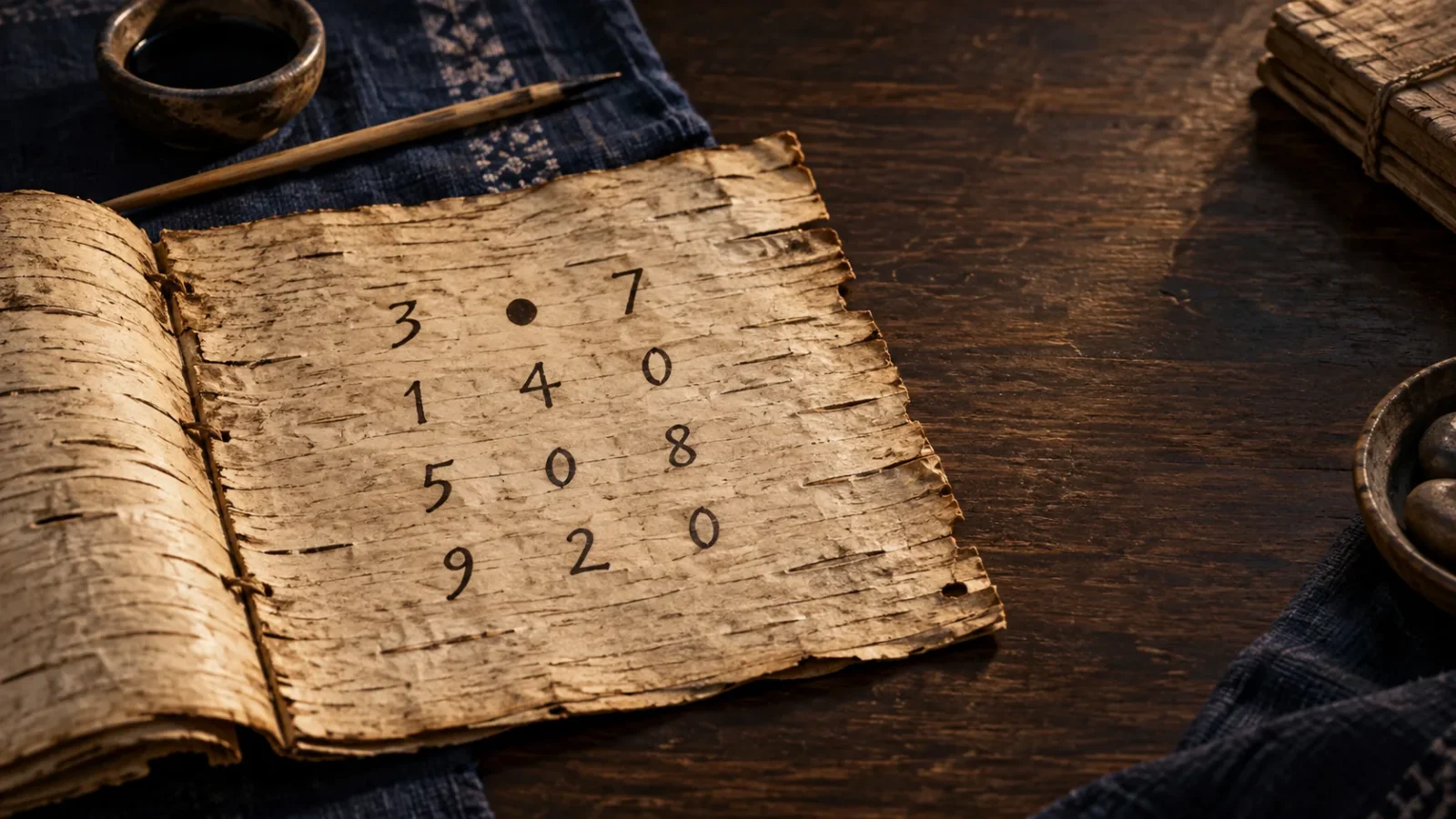
The Bakhshālī manuscript is a fragile collection of birch-bark folios found near the village of Bakhshālī, in present-day Pakistan, in 1881. Its pages contain mathematical problems and a dot that functions as a place marker. That dot is why the manuscript became central to popular stories about the “oldest zero.”
Oxford’s first public announcement in 2017 said that three tested folios included material as early as the third or fourth century. That result travelled widely, but it was not the end of the dating story. Oxford’s later report, published in 2024 after a revised analysis, dated five folios and modelled the manuscript’s production between about 799–892 and 900–1102 CE, with a 95.4 percent probability range.
The update matters, but it needs careful wording. Radiocarbon dating measures the age of the birch bark, not the moment when someone first thought of zero. A manuscript can preserve an older mathematical tradition, and a collection of folios can have a complicated history. A group of historians of mathematics also challenged the way the 2017 dates were interpreted, arguing that the earliest dated folio should not be treated as the date of the whole text.
So the Bakhshālī material remains important evidence for Indian place-value notation. It does not, by itself, identify the first person to use zero or settle when the underlying idea began.
When zero became something you could calculate with
The clearest early step toward zero as a number appears in the work of the Indian mathematician Brahmagupta. In 628 CE, his Brāhmasphuṭasiddhānta set out rules for calculations involving zero, positive numbers and negative numbers. Subtract a number from itself and the result is zero. Add zero to a positive number and the positive number remains.
Those rules sound elementary because modern arithmetic has absorbed them. In historical terms, they represent a change in what a number could mean. Zero was no longer only a gap in a written string. It could be the result of an operation and take part in further operations.
Brahmagupta did not solve every problem. His treatment of division by zero was wrong by modern standards, including the claim that zero divided by zero is zero. That does not cancel the achievement. It shows a mathematician testing a new object inside a system whose limits were not yet clear.
A dated zero in stone
There is another useful marker in the story: an inscription at Gwalior dated to 876 CE. It records a garden and quantities of flowers, including the numbers 270 and 50. The zero in those numbers is recognisable as a written numeral, not simply an invisible gap.
An inscription cannot tell us everything about mathematical practice, but it gives historians a fixed date for a form of zero that people used in public writing. Set beside Brahmagupta’s rules, it shows the difference between a concept in a mathematical text and a symbol in an everyday record.
Why “who invented zero?” is the wrong-sized question
The question is understandable because zero feels like a discrete invention. The evidence points to a longer development: placeholder marks appeared in more than one mathematical culture; Indian scholars built a powerful decimal place-value system; Brahmagupta described arithmetic with zero; later inscriptions and scholars helped stabilise its written use and transmission.
Indian mathematics was central to the form of zero that became part of the Hindu-Arabic numeral system. The ideas then moved through scholarly networks into the Islamic world and, much later, Europe. The word “zero” itself came through Arabic ṣifr, a reminder that the history of a symbol is also a history of translation and travel.
That path is as interesting as a neat origin story. It replaces the search for one forgotten genius with a record of people solving different problems: how to write a number without ambiguity, how to describe nothing as a quantity, and how to carry a notation between languages and calculation systems.
What the evidence can—and cannot—show
The Bakhshālī dot is evidence for a place-value practice. The Oxford report gives a new date range for the physical folios and corrects the dramatic 2017 headline. Brahmagupta’s text is evidence for early arithmetic rules. The Gwalior inscription anchors a written numeral to 876 CE. None of those sources is a birth certificate for zero.
That distinction is not a technical footnote. It is the difference between asking when a mark appears, when a number is defined and when a notation becomes common enough to leave records. The history of the infinity symbol offers a similar lesson: mathematical signs acquire their modern meaning over time, rather than arriving fully formed.
Zero looks like a circle, but its history is a chain of decisions. It began as a way to leave a space open, became an object of arithmetic, and eventually made the positional number system we use every day possible.
Sources and further reading
- Chivall et al., Radiocarbon dating of the Bakhshālī manuscript, University of Oxford Research Archive (2024)
- Bodleian Libraries, 2017 Bakhshālī dating announcement
- Plofker et al., “The Bakhshālī Manuscript: A Response to the Bodleian Library’s Radiocarbon Dating” (2017)
- MacTutor, “A history of Zero”