Look up at Naqsh-e Rostam and four doorways seem to hang above the plain. They are tomb façades cut into a cliff near Persepolis, but the rock is doing more than holding the carvings. From this height, a king’s burial becomes a public statement about power, ancestry and the order he claimed to defend.
The façades follow a design associated with the Achaemenid royal family. The first is identified with Darius I; the others are generally assigned to Xerxes, Artaxerxes I and Darius II. Those names come from inscriptions, style and the monuments’ setting. Not every tomb carries a sign saying who commissioned it, so archaeologists piece together the sequence from several clues.
A royal stage cut into the mountain
Naqsh-e Rostam means “Rostam’s Picture,” a name tied to the later Iranian hero. The cliff had already gathered layers of meaning before the Achaemenids carved their tombs. Elamite images appear across the wider landscape, and Sasanian kings later added victory scenes below the royal façades.
Keep exploring
Continue with Curiosmos
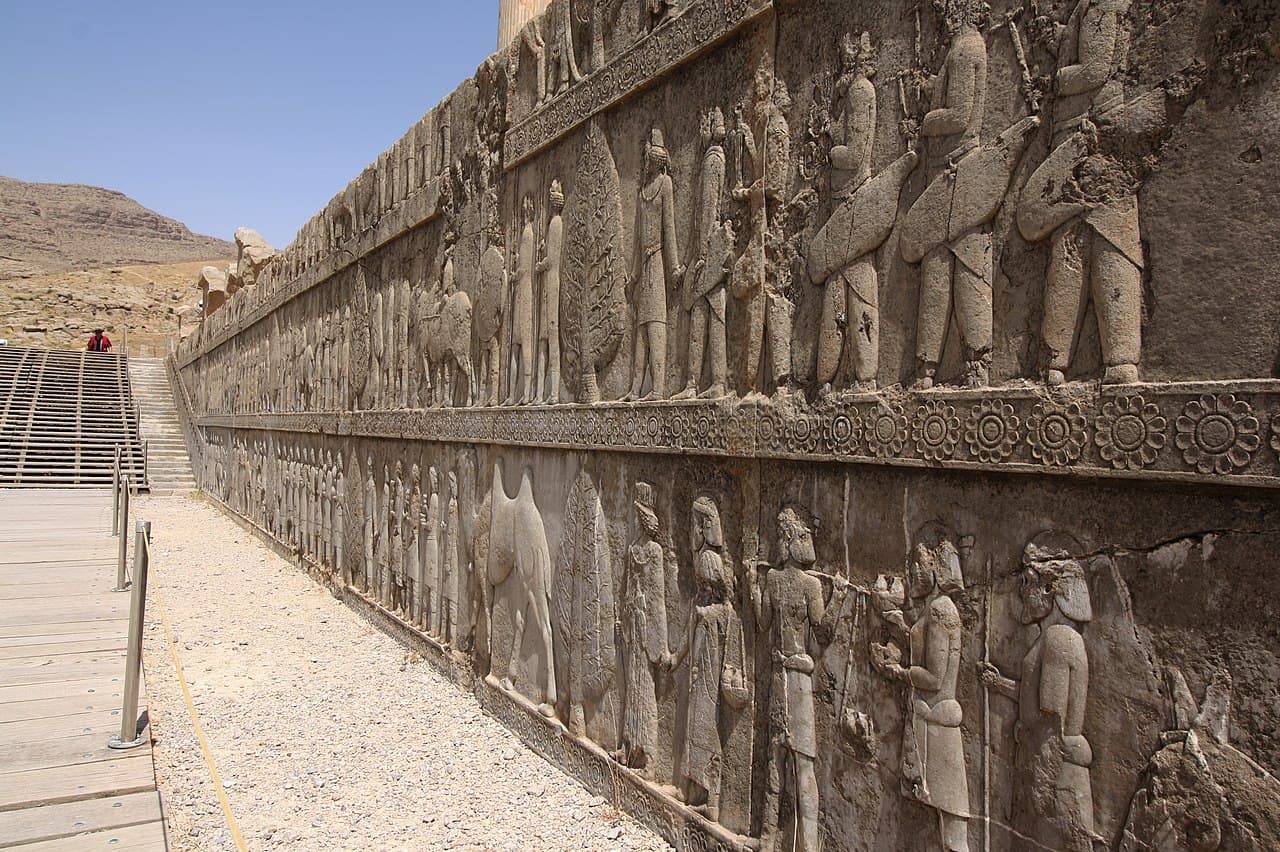
Each tomb front has a cross-shaped outline. Above the doorway, a royal scene shows the king raised on a platform supported by figures representing the peoples of his empire. On Darius’s façade, he stands before a fire altar. A winged disk, associated with royal and divine symbolism, appears overhead.
Imagine approaching the site from the plain. The burial rooms are hidden behind the stone, while the king’s image is visible from outside. The body was placed out of sight; the message about rule was put where people could see it.
Darius’s words beside his image
Darius’s tomb gives us the clearest identification. Its inscription names him, invokes Ahuramazda and lists the lands and peoples under his rule. Darius presents kingship as something granted by the god and held through a particular moral order.
Read beside the carved scene, the inscription turns the cliff into an argument for his authority. The king stands above the people who sustain the empire, yet the text places his power beneath Ahuramazda. Architecture, image and words work together; none needs a hidden code to make the monument powerful.
Four tombs, one dynastic memory
The later façades repeat Darius’s broad arrangement, though they are not exact copies. Their shared shape makes the family connection visible, while differences in carving help scholars work out when each was made. Encyclopaedia Iranica commonly identifies the three later tombs with Xerxes, Artaxerxes I and Darius II. Artaxerxes II’s related tomb at Persepolis belongs to a later development.
The surviving stone does not give us a complete building record. It does show successive rulers choosing to place their burials beside Darius’s monument. A new king could claim continuity with the dynasty simply by joining this landscape of royal memory.
A place reused across centuries
After the Achaemenid Empire fell, the cliff kept attracting rulers. Sasanian kings carved their own royal scenes beneath the older tombs, setting their victories against the remains of the earlier empire. The site was not frozen in one age; later generations added to its story.
Even the name reflects that long afterlife. “Rostam’s Picture” connects the ancient carvings with a hero from Iranian epic tradition, though the tombs were made many centuries before the stories took their surviving form. People kept finding new ways to read the same mountainside.
At Sacsayhuamán, huge fitted stones turn construction and engineering into part of a monument’s presence. At Monte Albán, builders reshaped a summit into a political centre. Naqsh-e Rostam works differently: the mountain itself becomes the dynastic backdrop. What would you want a visitor centuries later to remember about your rule? The Achaemenid kings answered by putting their images high above the road, where the cliff could keep them in view.