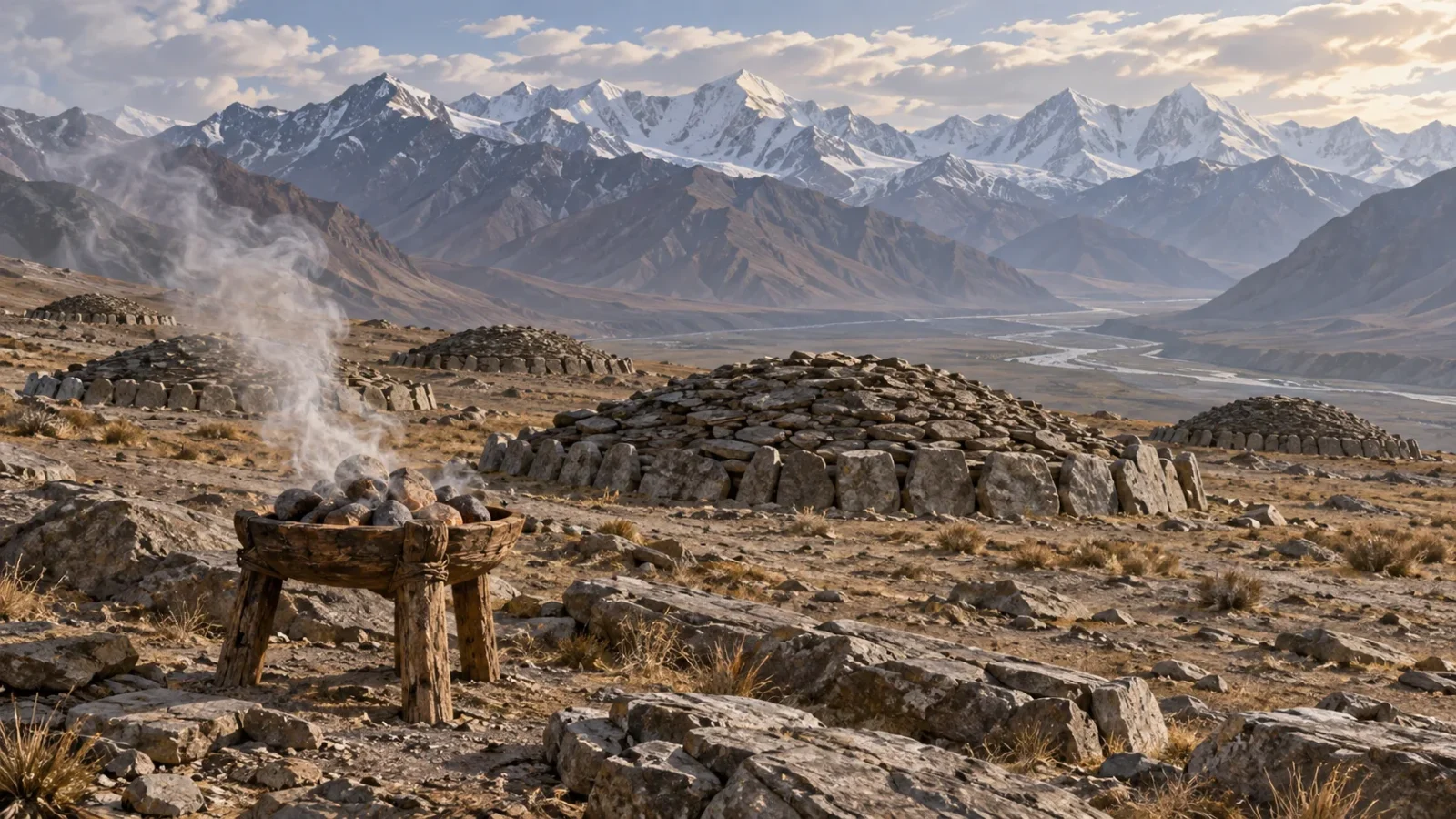
At Jirzankal Cemetery in the Pamir Mountains, mourners placed wooden braziers and heated stones beside the dead. Chemical traces in the objects show that cannabis was burned there about 2,500 years ago.
The find is sometimes nicknamed an “ancient gold bong.” That phrase makes a striking headline, but the objects were braziers, not pipes. Their setting points to a funeral ritual in which smoke or vapour became part of the ceremony.
Residue in the braziers
Jirzankal lies in what is now Xinjiang, more than 3,000 metres above sea level. Many graves were shaft chambers under circular stone mounds. Black and white stone strips crossed parts of the cemetery.
Keep exploring
Continue with Curiosmos
Archaeologists recovered ten wooden braziers from eight tombs. Burn-marked stones sat inside them. Researchers used gas chromatography–mass spectrometry to test charred material from the wood and stones. Nine braziers showed strong evidence of cannabinoids, and two of the heated stones carried the same chemical signal.
The 2019 Science Advances study links residue, a way of making smoke and a mortuary setting. Cannabis seeds in a grave would show that people possessed the plant. These braziers show that it was burned.
Smoke at a burial
The researchers suggest the braziers were used during ceremonies for the dead. Smoke with psychoactive compounds may have helped mourners enter an altered state or feel closer to the deceased. The graves do not tell us how people understood the experience. It could have been part of mourning, communication with the dead, purification or another ritual whose meaning is now lost.
Other objects from Jirzankal add to the scene. Excavators found musical instruments, including an angular harp, along with textiles, beads and objects linked to wider Central Asian exchange. Music and smoke may have accompanied the same ceremony, though the order of events cannot be reconstructed.
Where did the cannabis come from?
The residue had a strong chemical signature associated with psychoactive cannabis. Researchers could not determine whether people cultivated plants for stronger effects or gathered naturally potent varieties. Wild cannabis grows across Central Asia, and mountain conditions can affect the compounds plants produce.
No cannabis seeds were found in the braziers. The mourners may have selected flowering material, collected plants from a particular area or obtained them through exchange. The chemistry establishes what was burned, but not who grew or gathered it.
Human remains at the site show that some people buried at Jirzankal grew up elsewhere. Silk from eastern China, glass beads and a musical instrument with western connections also point to movement through the Pamirs. Cannabis was part of a world where people, goods and ideas crossed mountain routes long before the term “Silk Road” was used.
Not the same as the Pazyryk burials
Older Pazyryk burials in the Altai have also been linked to cannabis. One grave contained a copper vessel, heated stones and hemp seeds, a combination often compared with Herodotus’ account of Scythian rituals.
That is a separate archaeological context. The clearest chemical evidence for cannabis smoke comes from the Jirzankal braziers. The Pazyryk objects do not turn them into pipes, and neither discovery supports the modern nickname “gold bong.”
What the funeral reveals
The evidence shows cannabis being burned during mortuary ceremonies in the Pamirs. It cannot tell us exactly what mourners felt or said. The braziers were tools for a shared ritual, not proof of one universal use for the plant.
Cannabis also served as fibre, oil, food and medicine in different settings. Jirzankal preserves one particular use: smoke rising beside a burial in a high mountain cemetery. The material traces make that ritual visible, even though its meaning was never written down.
Curiosmos has also examined evidence for violence and burial at Jebel Sahaba, where graves preserve another kind of record about how communities faced death.