A polished stone beetle seems an unlikely place to find an argument with yourself. Turn an Egyptian heart scarab over, however, and the writing beneath it can become startlingly personal. The dead person addresses their own heart and asks it not to testify against them.
What if the witness who knew everything about you was also part of you? For an Egyptian preparing for the afterlife, the heart could be just such a witness. These amulets supplied a plea to it.
A witness carried within the body
The Metropolitan Museum of Art explains that the Egyptian heart represented thought, memory and moral character as well as life. In the final judgment, it was weighed against maat, the principle of order and justice. Heart scarabs offered protection during that encounter.
The flat base commonly carries a text known today as Book of the Dead spell 30B, or the less frequent 30A. The numbers are modern labels for related spells. The inscriptions themselves address a more urgent concern: passing the judgment and continuing to exist.
The gods in this setting had different responsibilities. Our account of Ra and the Egyptian sun god’s myths explores another part of that religious world. The heart scarab lets us approach it through something small enough to hold.
Pa-en-Ptah’s plea
A dark serpentine heart scarab in the Walters Art Museum, dated to 1070–736 BCE, names Pa-en-Ptah, an official associated with a beverages depot. Its inscription asks the heart received from his mother not to oppose him as a witness or contradict him before the divine court.
It also asks the heart not to damage his reputation before the judges or speak falsely against him. This is an appeal to a participant in the proceedings, rather than a general wish for good fortune.
Pa-en-Ptah’s name makes the plea personal. Whoever commissioned the scarab wanted the heart to protect a particular man’s reputation before the judges.
Hatnefer’s name replaced someone else’s
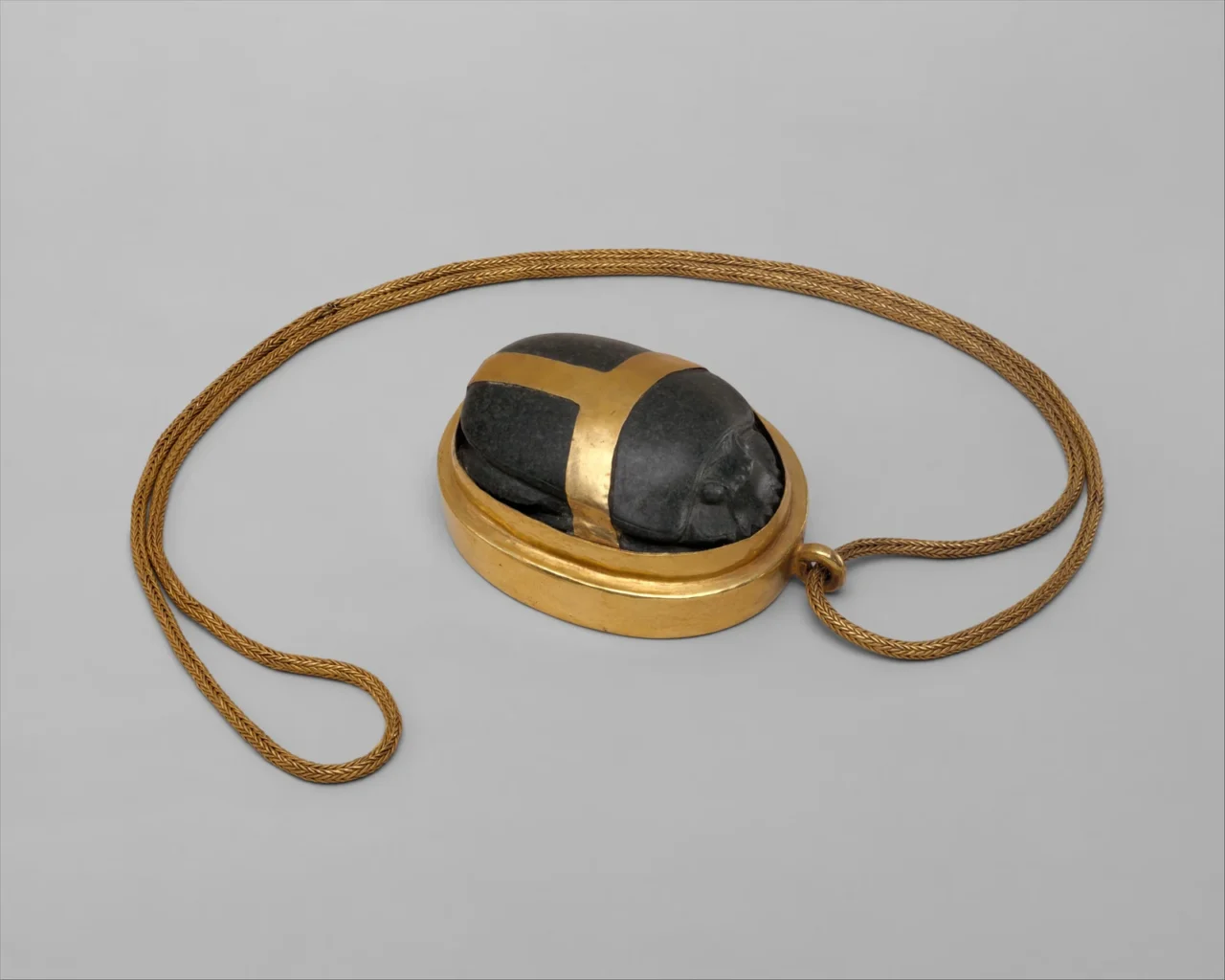
The Met’s heart scarab of Hatnefer, dated to about 1491–1473 BCE, was found in her tomb by the museum’s Egyptian Expedition in 1936. Made from serpentinite and mounted with gold, it hangs from an intricately plaited gold chain.
Its base carries a version of spell 30A. Hatnefer’s name was added over an erased inscription, showing that the scarab was originally made for someone else. We do not know the circumstances of that change.
How did a scarab made for one person end up in Hatnefer’s tomb? The erased inscription cannot tell us whether it was bought, given or reassigned. It does show that changing the owner meant changing the words: the protective appeal had to name Hatnefer.
Not every scarab carried the same message
A fragmentary heart scarab at the Met, dated to roughly 1802–1550 BCE, combines a scarab body with a human face. Six lines on its underside contain spell 30B. The basic purpose survived a striking change in appearance.
Compare that with a tiny faience scarab bearing Amenhotep III’s throne name, found at Malqata. Only 1.6 centimetres long, its underside identifies the king as beloved of Amun. The museum does not identify it as a heart scarab.
Shape alone therefore cannot tell us what an Egyptian scarab was intended to do. We need the inscription, material, scale and, where it survives, the excavation context.
The inscriptions make these objects unusually intimate. Pa-en-Ptah asks his own heart to protect his reputation; Hatnefer’s scarab has been renamed so that its appeal belongs to her. Beneath the polished beetle is a person preparing for judgment, with words chosen to keep the closest possible witness on their side.