Long before anyone wrote anything down, people moved enormous stones. They raised them into pillars, circles, tombs and avenues on every inhabited continent. Some of these megaliths are thousands of years older than the pyramids of Giza, and the oldest are older than farming itself.
This map shows the world’s oldest and most important megalithic sites, with dates from radiocarbon dating and excavation reports. Click a marker to see when each site was built, or scroll down for the full list, oldest first.
At a glance
- Oldest on the map: Karahan Tepe and Göbekli Tepe in Turkey, from around 9500 BC or earlier.
- Oldest in Europe: Barnenez in Brittany, from about 4850 BC.
- Stonehenge for scale: its first phase began about 3100 BC, around 6,000 years after Göbekli Tepe.
- Megalith: from the Greek for “big stone,” a structure made of large stones without mortar.
Dates are approximate and refer to when construction began, unless a range is given. BC = before Christ (about 2,000 years before today).
The oldest megalithic sites, by age
-
Karahan Tepe
A sister site of Göbekli Tepe in the Taş Tepeler (“Stone Hills”) region of southeastern Turkey. Its chambers are cut into bedrock and lined with T-shaped pillars, including one room filled with carved stone pillars and a human head emerging from the wall.
-
Göbekli Tepe
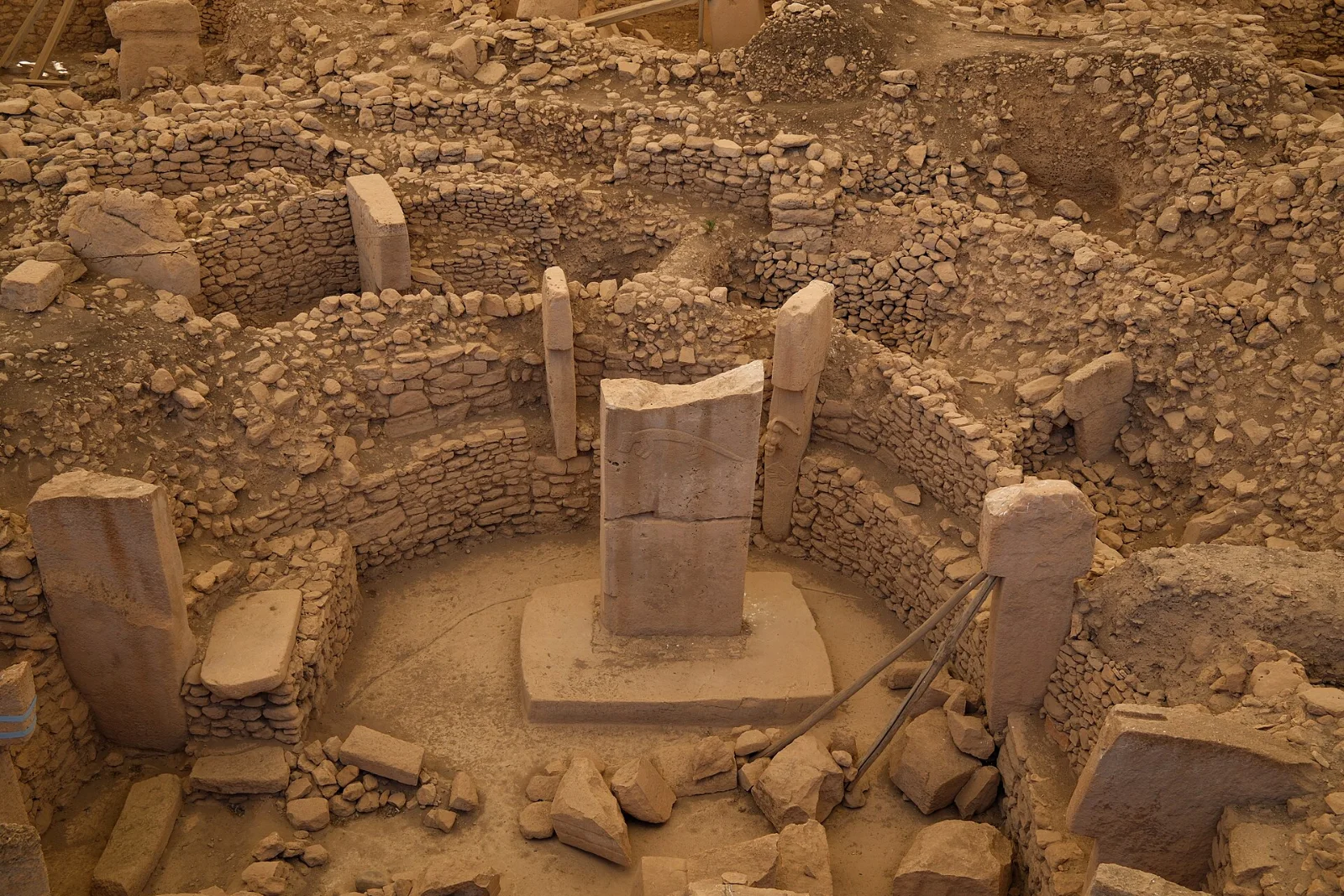
Huge circular enclosures of T-shaped limestone pillars, some over 5 meters tall and carved with foxes, boars, snakes and vultures. Built by people who had not yet adopted farming, it overturned the idea that monumental building came only after agriculture.
-
Nevalı Çori
A Neolithic settlement with a cult building of T-shaped pillars, similar to Göbekli Tepe. The site now lies under the waters of the Atatürk Dam reservoir, but its pillars and sculptures were rescued and are in the Şanlıurfa Museum.
-
Atlit Yam
A Neolithic village now 8 to 12 meters under the Mediterranean off the coast of Israel. It includes a semicircle of standing stones around a spring, one of the oldest known megalithic structures underwater.
-
Nabta Playa
In the Nubian Desert of southern Egypt, cattle herders built a small stone circle that may mark the summer solstice, along with alignments of standing stones. It is often called one of the world’s oldest astronomical monuments.
-
Barnenez
A long stepped cairn in Brittany with 11 passage graves inside. Its first phase is among the oldest surviving built structures in Europe, older than the pyramids of Egypt by about two thousand years.
-
Grand Menhir of Er Grah, Locmariaquer
Once the largest standing stone in Europe, about 20 meters tall and weighing roughly 300 tonnes. It fell and broke into four pieces around 4000 BC, possibly in an earthquake or deliberately.
-
Carnac stones
More than 3,000 standing stones arranged in long rows across the Breton countryside, the largest collection of its kind in the world. Most were raised around 3300 BC, but some may date to 4500 BC.
-
Almendres Cromlech
About 95 granite stones in two oval rings near Évora, the largest group of structured standing stones in the Iberian Peninsula. Several stones carry carved symbols.
-
Gavrinis
A passage tomb on a small island in the Gulf of Morbihan. Almost every stone inside is covered with carved spirals, arcs and zigzags, making it one of the richest examples of Neolithic art in Europe.
-
Poulnabrone dolmen
A portal tomb on the bare limestone of the Burren, with a flat capstone resting on two tall portal stones. Excavations found the remains of more than 30 people buried here over about 600 years.
-
Dolmen of Menga
One of the largest megalithic tombs in Europe, near Antequera. Its capstones weigh up to about 150 tonnes. The chamber faces a mountain rather than the sunrise, which is unusual for a dolmen.
-
Ġgantija
Two temples on the island of Gozo, built of huge limestone blocks. Local legend says a giantess built them, which is how they got their name, from the Maltese word for giant.
-
Ħaġar Qim
A temple complex on a ridge above the sea, part of Malta’s UNESCO-listed Megalithic Temples. One of its stones weighs about 20 tonnes.
-
Newgrange
A great passage tomb in the Boyne Valley. At dawn around the winter solstice, sunlight enters a roof-box above the entrance and lights up the inner chamber.
-
Standing Stones of Stenness
Four surviving tall, thin slabs on Orkney, the remains of one of the earliest stone circles in the British Isles.
-
Stonehenge
Built in several phases. It began as a circular ditch and bank around 3100 BC. The giant sarsen circle and trilithons went up between about 2600 and 2400 BC, and the bluestones were brought from Wales, about 225 km away.
Read: why Stonehenge was built
-
Rujm el-Hiri
Concentric circles of basalt stones with a burial mound at the center, often called the “Stonehenge of the Levant.” Its exact purpose is still debated.
-
Callanish Stones
A cross-shaped arrangement of standing stones on the Isle of Lewis, with a central circle. Historic Environment Scotland dates the stones to around 2750 BC, earlier than Stonehenge’s sarsens.
-
Avebury
The largest stone circle in Britain, surrounded by a huge henge. Part of the village of Avebury now stands inside it.
-
Ring of Brodgar
A great stone circle on Orkney that originally had up to 60 stones. Twenty-seven were standing at the end of the 20th century.
-
Plain of Jars
Thousands of large stone jars scattered across the Xiangkhouang Plateau, linked to burial practices. Some were placed as early as 1240 to 660 BC.
-
Gochang, Hwasun and Ganghwa dolmens
Korea has the world’s densest concentration of dolmens. These three UNESCO-listed clusters contain hundreds of stone tombs.
-
Senegambian stone circles
More than 1,000 stone circles along the Gambia River, the largest concentration in the world, built over many centuries as burial monuments.
What these dates tell us
For most of the 20th century, archaeologists assumed that monumental building required farming, cities and kings. The sites of southeastern Turkey turned that idea upside down. Göbekli Tepe and Karahan Tepe were built by people living at the very start of the Neolithic, and the effort of quarrying and raising their pillars may have been one of the things that pushed people toward settled life.
The great age of European megaliths came later and moved across the continent. Brittany and Iberia led from the fifth millennium BC, then Ireland, Britain and Malta in the fourth and third millennia. Megalithic traditions continued much later in other parts of the world. In Korea, Laos, West Africa and Indonesia, people kept raising great stones into historic times. In some places, they still do.
If you want to go deeper, start with what a megalith is and why ancient people built them and ten megaliths older than Stonehenge.
Sources10
- UNESCO: Göbekli Tepe
- UNESCO: Megalithic Temples of Malta
- UNESCO: Brú na Bóinne (Newgrange)
- UNESCO: Stonehenge, Avebury and Associated Sites
- UNESCO: Heart of Neolithic Orkney
- UNESCO: Gochang, Hwasun and Ganghwa Dolmen Sites
- UNESCO: Stone Circles of Senegambia
- UNESCO: Megalithic Jar Sites in Xiengkhuang (Plain of Jars)
- UNESCO: Antequera Dolmens Site
- Callanish Stones (citing Historic Environment Scotland)