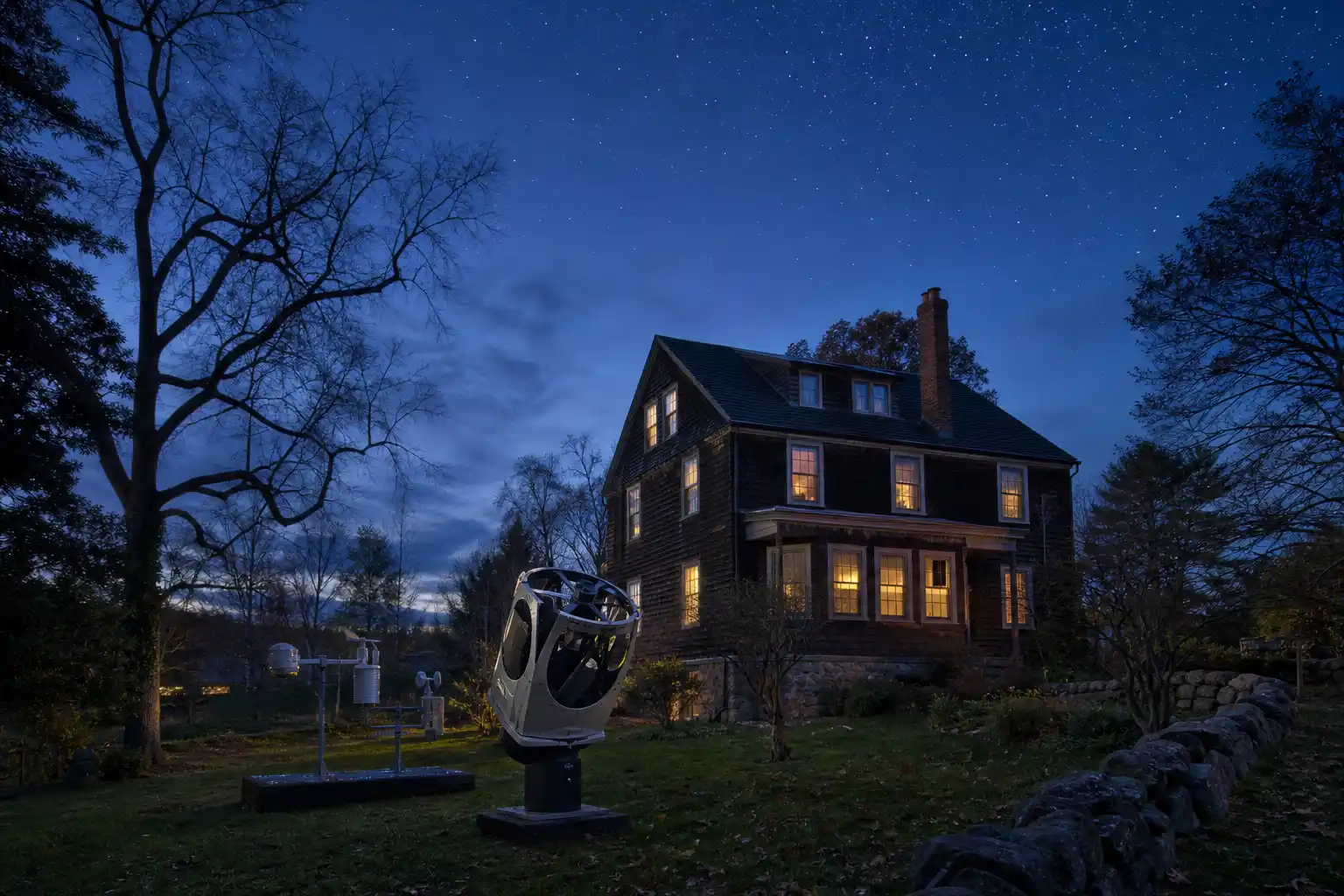
Carl Sagan’s former home could one day host a small observatory dedicated to watching the sky.
Avi Loeb, the Harvard astrophysicist who leads the Galileo Project, says he and the property’s owner, Adam Weitsman, hope to construct a new Galileo Observatory and a remotely operated telescope at the house near Cornell University. The proposal would combine a scientific search for unusual objects near Earth with a public-facing telescope that anyone could use for astronomy outreach.
It is an appealing idea because of the address. Sagan spent much of his career explaining why evidence matters when people ask large questions about life in the universe. Turning his former home into a place where visitors can look at the sky would connect that legacy to a new generation. But the project is still a proposal, not an operating observatory.
What Loeb is proposing
In his recent account, Loeb describes two related instruments. The Galileo Observatory would use sensors across several parts of the electromagnetic spectrum—including infrared, visible light and radio—along with audio monitoring. Its purpose would be to collect consistent data on objects moving through the nearby sky, including objects later classified as UAP.
The second instrument would be a conventional remotely operated astronomical telescope. It would focus on selected targets farther away, allowing members of the public to observe planets, stars and other objects without needing to be physically present at the telescope.
The distinction between the two systems is important. A sky-monitoring array designed to detect fast or unusual signals is not the same thing as a research telescope that studies a galaxy or a planet. They could share a site and public program while doing very different scientific work.
Loeb says data from the proposed Galileo Observatory would be made available for public and educational use. That commitment would be central to the project’s credibility. A catalogue of detections, calibration information and the conditions under which a signal was recorded would allow outside researchers to test the results rather than simply trust a headline.
The house is not an observatory yet
Reporting from 607 News Now says renovation work at the Carl Sagan House is underway, with completion anticipated in late 2027. That is the current physical state of the property. It does not mean the Galileo instruments have been installed or that the observatory has begun collecting data.
Loeb’s own wording is also careful: he says they “hope to construct” the observatory and telescope. There is no public schedule for first light, no published instrument list and no observing results from the proposed site. Those details would have to be settled before the project could be judged as a functioning research facility.
This is where the story becomes more interesting than a simple announcement. The project sits between an idea, a building renovation and a scientific plan. Each stage has a different standard of proof. A proposal can be reported as a proposal. It should not be presented as a completed discovery centre.
Why location and method matter
The Galileo Project has argued that UAP research needs instruments designed to measure more than a single dramatic image. A useful observation would record the same event with multiple sensors, establish distance and motion, and preserve enough raw data for an independent check.
A site associated with Sagan could help communicate that method to the public. Visitors would not need to decide in advance whether an unusual object was a secret aircraft, a natural phenomenon or something more unusual. They could learn how scientists separate those possibilities: collect the signal, measure its properties, compare it with known objects and keep the uncertainty visible.
That approach also respects Sagan’s legacy better than attaching his name to a sensational claim. Sagan was open to the possibility of life beyond Earth, but he repeatedly returned to the need for evidence. A public telescope and a transparent sky-monitoring project would make that lesson tangible.
What happens next
The next meaningful milestones are practical ones: the renovation, the final instrument design, the funding and the publication of an observing and data-release policy. If the project moves forward, the first useful result may not be an unexplained object. It may be a demonstration that several sensors can work together, that ordinary aircraft and satellites can be identified reliably, and that the public can inspect the records.
That would be valuable even if every strange light eventually receives a conventional explanation. Science advances when an instrument makes uncertainty smaller. A Galileo Observatory at Sagan’s former home would have a chance to do exactly that—but only once it exists, operates and releases data.
Sources and further reading
• Avi Loeb’s proposal for a Galileo Observatory at Carl Sagan’s former home
• 607 News Now report on renovations at the Carl Sagan House
**Internal links:** What’s in the cosmic message Carl Sagan sent to aliens?, what are UAPs?, the Great Attractor.